AI Receptionist for Physiotherapists: Never Miss Another Patient Enquiry
If you want help working out whether this would suit your clinic, you can book a strategy call or contact AI Bridge Club.
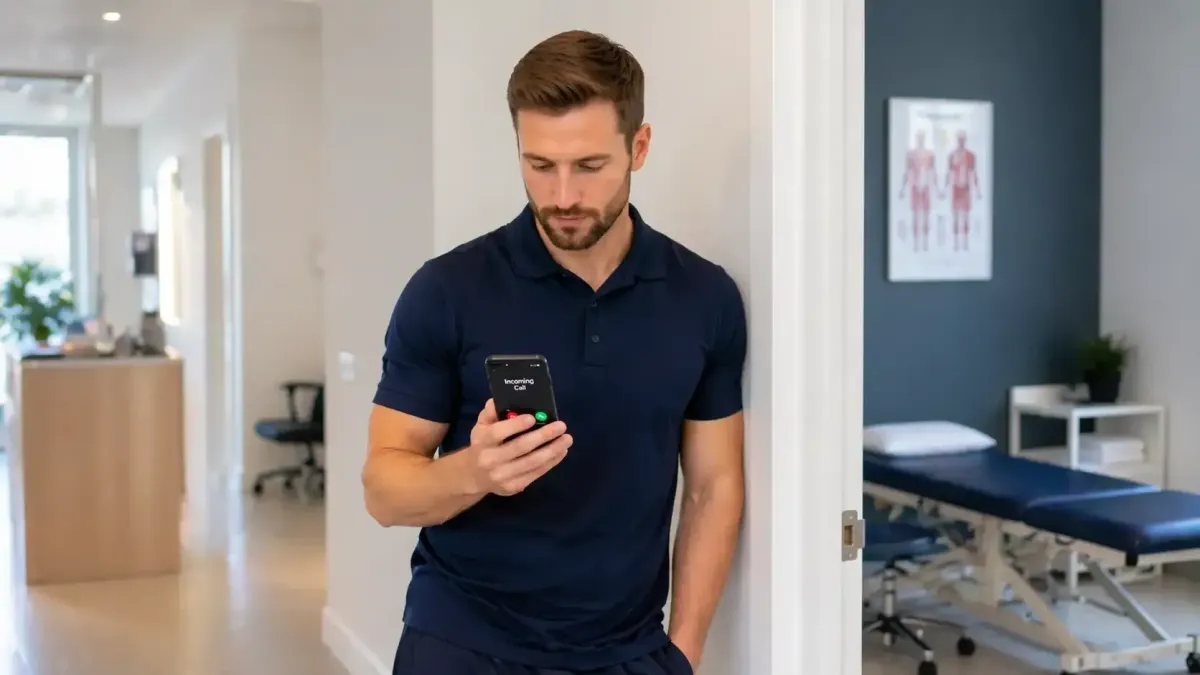
If you run a physiotherapy clinic, you already know the pattern. You are treating a patient, your phone rings, and by the time you can call back the new enquiry has gone cold.
That is one reason AI receptionist services are getting attention from UK physios. The interest is not really about chasing shiny tech. It is about capturing enquiries, reducing admin, and giving patients a faster reply when your team is busy. Physio First is already running practical guidance on how private physio practices can use clinical AI to reduce admin and improve patient engagement, while NHS England has backed AI tools to reduce missed appointments and free up staff time.
This article breaks down what an AI receptionist for physiotherapists actually does, where it helps, where it can go wrong, and how to decide whether it fits your clinic. If you want the bigger picture, see our AI for physiotherapists sector page.
What is an AI receptionist for physiotherapists?
An AI receptionist for physiotherapists is a phone, chat, and follow-up system that answers enquiries, handles routine questions, captures contact details, and moves patients towards booking when your clinic cannot respond instantly.
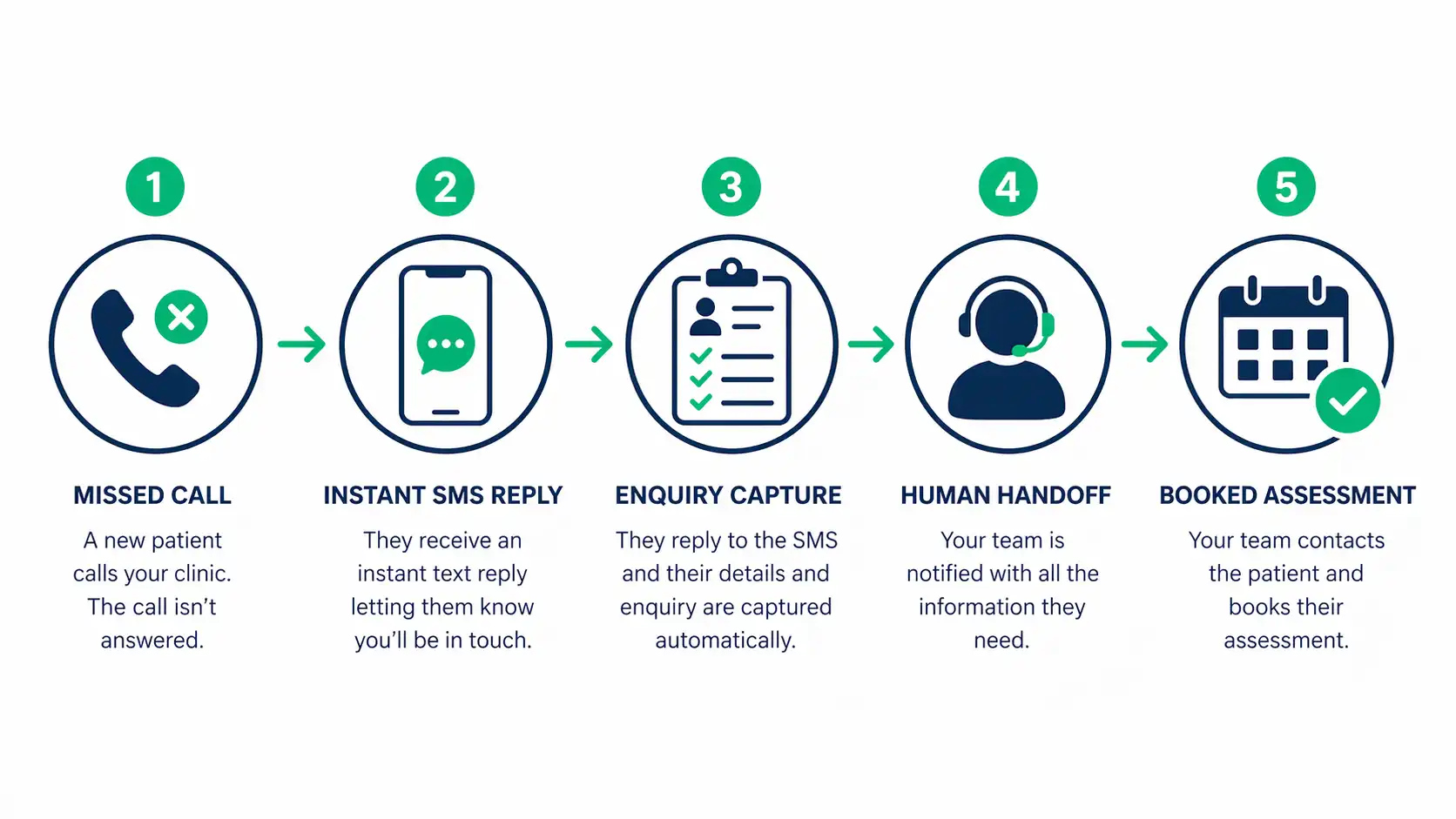
For most UK physiotherapy clinics, the real value is not “AI” by itself. It is what the system does in practice. It can answer calls after hours, send a text when you miss a call, reply to common booking questions, collect a few qualifying details, and route the enquiry to the right person.
That matters because physio clinics have a built-in response problem. Clinicians are often with patients. Even a good front desk can get overloaded at lunch, late afternoon, and on busy clinic days. A lot of missed opportunities happen in those gaps.
What a good setup usually includes:
call answering outside normal reception cover
instant missed-call text back
basic enquiry capture
appointment or callback requests
FAQ handling for location, parking, opening hours, pricing ranges, and services
routing urgent or complex cases to a human
The honest truth is that most clinics do not need a fully autonomous system on day one. They need something that stops leads going cold. That is why services like AI voice agents and missed call text back are often the best first move for physiotherapy clinics.
Why are UK physiotherapy clinics looking at AI receptionists now?
UK physiotherapy clinics are looking at AI receptionists because speed matters more than most owners think. A fast first response can be the difference between a booked assessment and a lost enquiry.
There are three reasons this topic is landing now.
First, clinic owners are under pressure to do more with limited admin time. Physio First’s private-practice guidance now talks openly about using clinical AI to reduce admin burden, support workflow, and improve patient engagement. That tells you the conversation has moved on from theory.
Second, the wider healthcare system is focused on reducing missed appointments and wasted capacity. NHS England said its AI rollout to reduce missed appointments followed a pilot that cut DNAs by almost a third in six months, and NHS guidance has highlighted the need to reduce DNAs to improve patient experience and free capacity.
Third, suppliers already serving physios are building AI into the tools they use. WriteUpp markets an AI medical scribe and physiotherapy software around saving time, handling bookings, and supporting busy practices, while Physio First’s partner listings now include AI tools for notes, emails, and 24/7 phone answering.
From a marketing point of view, this creates a simple reality. If one clinic replies straight away and another takes three hours, the quicker clinic often gets the patient.
In towns across Cheshire, Greater Manchester, and the wider North West, that matters even more when someone is searching with pain, urgency, or a specific availability need. They are not always comparing five clinics carefully. They are often choosing the first one that answers clearly.
What can an AI receptionist actually do in a physio clinic?
A well-configured AI receptionist can handle the first layer of communication, but it should not pretend to be a clinician. It works best when it manages admin tasks and passes anything sensitive or complex to a human.
In a private physio clinic, the most useful jobs are usually:
answering calls when reception is unavailable
sending an instant text after a missed call
collecting the caller’s name, number, and reason for enquiry
identifying whether the person wants an initial assessment, follow-up, sports massage, women’s health appointment, or another service
sharing practical information such as location, parking, opening hours, and general booking process
triggering follow-up inside your CRM or booking workflow
This is what actually works best in the real world:
keep the first interaction short
ask only the minimum useful questions
offer a clear next step
pass anything clinical, urgent, or uncertain to a person
A common mistake is trying to make the system do too much. If a caller wants clinical advice, safeguarding support, insurance clarification, or help with a complex case history, the AI should not guess. It should hand over.
If your clinic already has fragmented follow-up, an AI CRM automation setup is often what turns a basic answering service into something commercially useful. Capturing the enquiry is one thing. Following it up properly is where many clinics win or lose the booking.
Where does an AI receptionist save time and where should a human stay involved?
An AI receptionist saves the most time on repeatable admin. Humans still matter most where judgement, reassurance, or nuance are needed.
That split is important. Some providers oversell automation by making it sound like the front desk can disappear. In practice, clinics get the best results when AI handles the repetitive first layer and people handle exceptions.
Tasks that suit automation well:
first-response phone answering
missed-call recovery
appointment request capture
out-of-hours enquiries
FAQ replies
reminder and follow-up triggers
Tasks that usually need a human:
anything that sounds clinically urgent
complaints or emotionally charged calls
insurance and medico-legal complexity
sensitive personal situations
detailed pricing disputes
cases where the caller is confused or distressed
If you are still at the early stage, a smaller win can be better than a full rollout. A lot of clinics get value first from AI telephone answering or a missed-call workflow before layering in website chat, CRM automation, and booking logic.
If you want to sense-check whether your clinic is losing enquiries from poor response times, the missed call calculator is a useful starting point.
If you want help mapping where your clinic is losing enquiries and what part should be automated first, you can book a strategy call.
Will patients trust an AI receptionist when they contact a physio clinic?
Yes, many patients will accept an AI receptionist if it is fast, clear, and honest. No, they will not accept a clunky system that hides what it is, asks too many questions, or sounds robotic.
This is where many setups fall apart. The issue is rarely the technology alone. It is the experience.
Patients contacting a physiotherapy clinic usually want one of four things:
to know whether you can help
to know how soon they can be seen
to know what happens next
to feel they are dealing with a professional clinic
If the call flow or chatbot answers those points quickly, trust tends to hold up. If it sounds vague, artificial, or evasive, trust drops.
A few practical rules help a lot:
say clearly that they are speaking to an automated assistant for bookings and enquiries
keep the wording plain and friendly
give a human fallback option
avoid pretending the system is a clinician
confirm what will happen next and when
This is especially important in healthcare-adjacent services. Your AI should support the patient journey, not make it feel colder. A good AI smart site can help here because the phone, forms, and website messages all need to sound consistent.
The counter-intuitive bit is this: patients often prefer a quick automated response to no response at all. The bar is not “perfectly human.” The bar is “helpful, prompt, and clear.”
How much does an AI receptionist for physiotherapists usually cost in the UK?
Most clinics should look at cost in terms of lost enquiries recovered, not software alone. A cheaper system that misses good-fit leads can cost more than a better setup that converts.
Pricing varies a lot depending on call volume, channels, setup complexity, and whether the service includes CRM workflows, text messaging, or booking integrations. A basic missed-call or simple AI answering setup will usually cost far less than a full front-desk replacement build. More advanced systems with custom scripts, booking logic, and follow-up automation cost more upfront but can remove more admin friction.
A sensible way to judge cost is to ask:
how many calls do we miss each week
how many website enquiries wait too long for a reply
what is one new patient worth over 3 to 6 months
how much admin time are clinicians or staff spending on avoidable phone work
From experience, owners often focus too hard on monthly tool cost and not enough on wasted response time. That is why a joined-up setup like Business in a Box can appeal to some clinics. It brings the phone, text, follow-up, reminders, and CRM together instead of leaving bits disconnected.
What should physiotherapists look for before choosing an AI receptionist provider?
Physiotherapists should choose a provider that understands lead handling, patient experience, and handover rules. Fancy demos matter less than whether the system works reliably in day-to-day clinic life.
Here is what I would check first:
Can it handle missed calls and out-of-hours enquiries properly?
Can it pass complex or clinical issues to a human without confusion?
Can it integrate with your existing booking or lead workflow?
Can you change scripts and logic easily?
Is the tone right for a healthcare setting?
Are there clear boundaries around data handling and compliance?
Is there real onboarding support, or are you left to build it yourself?
Physio First’s commercial partner pages show how strongly the private-practice market is now framing AI around admin reduction, note creation, and 24/7 call handling, not just generic chatbots.
Red flags I would watch for:
the demo sounds good but gives no detail on fallback rules
the provider talks more about AI than outcomes
no one asks how your clinic currently handles leads
they push a full rollout before proving one workflow
the system cannot log or route enquiries properly
If you want broader context around website conversation tools, see AI chatbots. If your main issue is visibility rather than response handling, your next bottleneck may actually be SEO and AI search, not reception.
Is an AI receptionist enough on its own to grow a physio clinic?
No. An AI receptionist can improve response speed and enquiry handling, but it works best as part of a wider conversion system.
This is where clinic owners sometimes get disappointed. They install a tool, answer more calls, and still do not see the lift they hoped for. Usually the problem is not the receptionist layer by itself. It is what happens next.
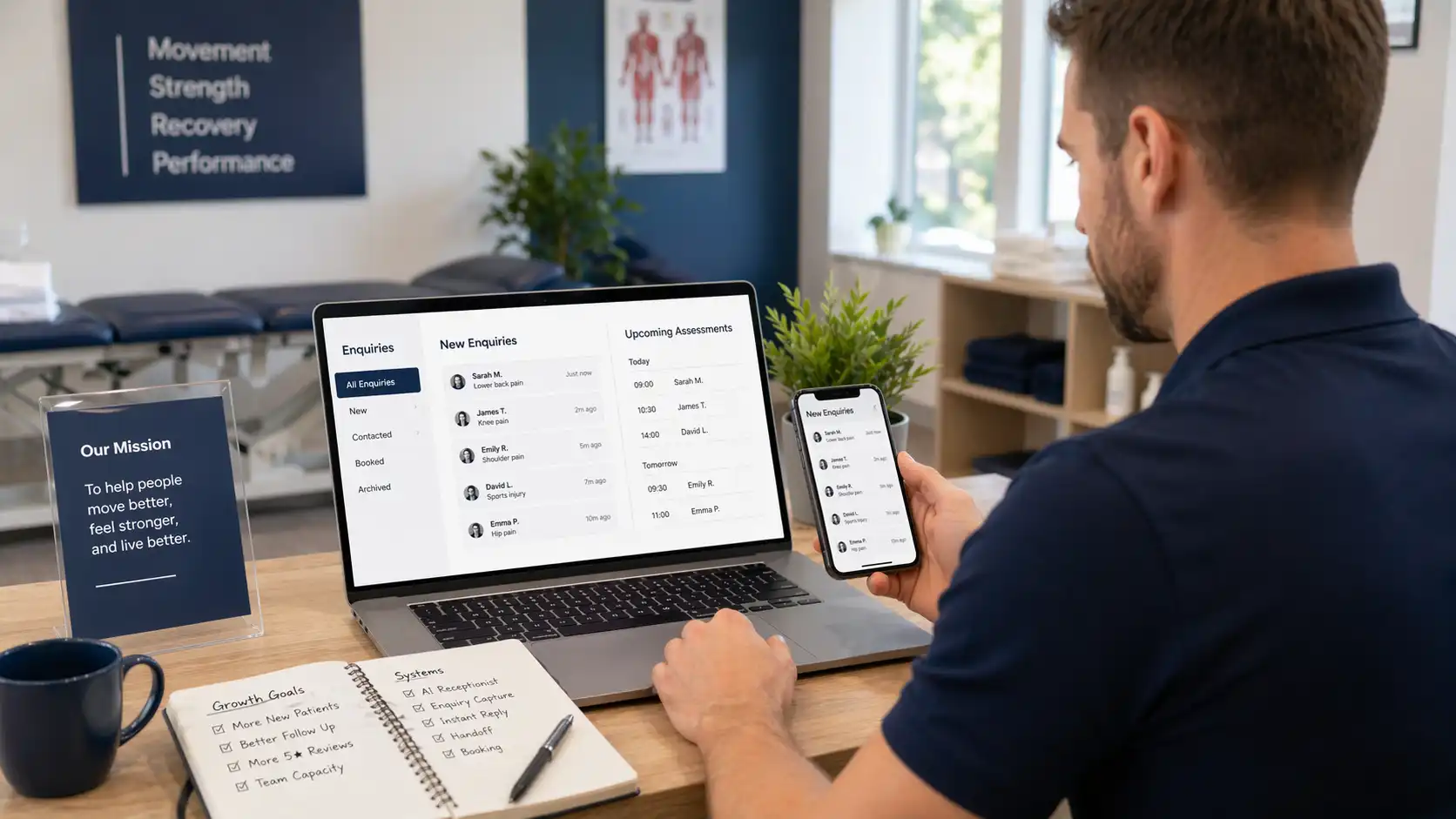
A stronger setup usually includes:
a clear website offer
a fast first response
a simple path to booking
reminders and follow-up
review generation
reactivation of old leads or lapsed patients
If you are comparing options, it can also help to read live vs automated answering. For some clinics, a hybrid model is the right fit rather than a fully automated front end.
If you want help deciding whether an AI receptionist, missed-call text back, or a hybrid setup is the better fit for your clinic, contact the team and map the enquiry journey before you buy anything.
What is the best way to start with AI automation in a physiotherapy clinic?
The best way to start is with one friction point that is easy to measure. For most physio clinics, that means missed calls, slow lead response, or patchy follow-up.
Do not begin with the most ambitious build. Begin with the clearest commercial leak.
A simple rollout plan looks like this:
track missed calls and unanswered enquiries for 2 to 4 weeks
set up missed-call text back or out-of-hours AI answering
create one clear handoff path to a human
log every enquiry into one place
review conversion rates after 30 days
add website chat or follow-up automation only after the first layer works
That kind of phased setup is usually safer, cheaper, and easier for the team to adopt. It also gives you a cleaner answer to the only question that matters: did it help the clinic convert more good-fit enquiries?
Before you roll anything out, get clear on what success looks like. More answered calls? Faster response time? Fewer lost leads? Less clinician admin? You do not need every feature. You need the right workflow.
If you want to talk it through properly, you can book a strategy call or call 07366 926333.
FAQ
Do physiotherapy clinics in the UK really use AI receptionists?
Yes. Private-practice physiotherapy resources now discuss AI for admin, workflow, patient engagement, notes, and 24/7 phone answering, so this is no longer a fringe topic.
Can an AI receptionist book physiotherapy appointments?
It can help with appointment requests and booking workflows, depending on how your system is set up. Many clinics start with enquiry capture and callbacks first, then add booking logic once the handover process is working smoothly.
Will patients mind speaking to AI?
Most patients mind poor service more than they mind automation. If the system is honest, quick, and gives them a clear next step, it can improve the experience rather than harm it.
Is an AI receptionist safe for healthcare-related enquiries?
It can be safe for admin and first-response tasks when boundaries are clear. Clinical advice, urgent concerns, and anything sensitive should always go to a human.
What is better for a physio clinic, live answering or AI?
That depends on call volume, budget, and the kind of enquiries you get. Some clinics suit a hybrid setup best, with AI covering after hours and overflow while people handle complex calls.
Can AI reduce missed appointments in physiotherapy?
AI can help with reminders, confirmations, follow-up, and quicker responses, which all support attendance. NHS England has already backed AI tools to reduce missed appointments and free staff time.
Should a solo physiotherapist use an AI receptionist?
Often yes, especially if they spend most of the day in treatment and cannot answer the phone. Even a simple missed-call and text-back setup can stop enquiries from going cold.
What is the best first AI tool for a private physio clinic?
For many clinics, it is either missed-call text back or AI telephone answering. Those tools solve an obvious problem quickly and create a base for wider automation later.

