

How to Get More Google Reviews as a Chiropractor Without Breaching GCC Guidelines
Google reviews are one of the most powerful drivers of new patient acquisition for a chiropractic practice. When a potential patient searches for a chiropractor in their area, the practices with the most recent, highest-rated reviews appear first — and those are the practices that get called.
Quick Question:
Do you have an updated GBP or Google Business Profile? (most only fill out 50% of them, if that!)
Is it updated regularly with posts (yes posts) + /all services/your charges/accurate opening hours/address?
The challenge for chiropractors is that the General Chiropractic Council's advertising standards guidance places specific restrictions on how patient testimonials can be used in marketing. Getting this wrong does not just risk a complaint — it risks a referral to the GCC's Professional Conduct Committee. Getting it right, with an automated system that requests reviews at the optimal moment and frames them correctly, builds a consistent flow of new patient enquiries from Google without any manual effort from your team.
This post covers what the GCC says about patient reviews, how automated review requests work, and what a compliant review strategy looks like in practice.
What Do the GCC Advertising Guidelines Say About Patient Reviews?
The GCC permits chiropractors to use patient testimonials and reviews in their marketing, with specific restrictions on content and framing.
The key principle in the GCC's advertising standards guidance — which aligns with the Advertising Standards Authority's CAP Code for healthcare — is that testimonials must reflect genuine patient experience and must not make claims that chiropractic can treat, cure or prevent specific medical conditions. This is the critical distinction.
"The GCC Code (Standard B3) and the GCC Advertising Guidance (November 2021) are the primary documents governing this. If you are uncertain about a specific review or testimonial, the ASA's free Copy Advice Service can assess specific marketing materials before they are published at asa.org.uk."
A review that says "I had a great experience at this clinic — the team was professional and I felt well looked after" is fully GCC-compliant. A review that says "My sciatica was completely cured after three sessions" is problematic because it claims a clinical outcome — and if that review appears on your website or in your marketing materials, you are responsible for the claim even if the patient wrote it.
On Google itself, you cannot control what patients write. But you can control how you respond to reviews, whether you feature them on your website, and how you prompt patients to leave them. The safest approach for automated review requests is to invite patients to share their experience of your practice — the team, the environment, the booking process, how they felt during their visit — rather than prompting them to describe clinical outcomes. Most satisfied patients will naturally leave positive experience-based reviews without needing clinical outcome framing in the prompt.
The GCC's Standards of Proficiency and advertising guidance are the primary documents governing this. If you are uncertain about a specific review or testimonial, the GCC's Guidance on Advertising (last updated November 2021) is available at gcc-uk.org and the ASA's free copy advice service can assess specific marketing materials before they are published.
Why Do Google Reviews Matter So Much for Chiropractic Practices?
Google reviews are a primary local search ranking factor and the first credibility signal most new patients check before booking.
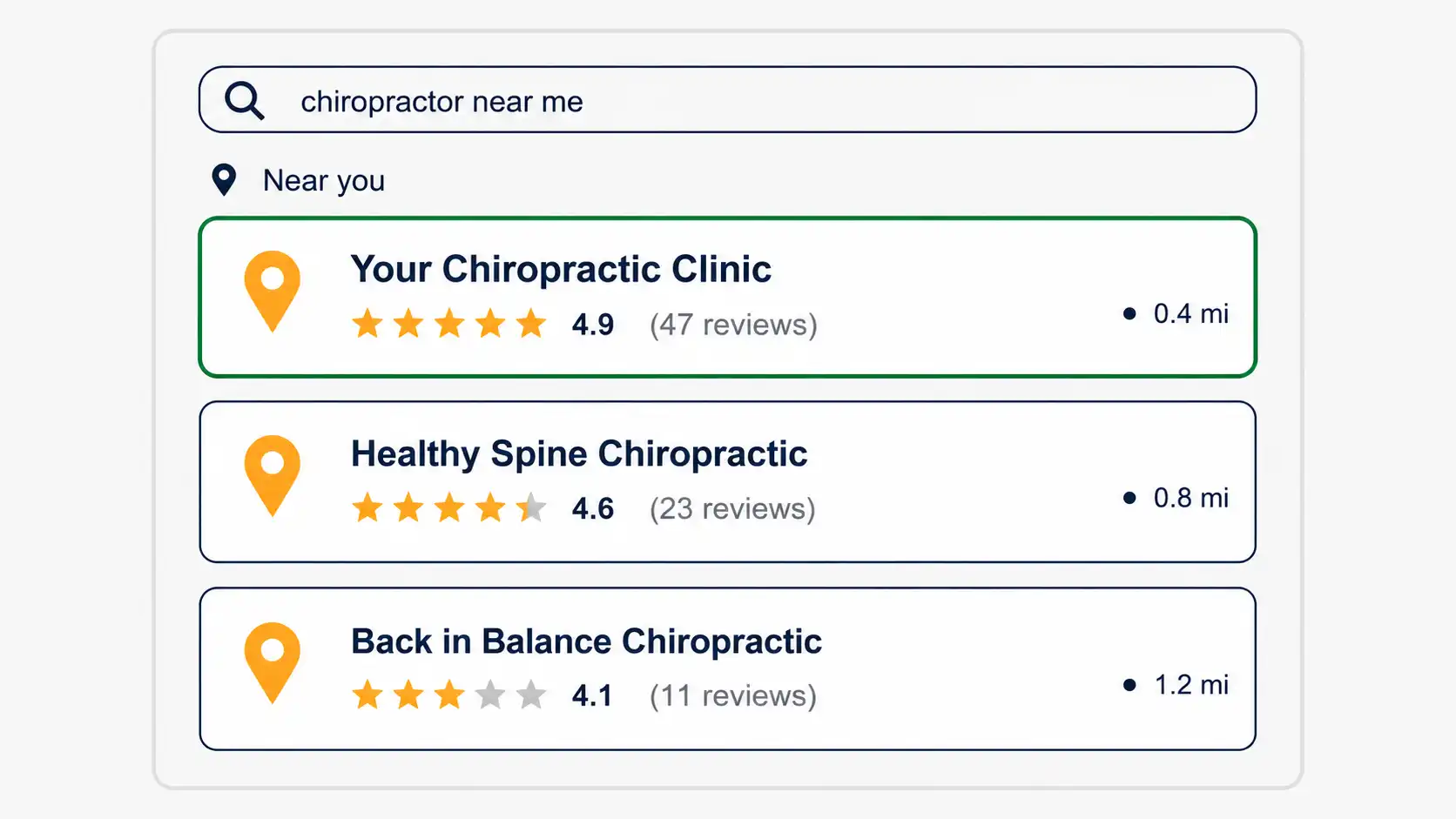
When a potential patient searches "chiropractor near me" or "chiropractor [town name]", Google's local pack — the map results showing three practices with ratings and review counts — is what most people click on first. Practices with more reviews, more recent reviews, and higher average ratings consistently appear higher in the local pack and receive more clicks.
The review count matters as much as the rating. A practice with a 4.8 rating from 6 reviews is typically outranked by a practice with a 4.6 rating from 47 reviews — because Google interprets review volume as a signal of established, active practice, and patients interpret it as social proof of consistent quality.
For AI automation across your chiropractic practice, including call answering and booking, the chiropractic sector page covers every service. But reputation management specifically — building and maintaining Google review volume — is often the highest-ROI single intervention for a practice that is already delivering good clinical care but is not converting that into visible social proof.
The time problem for most practices is not willingness — it is consistency. Staff remember to ask happy patients for reviews occasionally. They forget more often. Automated review requests solve the consistency problem by sending a review invitation to every patient at the right moment, every time, without relying on anyone remembering to do it.
How Does an Automated Chiropractic Review Request System Work?
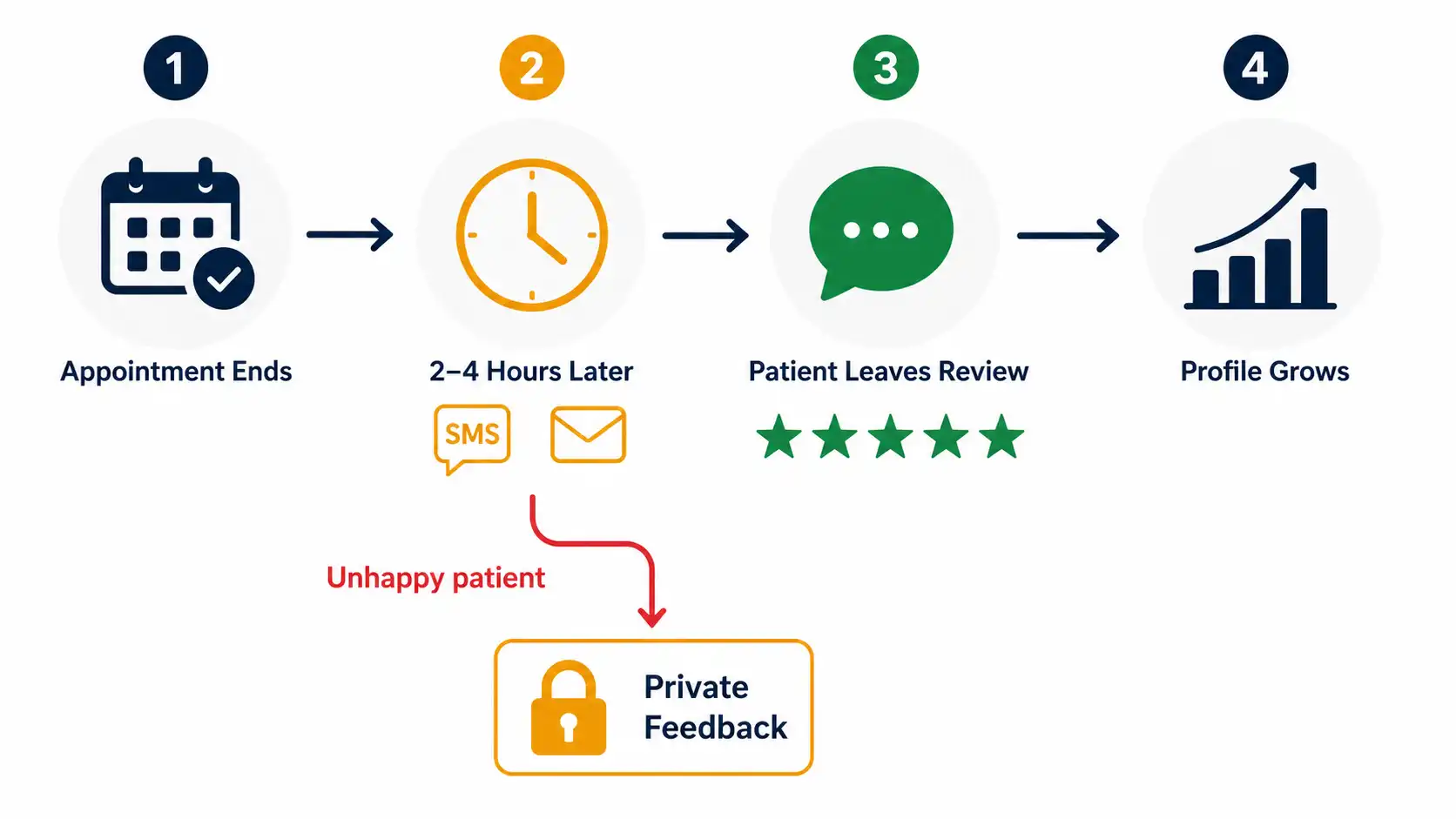
An automated review request system triggers a post-appointment message to the patient at a defined time after their visit — typically two to four hours after the appointment ends, when the patient is home and the experience is fresh.
The message is sent via SMS, email, or both, depending on the patient's communication preferences. It thanks them for attending, asks briefly how their visit went, and includes a direct link to your Google Business Profile review page — one tap takes them straight to the review form with no searching required.
The timing and channel of the request make a significant difference to response rate. Requests sent within a few hours of the appointment consistently outperform requests sent the following day. SMS requests consistently outperform email-only requests in clinical settings. A direct link to the Google review form consistently outperforms a general request to "leave us a review somewhere."
The review request workflow is part of AI CRM automation, which starts from £197/month on a 30-day rolling contract. The same automation platform handles appointment reminders, follow-up sequences, and post-appointment care instructions — the review request is one workflow within a broader patient communication system rather than a standalone tool.
Ready to see how this would work in your practice? Book a free 30-minute demo →
How Should Chiropractors Word Automated Review Requests to Stay GCC Compliant?
The framing of the review request message is where GCC compliance becomes practical.
The request should invite the patient to share their experience of the practice — not to describe what chiropractic did for their condition. The distinction sounds subtle but matters.
GCC-compliant framing: "Thank you for visiting [Clinic Name] today. If you have a moment, we would love to hear about your experience — a quick Google review helps other patients find us. [Review link]"
Framing to avoid: "Did your back pain improve after your session? Let other patients know by leaving us a review — [Review link]"
The first version invites an experience review. The second version prompts a clinical outcome statement. If a patient responds to the second version by writing "yes my back pain is completely gone," that review — if you then feature it in your marketing — becomes a testimonial making an efficacy claim, which the GCC and ASA both restrict.
What most patients write in response to a straightforward experience-based request is overwhelmingly positive and unproblematic — comments about the team, the clinic environment, feeling listened to, finding the booking process easy, and feeling better-informed about their condition. These reviews are valuable, compliant and genuinely useful to prospective patients.
Negative feedback handling is also part of a well-configured reputation system. If a patient indicates dissatisfaction in response to the initial check-in message — before reaching the Google review link — the system routes that feedback internally for private resolution rather than directing an unhappy patient straight to a public review platform. This is a standard feature of GoHighLevel-based reputation management and is fully compliant with consumer protection requirements.
"The GCC has also reminded registrants that they are personally accountable for their Google Business Profile even when it is managed by a third party or agency — making it important to ensure anyone with access to your profile, including automation platforms, operates within clearly agreed parameters."
How Many Google Reviews Does a Chiropractic Practice Need?
There is no fixed threshold, but there are practical benchmarks worth being aware of.
In most UK towns and cities, the top three chiropractic practices in the Google local pack have between 30 and 100 reviews. A practice with fewer than 20 reviews is typically outranked by practices with more, even where the average rating is similar. A practice with fewer than 10 reviews is often invisible in the local pack for competitive searches.
For a practice currently at 5–15 reviews, consistently sending automated review requests after every appointment will typically add 3–8 new reviews per month depending on appointment volume. Reaching 30–40 reviews in three to four months is a realistic outcome for an active practice starting from a low base.
The review recency also matters. Google weights recent reviews more heavily than older ones. A practice that had 50 reviews three years ago and has received 2 reviews in the last six months will be outranked by a practice with 20 reviews but 8 in the last month. Consistent automated requests maintain recency as well as volume.
For a broader picture of how AI marketing for chiropractors fits alongside reputation management, the AI marketing post covers the full picture of digital visibility for chiropractic practices.

Frequently Asked Questions
Can chiropractors use patient testimonials in their marketing? Yes, with GCC-compliant framing. The GCC permits experience-based testimonials — comments about the practice environment, team, booking experience and how the patient felt during their visit. Testimonials that claim chiropractic treats, cures or prevents specific medical conditions are not permitted under GCC advertising standards and the ASA's CAP Code. Automated review request messages should invite experience-based feedback rather than prompting clinical outcome statements.
Do Google reviews help a chiropractic practice get more patients? Yes. Google reviews are a primary local search ranking factor — practices with more recent, higher-rated reviews appear higher in the Google local pack and receive more clicks from prospective patients. Review volume matters as well as average rating. A practice with 40 reviews at 4.6 will typically outrank a practice with 8 reviews at 4.9 for competitive local searches.
When is the best time to ask a chiropractic patient for a Google review? Two to four hours after the appointment ends — when the patient is home, the experience is fresh, and they have a moment to respond. Review requests sent in this window consistently achieve higher response rates than requests sent the following day. SMS requests with a direct Google review link outperform email-only requests in clinical settings.
What should a GCC-compliant review request message say? Invite the patient to share their experience of the practice rather than describing clinical outcomes. An example: "Thank you for visiting [Clinic Name] today. If you have a moment, we would love to hear about your experience — a quick Google review helps other patients find us. [Review link]." Avoid prompting patients to describe what chiropractic did for their specific condition, as this can generate reviews that make efficacy claims restricted under GCC and ASA guidance.
What happens if a patient leaves a negative review? A well-configured reputation system routes dissatisfied patients to a private feedback channel before they reach the public review platform. If a patient indicates dissatisfaction in their initial post-appointment check-in, the system flags this internally for the practice to resolve privately rather than directing them to Google. Reviews that do appear publicly should be responded to professionally — acknowledging the feedback without disclosing clinical details or making admissions of liability.
How much does automated review management cost for a chiropractic practice? Review request automation is included within AI CRM automation, which starts from £197/month on a 30-day rolling contract with a £197 setup fee. The same platform handles appointment reminders, post-appointment follow-up, and patient reactivation sequences — the review workflow is one part of a broader patient communication system.
How quickly can a chiropractic practice build up Google reviews with automation? For an active practice starting from a low review base, consistently automated review requests typically add 3–8 new reviews per month depending on appointment volume. Reaching 30–40 reviews from a starting point of 5–15 is a realistic outcome within three to four months. Consistency of request — every patient, every appointment — is the key variable.
Do I need to be based in Cheshire to work with AI Bridge Club? No. We work with chiropractic practices remotely across the UK. Our base is in Sandbach, Cheshire, and we can meet face-to-face with clinics in the North west
Is there a minimum contract term? No. All AI Bridge Club services run on 30-day rolling contracts. You can cancel with 30 days' notice at any time.
Your chiropractic practice is delivering good results for patients. Your Google profile should reflect that.
Book a free 30-minute demo with AI Bridge Club. We will show you how automated review requests work in practice, walk through the GCC-compliant message framing, and set up a system that builds your review count consistently — with no obligation and no long-term contract.

