

How to Reduce Gym Member Cancellations: What Actually Works
The average gym in the UK loses roughly 1 in 3 members every year. The HFA 2025 Fitness Industry Benchmarking Report — covering 175 companies and more than 17,000 facilities — puts the median annual retention rate at 66.4%. That means 33.6% of your current membership base is leaving every twelve months, regardless of how good your facilities are or how hard your team works.
Most of those cancellations are not inevitable. Research consistently shows that the majority of gym member cancellations happen because of failures in communication, onboarding and follow-up — not because the member disliked the gym. They go quiet, lose momentum, feel like a number, and cancel before anyone notices.
This post covers what actually causes gym member cancellations, which ones automation can prevent, and what a practical retention system looks like for an independent gym, fitness studio or personal training business in the UK.
Why Gym Members Actually Cancel
Understanding the real causes of cancellations matters before putting any system in place. The data from Xplor Gym's Winning The War On Attrition research — covering over 300,000 UK gym members who cancelled over a five-year period — reveals a more nuanced picture than most gym owners expect.
The single biggest reason UK gym members cancel is a payment failure — 40% of former members had their membership cancelled because a direct debit failed due to insufficient funds rather than actively choosing to leave. These are not voluntary cancellations. The member did not decide to quit. The payment failed silently and the membership ended before the gym had a chance to intervene.
Combined with the 12% who cancelled without giving any reason, that means 52% of former members cancelled silently — without the gym knowing why or having the chance to respond.
Beyond payment issues, 27% of members who cancelled said it was because the membership was too expensive, while 14% cited lack of time and a similar number cited a change in personal circumstances.
What this tells you is that most cancellations are not about the gym itself. They are about life circumstances, communication failures and the absence of a system that spots and responds to at-risk members before the direct debit stops.
The Four Cancellations You Can Actually Prevent
Not all cancellations are preventable. A member who moves to another city will cancel. A member who loses their job and genuinely cannot afford the membership will cancel. These are circumstances outside your control.
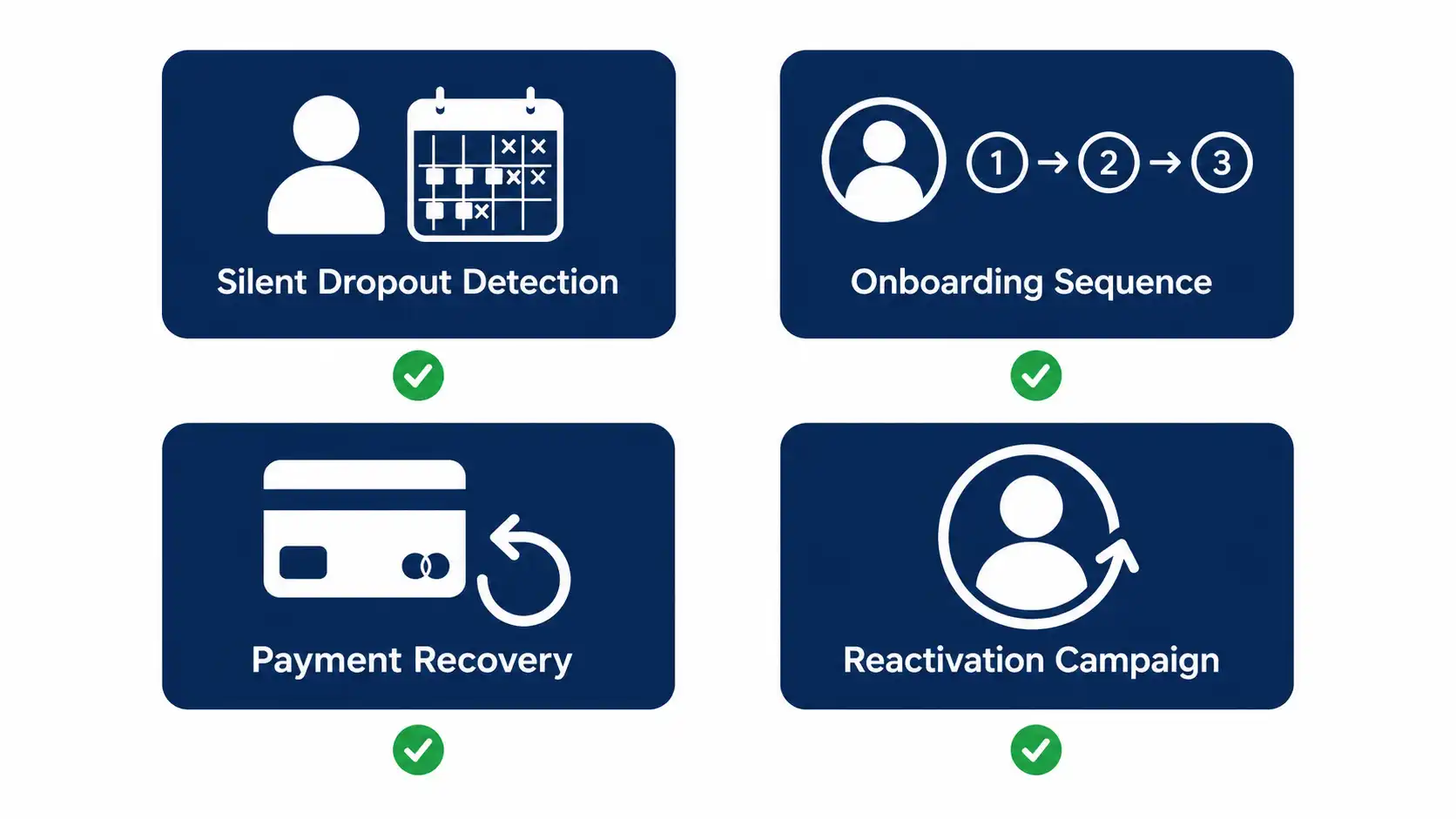
But four specific cancellation types are consistently preventable with the right system in place.
Preventable cancellation 1 — The silent dropout
31% of current UK gym members are sleeping — they have not visited in the last 30 days — yet most gyms have no automated system to detect this and respond before it becomes a cancellation. A member who stops attending does not immediately cancel. There is a window — typically two to four weeks — between the point where attendance drops and the point where a cancellation decision is made.
An automated attendance monitoring system flags members who have not visited in a defined period and triggers a re-engagement message. Not a generic email — a specific, personal message from the gym acknowledging the gap and offering support. The message costs nothing to send and consistently brings members back before they reach the cancellation decision.
Preventable cancellation 2 — The new member who never found their routine
Poor gym member onboarding is a huge factor in why 50% of new members quit within the first 90 days — often because they feel lost or disconnected. A new member who joins in January with good intentions but receives no structured communication after their induction will quietly stop attending within weeks. By the time their second monthly payment processes, they are already mentally checked out.
An automated onboarding sequence changes this. Messages that check in on day three, celebrate the first week, review goals at two weeks and mark the first month create the feeling of being supported — even when your team is busy with other members.
Preventable cancellation 3 — The payment failure that was never recovered
96% of UK gym operators who use direct debits say payment failures due to insufficient funds have an impact on business, with ONS data showing 5.79% of direct debits processed for fitness facilities failed due to insufficient funds in the first eight months of 2025.
An automated payment failure sequence — a message within hours of a failed payment, followed by a follow-up two days later with a direct payment link — recovers a significant proportion of these silent cancellations before they become permanent. The member often does not even know the payment failed.
Preventable cancellation 4 — The lapsed member who was never contacted again
A member who cancelled six months ago may have done so because of a temporary situation — financial pressure, an injury, a busy period at work. Their circumstances may have changed. Most gyms never contact them again. A structured reactivation sequence — a genuine, personal message at 30 days and 90 days post-cancellation — consistently surfaces members whose circumstances have changed and who would return if asked.
What a Gym Retention Automation System Looks Like
A practical gym retention automation system does not require your team to monitor dashboards or remember to send messages. It runs in the background, triggered by member behaviour, and handles the communication that currently falls through the cracks.
The core components are:
Attendance monitoring and re-engagement triggers When a member's attendance drops below a defined threshold — say, no visit in 14 days — an automated message is sent. Not a generic marketing email. A short, personal message: "Hi [Name], we noticed you have not been in for a couple of weeks — is everything okay? Your [fitness goal] is still waiting for you. We are here if you need anything." This message costs seconds to automate and consistently brings members back.
New member onboarding sequence Every new member receives the same structured sequence regardless of how busy the team is on the day they join. The sequence runs automatically from the moment the membership is created in the CRM.
Payment failure recovery sequence An automated message fires within hours of any failed payment, with a direct link to update payment details. A follow-up sends two days later. Most payment failures are recovered before the member even realises there was a problem.
Reactivation campaigns Cancelled members receive a personal message at 30 days and 90 days post-cancellation. At key seasonal windows — January, September — a broader reactivation campaign goes to the full lapsed member database.
Review requests After positive interactions — a fitness milestone, a class completion, a membership anniversary — an automated review request sends with a direct link to Google. Studios that focused on member engagement cut cancellations by 6% year-over-year — and consistent Google reviews improve local search visibility for queries like "gym near me" and "gym in [town]."
All of this runs on GoHighLevel, integrated with your existing membership management software. For more on how this works in practice for gyms, fitness studios and PT businesses, visit our AI automation for gyms sector page.
Want to know which of the four preventable cancellation types is costing your gym the most? Book a free 30-minute retention audit →
The Maths on Gym Member Retention
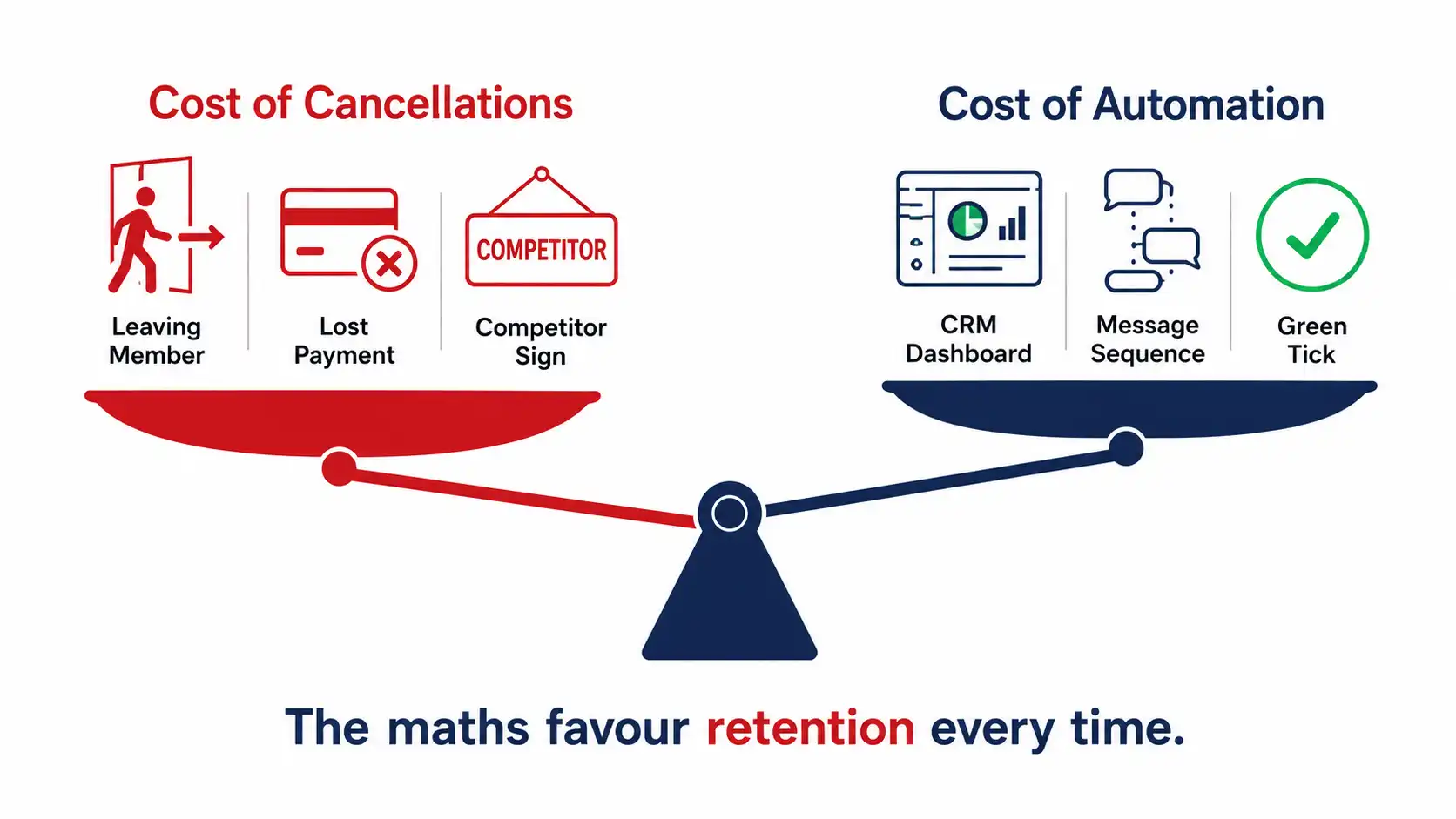
Signing up a new member can be anywhere from 5 to 25 times more expensive than retaining an existing one. And if you can increase retention rates by 5%, profits could increase by 25 to 95%.
At a typical UK gym membership fee of £35 to £50 per month, retaining five additional members per month through better onboarding, attendance monitoring and payment recovery generates £175 to £250 in additional monthly recurring revenue. That covers the cost of a CRM automation system and generates a clear return from month one.
The investment is not in the automation itself — it is in building the system once and letting it run. For more on what gym automation costs and what each service level includes, read our business automation pricing guide.
Ready to stop losing preventable cancellations?
Book a free 30-minute call with AI Bridge Club. We will review your current member journey, identify which cancellation types are costing you the most and show you exactly what an automation system would look like for your gym, studio or PT business.
No obligation. No hard sell.
Book your free retention audit →
Or call us: 07366 926333
Frequently Asked Questions
Why do gym members cancel their memberships? Research from Xplor Gym covering over 300,000 UK gym members shows the biggest single cause is payment failure — 40% of members had their membership cancelled because a direct debit failed, not because they chose to leave. Beyond payment issues, 27% of members who actively cancelled cited cost, 14% cited lack of time and a similar number cited a change in personal circumstances. Most cancellations are not about the gym itself — they are about communication failures, poor onboarding and the absence of a system that spots at-risk members early.
What is the average gym member retention rate in the UK? The current industry benchmark is 66.4% annual retention, according to the HFA 2025 Fitness Industry Benchmarking Report covering 175 companies and more than 17,000 facilities across 27 countries. This means the average gym retains roughly 2 in 3 members each year and loses approximately 1 in 3. The figure has declined from around 71% a decade ago, reflecting increased competition and the impact of cost-of-living pressures on UK consumers.
How can gyms reduce member cancellations? The four highest-impact interventions for reducing gym member cancellations are: automated attendance monitoring that flags inactive members before they cancel; structured new member onboarding sequences during the high-risk first 90 days; automated payment failure recovery sequences that recover lapsed direct debits before they become cancellations; and reactivation campaigns for former members whose circumstances may have changed. Each of these can be automated and runs without manual input from your team.
What percentage of new gym members quit within 90 days? Research consistently shows that 50% of new gym members quit within their first 90 days. UK-specific data from Xplor Gym shows 1 in 10 UK gym members quit within 90 days of their first agreement. The first 30 days are the highest-risk window — members who do not form an attendance habit in month one rarely form it at all.
How does automated gym CRM work? A gym CRM automation system triggers communications based on member behaviour rather than requiring staff to initiate them. When a member's attendance drops, a re-engagement message fires automatically. When a new member joins, an onboarding sequence starts. When a payment fails, a recovery message sends within hours. When a member hits a milestone, a review request goes out. The system is built and configured once by AI Bridge Club and runs without manual input ongoing.
How much does gym retention automation cost in the UK? AI Bridge Club's gym CRM and retention automation is priced based on the complexity of the setup — the number of automation sequences, integrations with your existing membership software and the scope of the member journey mapped. A discovery call is required to provide an accurate quote. Entry-level automation starts from £97 per month for missed call text back, with full CRM member retention systems typically starting from £197 to £300 per month. All services are on 30-day rolling contracts with no minimum term.
Does automation make gyms feel less personal? No — when built correctly, automation makes gyms feel more personal, not less. Members receive consistent, timely communication that feels attentive. A check-in message on day three after joining feels caring. An attendance re-engagement message feels like the gym noticed they were missing. A milestone celebration feels genuine. The key is that automation handles the communication that currently falls through the cracks — not the human interactions that define your gym's culture.
Can AI automation help fitness studios and personal trainers reduce cancellations? Yes. The same cancellation patterns that affect gyms apply to fitness studios with class-based models and personal trainers with regular client sessions. New clients who do not hear from you after their first session drift away. Lapsed clients who cancelled are never recontacted. Payment failures are not followed up. Automated retention sequences address each of these gaps for any fitness business, regardless of size or format.
What is the silent dropout problem in gyms? The silent dropout is a member who stops attending without cancelling. Research from Xplor Gym shows 31% of current UK gym members have not visited in the last 30 days — they are paying but not attending. These members are at high risk of cancelling but have not yet made the decision. An automated attendance monitoring system identifies them and triggers a re-engagement message during the window between attendance dropping and a cancellation decision being made.
How long does it take to set up a gym retention automation system? Most gym retention automation systems built by AI Bridge Club are live within one to two weeks of the initial discovery call. The setup covers discovery, build, testing, team walkthrough and go-live monitoring. The gym owner's time commitment is a 30 to 45 minute discovery call and a review session before launch.

