
How to Reduce No-Shows at Your Chiropractic Practice With Automated Reminders
No-shows are one of the most controllable costs in a chiropractic practice. Each empty slot represents £40–£80 in lost treatment revenue — not from a clinical failure or a pricing problem, but simply because a patient forgot, lost track of time, or could not be bothered to cancel.
The good news is that the majority of no-shows are preventable. Research consistently shows that automated appointment reminders reduce no-show rates by 40–60% in clinical settings. For a busy chiropractic clinic with a full diary, that reduction translates directly into revenue recovered and a schedule that runs as planned.
This post covers why chiropractic no-shows happen, what an automated reminder system looks like in practice, how it integrates with existing booking software, and what it costs.
Using Jane App or similar software already to solve this?
Ok, one of the limitations, we have experienced with these apps appears to be a lack of control. Mainly due to the fact, they only "remind" the customer, they don't then interact dynamically with the patient. Normally they don't offer an opportunity to say Yes I'm still attending the appointment, or cancel, modify or re-book from within those emails/SMS messages. They don't then notify the Chiropractor & the patient automatically on the changes that have just happened. Automation is powerful stuff & will help you prevent "no shows" & increase profits.
If you have not yet addressed call answering at your practice, read AI receptionist for chiropractors: how it works and what it costs first — no-show reduction delivers its strongest results once new patient enquiries are being captured reliably
Why Do Chiropractic Patients Not Show Up for Appointments?
No-shows at chiropractic clinics happen for three main reasons: patients forget, patients recover temporarily and do not think the appointment is still needed, or patients intend to cancel but do not get around to it.
The forgetting problem is the most common and the most fixable. A patient books an appointment three weeks in advance when their back is painful. By the time the appointment date arrives, the acute episode has settled — they feel better, the appointment has drifted to the back of their mind, and they simply do not show up. This is not deliberate. It is the natural result of booking ahead in a clinical setting where patients attend episodically.
The temporary recovery problem is specific to musculoskeletal clinics including chiropractic. Unlike dentistry or GP appointments, patients attending for back or neck pain often experience fluctuating symptoms. When they feel better on the morning of the appointment, the perceived urgency drops — and without a reminder prompting them to attend, they skip it.
The failed cancellation problem is structural. Most patients who decide not to attend do intend to let the clinic know. But in a busy day, making that call gets deprioritised until it is too late — and the slot is wasted for both parties.
Manual reminders — a staff member calling each patient the day before — address all three problems. But in a solo or dual-practitioner chiropractic practice with no dedicated reception staff, making 20 or 30 reminder calls per week is not a realistic use of clinical time. Automated systems do the same job, to every patient, every time, without any staff involvement.
How Does an Automated Chiropractic Appointment Reminder System Work?
An automated reminder system works by connecting your booking calendar to a CRM automation platform that triggers pre-written SMS and email messages at set intervals before each appointment.
The standard sequence used in UK chiropractic practices is:
48 hours before: SMS and email sent confirming the appointment date, time and address. Includes a one-tap cancellation or rescheduling link so patients who cannot attend can act immediately rather than letting the slot go to waste.
24 hours before: SMS reminder with appointment details and a brief prompt — "your chiropractic appointment is tomorrow at 10:30am at [Clinic Name]. Are you still coming? Reply YES or CANCEL/Re-Schedule to free the slot if you can no longer make it."
2 hours before: Final SMS for same-day appointments — short, direct, useful for patients who have left home and need the address confirmed.
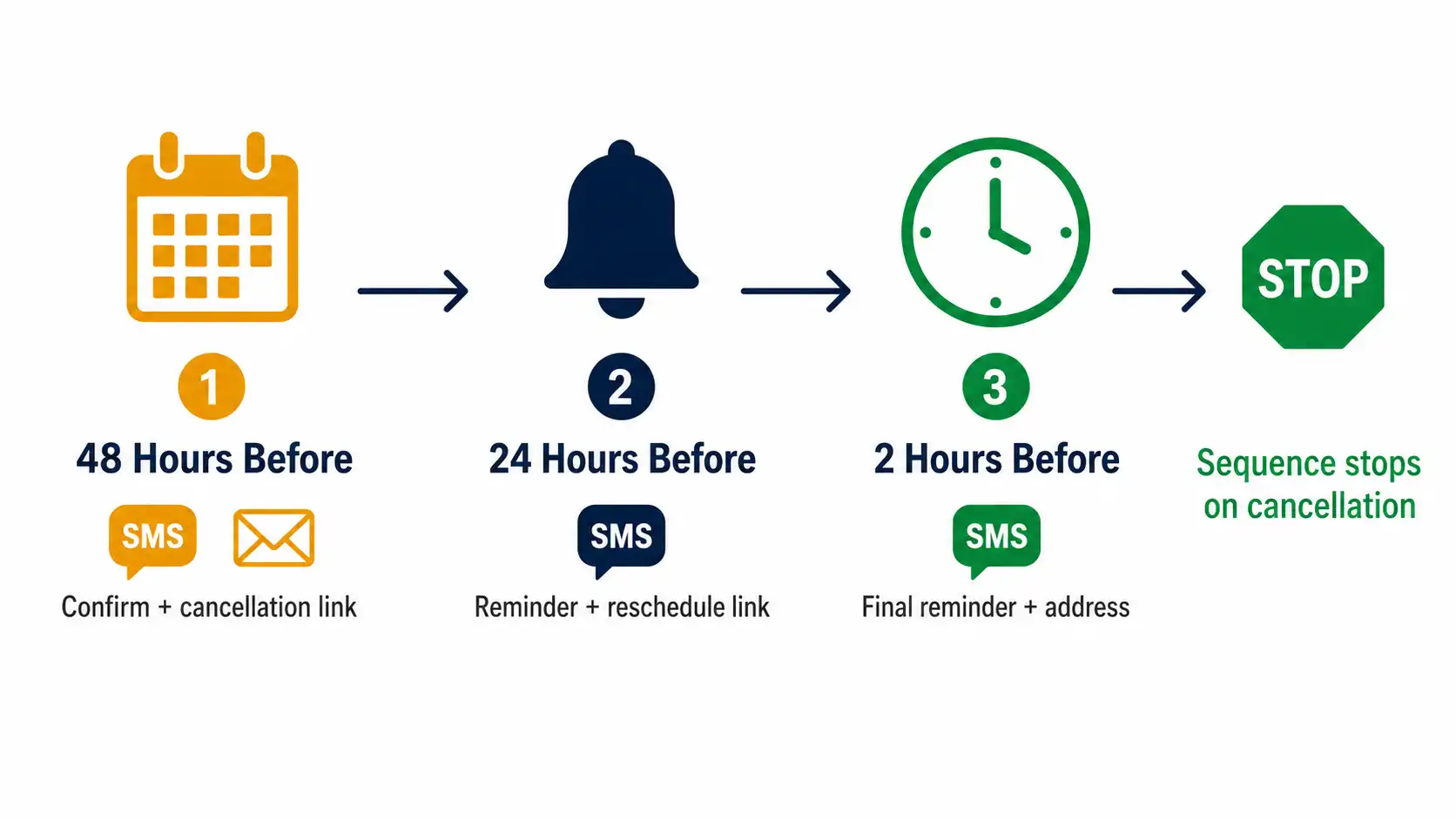
The sequence stops automatically if the appointment is cancelled or rescheduled. If a patient cancels in response to a reminder, the system can immediately trigger a slot-fill sequence — a message to patients on your waiting list offering the freed-up slot. This is where automated reminder systems recover significant value: not just by reducing no-shows but by filling the slots that do empty.
AI CRM automation is the underlying system that runs these workflows — starting from £197/month on a 30-day rolling contract, with no manual input required from your team once the sequences are configured.
The entire process — from appointment booking to confirmation, reminder sequence and post-appointment follow-up — runs without a staff member needing to touch it. For a solo chiropractor already running clinical and admin responsibilities simultaneously, that matters significantly.
Want to see how this would work with your specific booking system? Book a free 30-minute demo →
What Is the Real Cost of No-Shows to a Chiropractic Practice?
The cost of a chiropractic no-show is not just the lost treatment fee for that slot. It compounds.
A slot that sits empty cannot be filled at short notice for most practices — particularly solo clinics where the practitioner is already in session and cannot proactively reach out to the waiting list in real time. The direct cost is £40–£80 in lost revenue. The indirect cost is the admin time spent attempting to contact the patient, the disruption to the practice's rhythm for that session, and the capacity pressure if the patient later tries to rebook urgently.
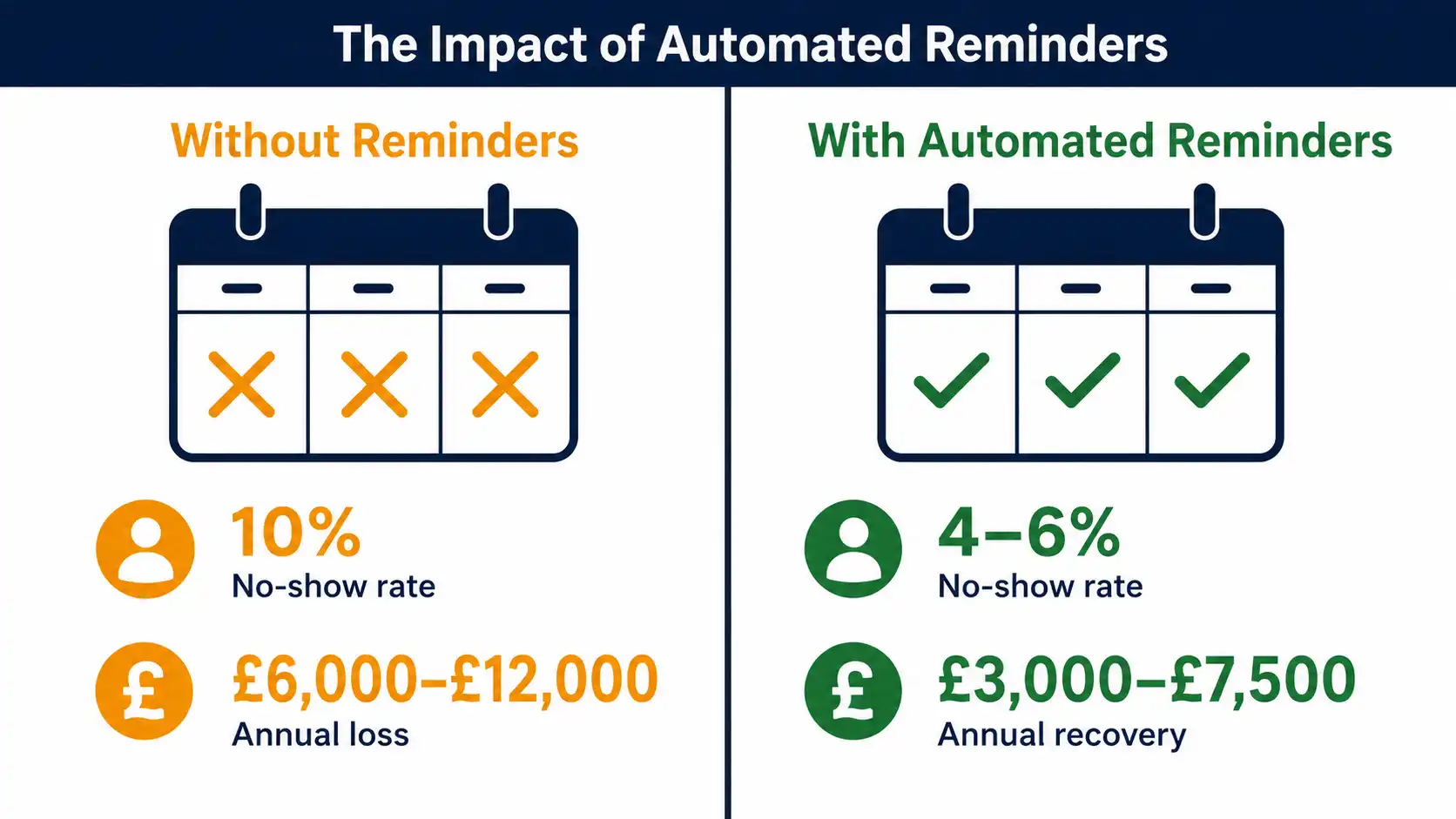
For a practice with 30 appointments per week and a 10% no-show rate — which is not unusual for clinics without automated reminders — that is three empty slots per week. Over a year, that is approximately 150 empty slots, representing £6,000–£12,000 in lost treatment revenue at typical chiropractic pricing.
An automated reminder system at £197/month costs £2,364 per year. If it reduces no-shows by 50% — recovering 75 slots per year at an average of £55 each — that is £4,125 in recovered revenue against a £2,364 cost. The arithmetic is straightforward.
These figures are illustrative. Your actual results will depend on your current no-show rate, appointment value and booking volume. What AI Bridge Club will do before recommending a system is work through those figures with you on the discovery call.
Does an Automated Reminder System Replace the Need to Call Patients?
Automated reminders replace the vast majority of manual reminder calls — but not all patient communication.
For routine appointments with established patients, automated SMS and email reminders are more effective than phone calls in most cases. They arrive at a convenient moment rather than interrupting the patient, they contain actionable links for cancellation or rescheduling, and they do not require the patient to be available to answer. Response rates to SMS reminders in clinical settings are consistently higher than response rates to phone call reminders.
For new patient appointments, or for patients who have not attended in a long time, an additional personalised touch from the practitioner or a team member can improve show rates further. The automated system handles the baseline reminder; a brief personal message layered on top handles the higher-risk bookings.
For AI automation across your entire chiropractic practice — including call answering, new patient booking, and reputation management — the chiropractic sector page covers every service in context.
The practical outcome is that staff reminder calls drop to near zero for routine appointments, and the clinical team's time is focused on the cases that genuinely warrant personal contact.
How Does an Automated Reminder System Integrate With Chiropractic Booking Software?
Automated reminder systems built on GoHighLevel integrate with the booking and calendar software most UK chiropractic practices already use.
Compatible platforms include JaneApp, Cliniko, WriteUpp, and standard Google or Outlook calendars. The integration works via API connection or calendar sync depending on the platform. When an appointment is booked in your existing software, the automation platform receives the booking data and triggers the reminder sequence automatically.
For practices using platforms that do not have direct API access, calendar-based triggers can be used as an alternative. The discovery call with AI Bridge Club confirms the integration method before any build begins — if your specific platform cannot be integrated cleanly, that will be stated before the contract is signed.
The reminder system sits alongside your existing booking software rather than replacing it. Your team continues working in the same system they know. The automation layer handles the outbound communication that currently either does not happen or happens manually.
If your practice does not currently have a dedicated booking platform and is using a standard calendar, AI Smart Sites can integrate a conversion-focused booking system directly into your website alongside the reminder automation — combining both in a single setup.
What Happens When a Patient Cancels in Response to a Reminder?
A cancellation triggered by a reminder is not a lost appointment — it is a recovered slot.
When a patient cancels via the link in their reminder message, the system registers the cancellation and can immediately trigger a slot-fill sequence. This is a pre-written message sent to patients on your waiting list or to patients who previously enquired about an appointment but did not yet book. It offers the freed-up slot directly — with date, time and a one-tap booking link.
In active chiropractic practices with a waiting list, this slot-fill sequence regularly fills cancelled appointments within minutes of the cancellation being received. The slot that would have sat empty becomes a filled appointment — often with a patient who has been waiting weeks.
This is where the full value of AI CRM automation becomes visible beyond just reminders. The system manages the entire appointment lifecycle — booking confirmation, reminder sequence, cancellation handling, slot-fill trigger, and post-appointment follow-up — as a connected workflow running in the background with no staff input.
For a complete picture of how AI handles patient reactivation alongside new appointment management, read how to reactivate lapsed chiropractic patients with automated follow-up.

Frequently Asked Questions
How much does a no-show cost a chiropractic practice? Each no-show costs a chiropractic practice the full treatment fee for that slot — typically £40–£80 for a standard adjustment appointment — plus any admin time spent attempting to contact the patient. For a practice with a 10% no-show rate across 30 appointments per week, that represents approximately three empty slots per week and £6,000–£12,000 in lost annual revenue at typical chiropractic pricing.
What is the most effective way to reduce no-shows at a chiropractic clinic? Automated appointment reminders sent via SMS and email at 48 hours, 24 hours and 2 hours before each appointment are the most consistently effective intervention for reducing chiropractic no-shows. Research in clinical settings shows no-show rates reduced by 40–60% with automated reminder systems. The 48-hour reminder is the most important — it gives patients enough notice to cancel and allows the slot to be offered to someone else.
How does an automated chiropractic reminder system work? An automated reminder system connects your booking calendar to a CRM automation platform. When an appointment is booked, the system triggers a pre-written sequence of SMS and email messages at set intervals — 48 hours, 24 hours and 2 hours before the appointment. Each message includes a cancellation or rescheduling link. If the patient cancels, the sequence stops and a slot-fill message can be triggered automatically to your waiting list.
What booking systems does the reminder automation integrate with? AI Bridge Club's reminder system integrates with JaneApp, Cliniko, WriteUpp, and standard Google or Outlook calendars. The integration method — API connection or calendar sync — is confirmed during the discovery call. If your specific platform does not support direct integration, this is stated before any contract is signed.
How much does an automated reminder system cost for a chiropractic practice? AI CRM automation — which includes appointment reminders, follow-up sequences and post-appointment workflows — starts from £197/month on a 30-day rolling contract with a £197 setup fee. For most active chiropractic practices, recovering one or two no-shows per month covers the full monthly cost of the system.
Do I need to change my booking system to use automated reminders? No. The reminder automation sits alongside your existing booking software. Your team continues using the same system. The automation layer handles outbound reminders and cancellation management in the background. Your booking workflow does not change.
Will patients find automated reminders impersonal? No — in practice, patients respond positively to timely, clear reminders regardless of whether they were sent by a person or an automated system. What patients find impersonal is not receiving any communication at all, or receiving a call at an inconvenient time. An SMS reminder that arrives at a reasonable time with a clear action link is typically well received. Messages are written in your clinic's tone and sent from your clinic's name — they read as coming from your practice, not from a generic system.
Do I need to be based in Cheshire to work with AI Bridge Club? No. We work with chiropractic practices remotely across the UK. Our base is in Sandbach, Cheshire, and we can meet face-to-face with clinics in Crewe, Nantwich, Macclesfield, Chester, Warrington, Wilmslow, Knutsford and Congleton.
Is there a minimum contract term? No. All AI Bridge Club services run on 30-day rolling contracts. You can cancel with 30 days' notice at any time. No long-term commitment is required.
Your chiropractic diary has empty slots that should not be empty. Automated reminders fix that.
Book a free 30-minute demo with AI Bridge Club. We will map your current no-show rate, show you exactly how the reminder system integrates with your booking software, and give you a straight answer on whether it makes sense for your practice — with no obligation and no long-term contract.
Based in Sandbach, Cheshire. Working with chiropractic practices across the UK.

