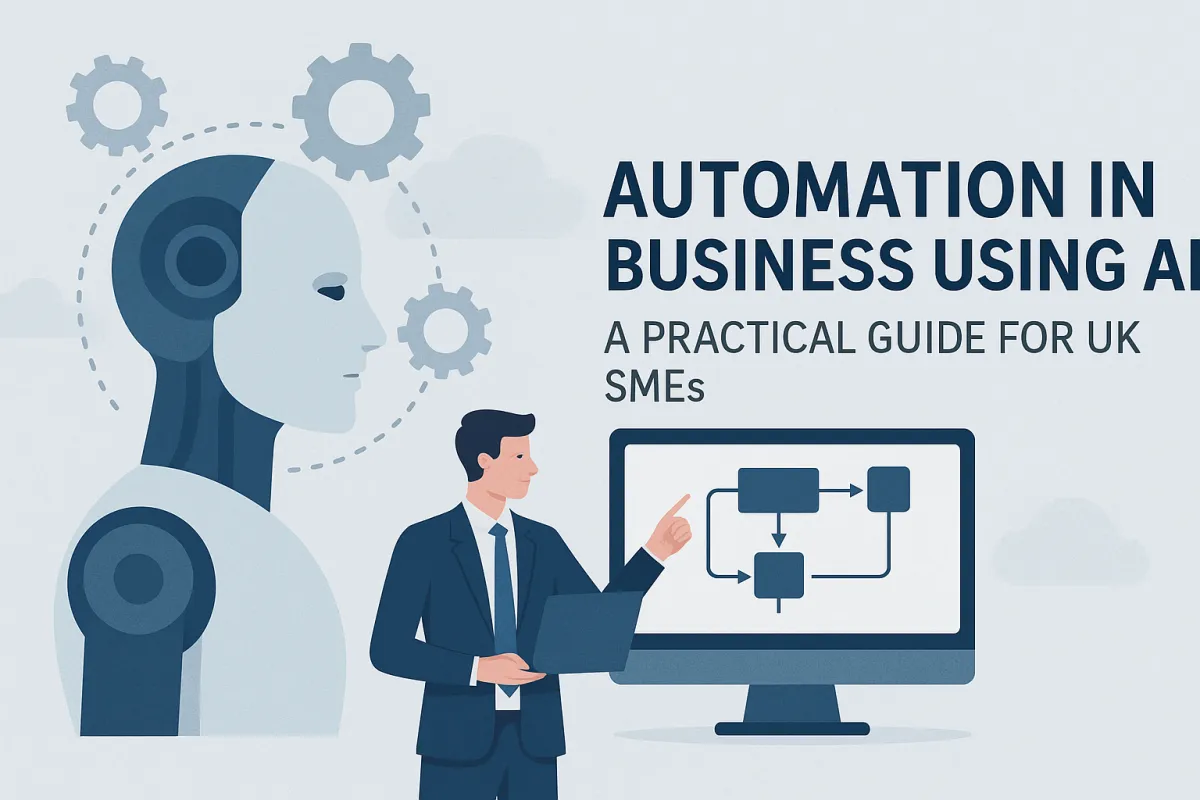
Automation in Business Using AI: A Practical Guide for UK SMEs
Right, let's have a proper chat about automation and what it actually means for your business. I'm not here to bore you with techy jargon or sell you some daft dream that'll never happen. I'm here to give you the straight truth about how AI and automation can genuinely help small to mid-size UK businesses like yours work smarter, not harder.
Look, I get it. You're busy running your business, dealing with customers, managing staff, and trying to keep all the plates spinning. The last thing you need is someone banging on about robots taking over or some pie-in-the-sky technology that costs a fortune and takes forever to set up. But here's the thing: automation isn't what it used to be. It's not just for massive corporations with deep pockets anymore. It's for businesses like yours, and it's more accessible than you might think.
To see how AI automation enquiries, bookings and follow‑ups automatically, check out our AI CRM automation guide.
What Is Business Automation, Really?
Let's strip away all the fancy marketing speak for a minute. Business automation is simply getting technology to handle the repetitive, time-consuming tasks that don't need a human brain. Think about all those bits and bobs you do every day that are necessary but, let's be honest, a bit soul-destroying. Answering the same customer questions over and over. Data entry. Scheduling appointments. Sending follow-up emails. Chasing invoices.
Now, with AI, automation has gotten properly clever. We're not just talking about basic "if this, then that" rules anymore. Modern AI can understand context, learn from patterns, and make decisions that used to require human judgment. It can chat with your customers in a way that feels natural, spot trends in your data that you'd never notice manually, and predict what's likely to happen next based on what's happened before.
According to research from McKinsey, businesses that implement automation and AI see productivity gains of 20-40% in specific workflows. That's not small change—that's the difference between working yourself into the ground and actually having time to grow your business strategically.
Why UK Small and Mid-Size Businesses Need Automation Now
You might be thinking, "This sounds great, but is it really for me?" Short answer: yes. Long answer: absolutely yes, and here's why.
The UK market is competitive. Properly competitive. Your customers expect fast responses, seamless service, and personalised experiences—whether you're a plumber in Manchester or a marketing agency in Brighton. The businesses that can deliver this consistently are the ones that'll thrive. The ones that can't? They'll get left behind, simple as that.
But here's the rub: you probably don't have the resources to hire a massive team to handle everything. Staff costs are eye-watering these days, and good people are hard to find and even harder to keep. This is where automation becomes your secret weapon. It's like having extra team members who work 24/7, never call in sick, and don't need a brew every half hour.
I've worked with dozens of UK businesses—from trades to professional services—and the pattern is always the same. They're drowning in admin, struggling to keep up with customer service demands, and spending their evenings catching up on tasks that should take minutes, not hours. Sound familiar? That's exactly what automation fixes.
Where Automation Makes the Biggest Difference
Let me get practical with you. Where does automation actually help in a typical UK SME? Based on what I've seen working with businesses across Cheshire and beyond, here are the areas where you'll see the biggest impact.
Customer Service and Communication: This is the big one. An AI voice agent or chatbot can handle the first contact with customers, answer common questions, book appointments, and qualify leads—all while you're getting on with actual work. I'm not talking about those dodgy chatbots from five years ago that made everyone want to throw their phone at the wall. Modern AI can hold proper conversations, understand different accents (crucial in the UK!), and escalate to a human when needed.
One of my clients, a heating engineer, was missing calls left, right, and centre because he was out on jobs. We set up an AI voice agent that took enquiries, booked appointments, and even provided basic quotes. His conversion rate went through the roof because people weren't ringing his competitors when he couldn't answer.
Administrative Tasks: Invoicing, data entry, scheduling, document management—this stuff is necessary but it's not what you started your business to do. Automation can handle most of it without breaking a sweat. You set the rules, and the system does the rest.
Marketing and Lead Generation: Automation can manage your social media posting, send personalised email campaigns, follow up with leads at exactly the right time, and track what's working and what isn't. It's like having a marketing manager who never forgets a task and works purely on data, not gut feeling.
The Real Cost of Not Automating
Here's something nobody talks about enough: the cost of doing nothing. Every hour you spend on tasks that could be automated is an hour you're not spending on growing your business, serving customers better, or—dare I say it—having a life outside of work.
Let's do some quick maths. If you're spending two hours a day on repetitive admin tasks, that's ten hours a week. Forty hours a month. That's an entire working week every month that you're losing to stuff a computer could handle. What's your time worth? Even if we're conservative and say £50 an hour, that's £2,000 a month in lost opportunity. Over a year? £24,000. That's a significant chunk of change that could be invested back into your business or, you know, your life.
But it's not just about your time. There's the human cost too. Burnout is real, and it's rampant among UK small business owners. According to Federation of Small Businesses research, work-related stress is one of the top reasons entrepreneurs consider packing it all in. Automation isn't just about efficiency—it's about sustainability. It's about building a business that doesn't require you to work yourself into the ground just to keep the lights on.
Getting Started with Automation: It's Easier Than You Think
Right, so you're sold on the idea. Now what? The good news is you don't need to automate everything overnight. In fact, you shouldn't. The best approach is to start small, prove the value, and then expand from there.
Step One: Identify Your Pain Points. What tasks are driving you up the wall? What's taking up most of your time? What's causing bottlenecks in your business? Write them down. Be specific. "Customer enquiries" isn't specific enough. "Answering the same five questions about our services 20 times a day" is specific.
Step Two: Start with One High-Impact Area. Don't try to automate your entire business in one go. Pick one area where automation will make the biggest difference and start there. For most businesses, this is either customer communication or admin tasks. Get that sorted, prove the ROI, and then move on to the next thing.
Step Three: Choose the Right Tools. This is where a lot of businesses go wrong. They either pick something too complicated that requires a PhD to operate, or they go for the cheapest option that doesn't actually do what they need. You want tools that are powerful but user-friendly, and that integrate with what you're already using.
Our business automation services are designed specifically for UK SMEs. We don't do complicated. We don't do expensive. We do practical automation that works, that you can understand, and that delivers results you can measure.
Common Myths About AI and Automation
Let me bust a few myths that might be holding you back.
Myth: "It's too expensive for a business my size. "Not anymore. Modern automation tools are subscription-based and scale with your business. You can start small and grow. Plus, the cost of automation is usually a fraction of what you'd pay to hire additional staff to do the same work.
Myth: "It's too complicated and I'm not technical enough. "You don't need to be a tech wizard. The best automation tools are designed for normal people running normal businesses. If you can use email and a spreadsheet, you can use modern automation platforms. And if you work with a provider who knows what they're doing (like us), they'll handle the technical bits while you focus on your business.
Myth: "Customers hate automated systems. "Customers hate bad automated systems. They hate waiting. They hate not getting answers. They hate having to repeat themselves. A well-designed AI system provides instant responses, remembers previous interactions, and gives customers what they need quickly. That's what people actually want.
Myth: "It'll replace my staff. "This is the big one everyone worries about. Here's the reality: automation replaces tasks, not people. It frees your team up to do more valuable work—the stuff that actually requires human judgment, creativity, and empathy. Your staff will thank you for not making them do the boring, repetitive stuff anymore.
Psst! - If the jargon used is getting to you? AI jargon explained (plain English)
What Success Actually Looks Like
I'm all about being realistic, so let me paint you a picture of what success actually looks like when you get automation right.
You start your day by checking the dashboard on your phone while having your morning brew. Overnight, your AI assistant has qualified three new leads, booked them into your calendar, and sent them confirmation emails with all the relevant information. Two customers asked questions via your website chat, got instant answers, and one of them placed an order. Your social media posts went out on schedule, and you've got engagement data showing what's resonating with your audience.
By 10am, you've dealt with the handful of enquiries that genuinely needed your personal attention, and you're getting on with the work that actually makes you money. No email ping-pong. No phone tag. No fire-fighting.
By the end of the month, you're looking at analytics that show exactly where your business is thriving and where you need to focus. You've served more customers, closed more deals, and—here's the kicker—you've actually left work on time most days. You've had weekends. You've had headspace to think strategically about where your business is going, not just react to what's happening right now.
That's not a fantasy. That's what happens when you implement automation properly. It's not about becoming some soulless tech company. It's about using technology to be more human—to have time for the things that matter.
Your Next Steps
Look, I could bang on about this all day, but you've got a business to run. Here's what I reckon you should do next:
First, take 20 minutes to think about where automation could make the biggest difference in your business. Write it down. Be honest about what's wasting your time and what could be done better.
Second, have a look at what's possible. Check out case studies, talk to other business owners who've done it, and see what tools are out there. Knowledge is power, and all that.
Third, start small. Pick one thing. Prove it works. Then expand. You don't need to revolutionise your business overnight. Small wins add up to big results.
Ready to See What Automation Can Do for Your Business?
I've been helping UK small and mid-size businesses implement practical, effective automation for years. No nonsense, no over-promising, just real solutions that deliver real results.
If you're curious about how AI and business automation could work for your specific situation, let's have a chat. I'm not going to give you a hard sell—I just want to understand your business and see if there's a genuine fit.
Get in touch:
No obligation, no pressure. Just a proper conversation about how we might be able to help your business work smarter.
In a Nut Shell:
Automation is accessible: Modern AI-powered automation is no longer just for big corporations—it's practical, affordable, and designed for UK small and mid-size businesses.
Start where it hurts most: Focus on automating the repetitive tasks that consume your time and energy, particularly customer service and administrative work.
The cost of inaction is real: Every hour spent on tasks that could be automated is lost opportunity for growth, strategic thinking, and work-life balance.
Automation enhances, doesn't replace: Good automation frees your team to focus on high-value work that requires human judgment, creativity, and relationship-building.
Small steps lead to big wins: You don't need to automate everything at once. Start with one high-impact area, prove the value, then expand strategically.
Success is sustainable growth: Proper automation enables you to serve more customers, close more deals, and maintain a healthier work-life balance—that's what long-term business success looks like.
Related reading

