
AI Marketing for Dental Practices: What Actually Works for Private Clinics
Most dental practice owners think their marketing problem is visibility. They need more Google Ads. A better website. More Instagram posts. So they spend money on those things — and still have empty chairs on Tuesday afternoons and a recall list nobody is working.
Here is the thing most marketing agencies will not tell you: for the majority of private dental practices in the UK, the visibility is not the problem. The enquiries are already coming in. The problem is what happens to those enquiries after they arrive.
Calls going unanswered during surgery. Cosmetic enquiries landing at 8pm to a website with no chat. Patients who had a treatment plan consultation three weeks ago and never heard back. Happy patients who would have left a Google review if anyone had thought to ask.
That is where AI marketing for dental practices makes its biggest difference. Not in generating more traffic — in converting the traffic you already have. This post covers what actually works, what it costs, and what the compliance picture looks like for a GDC-registered practice.
For a deeper look at the call-handling layer specifically, our post on AI receptionists for dental practices covers that in detail.
What does AI marketing actually mean for a dental practice?
AI marketing for dental practices means using automation and artificial intelligence to capture patient enquiries, follow up on them instantly, book appointments, reduce no-shows, run recall campaigns, follow up unconverted treatment plans, generate Google reviews, and reactivate lapsed patients — without adding headcount or manual admin.
It is not about replacing your SEO agency or stopping your Google Ads. It is the conversion layer that runs underneath your existing marketing — the system that catches every enquiry your current setup is dropping.
For a private or mixed dental practice, AI marketing covers five practical areas:
Enquiry capture — answering calls, website chats, and messages 24/7 so no lead goes cold
Booking conversion — turning enquiries into appointments without manual back-and-forth
Treatment plan follow-up — automated sequences for patients who received a plan but did not commit
Retention and recall — reminders, recall campaigns, review requests, and discharge follow-up
Reactivation — bringing lapsed patients back into the diary through timed outreach campaigns
You can see how each of these maps to a specific service on our AI automation for dental practices page.
The private dental market in the UK is now worth £8.4 billion, with private dentistry accounting for 69% of the total market — the highest proportion ever recorded, according to LaingBuisson's 2023/24 market analysis. In 2024, 1 in 5 people in Great Britain used private dental care, and that number is still growing (CMA, GOV.UK, 2024). The opportunity is significant. But it only converts into revenue for practices that respond fast and follow up systematically.
Why most dental marketing fails before a patient even books
The biggest marketing failure in private dentistry is not traffic. It is conversion — specifically, the gap between an enquiry arriving and a patient actually getting into the chair.
Here is how it plays out. A patient searches for Invisalign providers in their area on a Sunday afternoon. They find three practices via Google. They send an enquiry or call all three. One practice has a chatbot that answers immediately, provides treatment information, and offers to book a free consultation. The other two have contact forms that promise a response within 24 hours.
By Monday morning, the patient has already booked with the first practice.
This is the cosmetic dental enquiry dynamic — and it is entirely different from, say, a patient searching for emergency dental treatment. Cosmetic patients are not in pain. They are comparison shopping. The practice that responds first with useful information wins. The practices that respond later lose, regardless of how good their treatment actually is.
For implant enquiries the stakes are even higher. An implant case at £3,000–£5,000 missed once a week because the practice was closed or the receptionist was busy represents £150,000–£260,000 in annual lost revenue. Use our missed call cost calculator to run the numbers for your specific practice.
How AI handles the conversion gap in dental marketing
An AI chatbot on your website closes the gap between a patient landing on your site and actually booking — at any hour of the day or night.
For a dental practice specifically, the chatbot is configured to handle:
Questions about which treatments you offer and at what price
What a first consultation or check-up involves
How long treatments like Invisalign, implants or veneers typically take
Whether you offer payment plans or dental finance
Whether you have NHS availability or are fully private
Booking a consultation or check-up appointment directly
Handling nervous patient enquiries with appropriate reassurance — recognising that 52% of UK adults report some fear of visiting the dentist (Space Dental survey, Dentistry.co.uk, October 2024)
An AI missed call text back system works on the phone side — firing a personalised SMS within seconds of a missed call, with a booking link and a prompt to continue the conversation. It recovers the enquiry before the caller has had a chance to try the next practice on the list.
For practices in Cheshire and the North West — Warrington, Chester, Macclesfield, Wilmslow, Crewe — the cosmetic dental market is competitive. Patients within 10 miles often have 5–10 practice choices for implants or Invisalign. Response speed and quality of the first interaction are the differentiators that matter most.
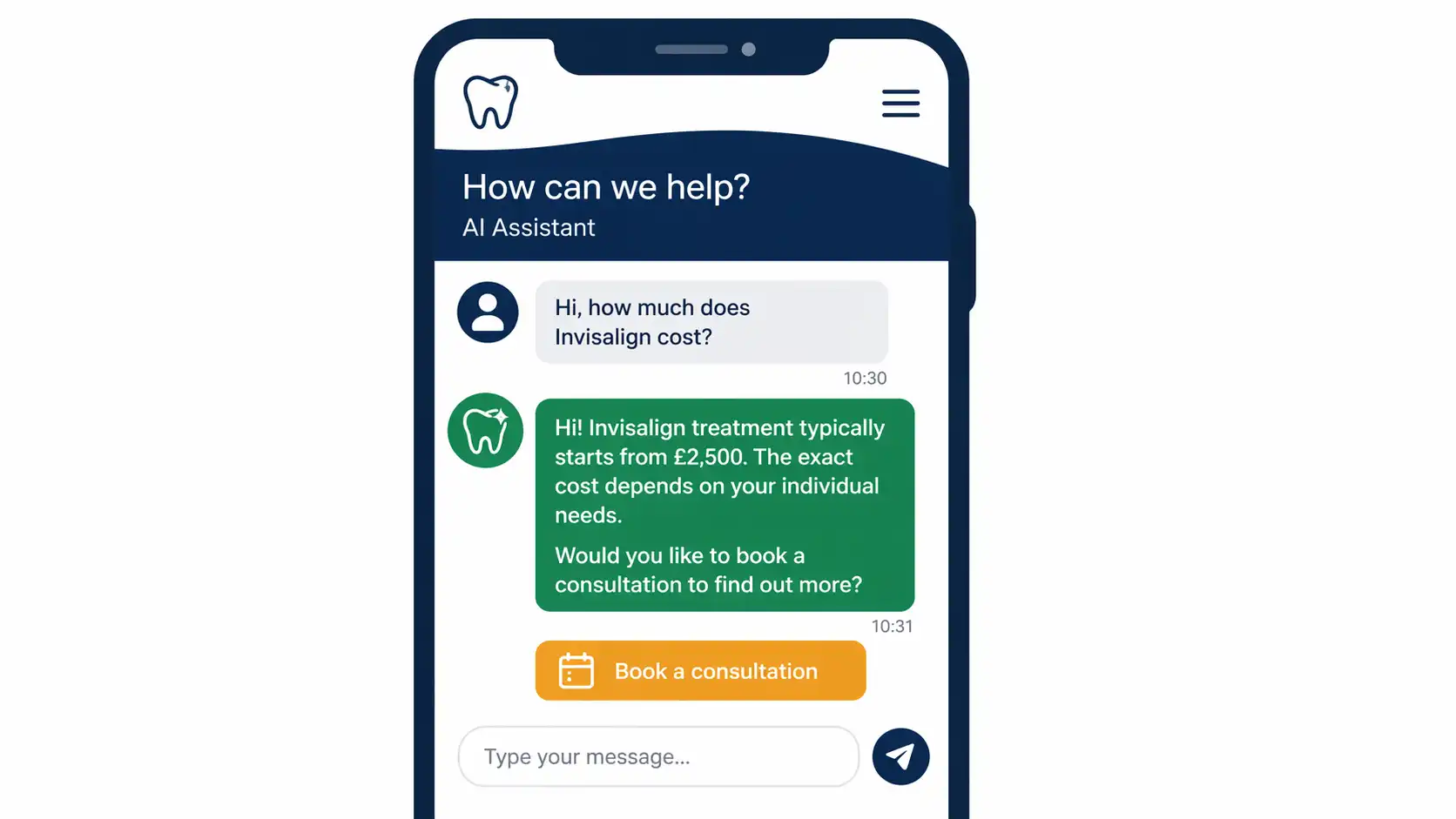
Want to see the enquiry conversion layer in action for a dental practice? Book a free 30-minute demo and we will show you a live chatbot handling a cosmetic treatment enquiry, a missed call recovery flow, and how both capture into your CRM automatically. Book your free demo →
How does treatment plan follow-up automation work for dental practices?
Treatment plan follow-up is a dental-specific AI marketing opportunity that does not exist in the same way in other healthcare sectors. It is also one of the highest-value applications of CRM automation for a private practice.
The scenario is familiar to every dentist: a patient comes in for a cosmetic consultation. You present a treatment plan for implants, Invisalign, composite bonding or veneers. They say they will think about it and call you back. Three weeks later, nobody has followed up and the patient has either gone elsewhere or simply never got round to booking.
Automated treatment plan follow-up sequences change this completely. When a consultation is logged in the CRM without a confirmed booking, the automation triggers:
A personalised message at 3 days — helpful, not pushy, summarising the treatment discussed and answering common questions
A follow-up at 7 days — offering to answer any questions or concerns before they decide
A final message at 14 days — including a direct booking link and, where relevant, a mention of any current finance or payment plan options
The tone throughout is informative and patient — not a hard sell. For high-value treatments like implants (£3,000–£5,000) and Invisalign (£3,500–£6,000), recovering even one or two unconverted consultations per month represents a significant revenue gain against the cost of the automation.
This feature is configured as part of the AI CRM automation layer and runs without any manual effort from your team.
How does recall automation work as a dental marketing tool?
Dental recall is one of the most consistent and predictable AI marketing opportunities available to a practice — and one of the least well executed in most practices we speak to.
Every patient on your database has a recall cycle. Six-month check-up. Annual hygiene. Post-treatment review. In most practices, the recall process is either a letter that gets ignored, a phone call that the receptionist does not always get round to making, or a third-party recall service that charges per message and delivers inconsistent results.
Automated recall campaigns change the economics entirely. Every patient on your active list is on a recall sequence. When they reach the recall date, a personalised message goes out automatically — text, email, or both — with a direct booking link. No manual effort. No missed recalls because the receptionist was busy.
For a practice with 800 active patients on a 6-month cycle, even a 15% recall response rate from automated messages is 120 appointments booked without a single manual call. At £55 per check-up that is £6,600 per recall cycle — from a system that runs automatically in the background.
How does AI improve local SEO and Google rankings for dental practices?
Local SEO for a dental practice is primarily about ranking in Google's map pack for searches like "dentist near me", "private dentist [town]" and high-value treatment searches like "dental implants Chester" or "Invisalign Warrington".
The AI marketing layer improves local SEO in two specific ways.
Review generation at scale Google reviews are the dominant local ranking signal for dental searches. A practice with 300 reviews at 4.9 stars outranks a practice with 40 reviews at 5.0 stars on almost every local search. The problem is that asking patients for reviews manually is inconsistent — it relies on someone remembering to ask, and most practices do not ask every time.
Automated review request sequences send a personalised message to every patient after a completed appointment. For cosmetic and implant patients — where satisfaction is high and the result is visible — this timing is particularly effective. Most practices see their monthly review volume double or triple within 3 months of activation.
AI search visibility An increasing share of dental searches now start with AI tools — Google AI Overviews, ChatGPT, Perplexity. Practices whose websites have proper FAQ content, schema markup, and direct-answer copy get cited in those AI results. Practices without it are invisible to that traffic. This is covered as part of the SEO service on our dental practice automation page.
Interested in a free local SEO snapshot for your practice? We include a local search visibility review in the demo — no commitment required. Book your free demo →
What does AI marketing cost for a dental practice?
The honest framing: most dental practices that calculate their missed call losses, unconverted treatment plan value, and overdue recall backlog discover they are already losing more per month than the entire cost of AI marketing automation. The system typically pays for itself in the first 4–8 weeks, primarily through recovered cosmetic and implant enquiries.
Key points on cost:
All services are 30-day rolling — no long contracts, no minimum terms
Setup fees are one-off — the monthly fee covers hosting, maintenance and support
Business in a Box (full stack including everything) starts at £850/month — for a practice with active cosmetic work, this is recovered from a single implant enquiry
Is AI marketing for dental practices GDC and GDPR compliant?
The compliance position for AI in dental marketing is clear when you separate admin and marketing functions from clinical functions.
GDC compliance The General Dental Council does not prohibit AI use in practice administration or marketing. MDDUS guidance (2025) confirms that AI must align with GDC Standards, patients must be informed where AI is used in their care pathway, and patient consent must be obtained for AI-assisted call recordings or transcriptions (MDDUS, 2025). In September 2024, the GDC commissioned a Rapid Evidence Assessment on AI in dental service provision — confirming active engagement with AI as part of modern practice (GDC, 2024).
AI marketing automation — chatbots, missed call text back, recall campaigns, review requests, treatment plan follow-up — sits entirely within the admin and marketing layer. It does not make clinical decisions, access treatment records for clinical purposes, or provide clinical advice to patients.
GDPR compliance All patient communications are handled under UK GDPR. We use the OpenAI API and Anthropic API directly — patient data is never used to train AI models. Marketing communications use the correct lawful basis — legitimate interests for existing patients, explicit consent for new contacts. Every automated message includes a compliant opt-out. DPAs are in place with all data processors.

Ready to see AI marketing working for your dental practice?
The practices making the most of AI marketing are not the biggest or most tech-forward. They are the ones that stopped losing implant and cosmetic enquiries to practices that answer faster, and put a system in place to follow up every treatment plan and recall every overdue patient automatically.
Setup takes 4–6 weeks. ROI shows in the first month. 30-day rolling contract — no risk.
Book your free demo → | Call 07366 926333 | Contact us
Dental AI marketing — frequently asked questions
1. What is AI marketing for dental practices? AI marketing for dental practices uses automation to capture patient enquiries instantly, convert them into bookings, follow up unconverted treatment plans, run recall campaigns, generate Google reviews, and reactivate lapsed patients. It covers the conversion and retention side of running a private or mixed practice — not clinical work. The most common starting points are missed call text back and AI chatbot for out-of-hours enquiry capture.
2. How much does AI marketing cost for a dental practice? Missed call text back starts at £97/month plus £97 setup. AI chatbot or voice agent starts at £197/month plus £197 setup. CRM automation — recall campaigns, treatment plan follow-up, review requests — is based on requirements. Business in a Box (full stack) starts at £850/month. All services are 30-day rolling. Most practices recover the cost within the first month through recovered cosmetic or implant enquiries.
3. What is treatment plan follow-up automation and why does it matter for dental practices? Treatment plan follow-up automation sends a personalised sequence to patients who received a treatment plan but did not confirm — at 3 days, 7 days and 14 days post-consultation. For high-value treatments like implants (£3,000–£5,000) and Invisalign (£3,500–£6,000), recovering one or two unconverted consultations per month represents significant additional revenue from a system that runs automatically.
4. How does dental recall automation work? Every patient on your active list reaches a recall date — typically 6 months for check-ups, 12 months for hygiene, or per your practice's treatment protocols. When that date arrives, an automated personalised message goes out via text and/or email with a direct booking link. No manual effort from your team. For a practice with 800 active patients, even a 15% response rate generates over 100 automatic bookings per recall cycle.
5. Is AI marketing compliant with GDC standards? Yes. MDDUS guidance confirms AI use must align with GDC Standards — patients must be informed where AI is used, consent must be obtained for call recordings, and AI must not make clinical decisions. AI marketing automation covers admin and marketing functions only: enquiry capture, booking, follow-up, recall, review requests. It does not diagnose, advise on treatment, or access clinical records for clinical purposes.
6. Will AI marketing work with my dental PMS (Dentally, Exact, SOE, R4)? Integration with Dentally, Exact/Software of Excellence, Carestream, R4 and other dental PMS systems is possible via webhooks and middleware. For practices using GHL CRM natively, the integration is seamless. For third-party PMS, integration scope is confirmed in the discovery call based on your specific system and its API. We do not commit to integration before verifying what is technically possible.
7. How does AI help dental practices get more Google reviews? Automated review request sequences send a personalised message to every patient after a completed appointment — typically 2–4 hours post-visit. For cosmetic and implant patients, this timing is particularly effective. Consistent automated review requests typically double or triple monthly review volume within 3 months, improving local search rankings for dentist near me and treatment-specific searches.
8. Can AI marketing handle NHS and private patient communications separately? Yes. The system is configured to treat NHS and private patients differently — different messaging, different booking flows, different follow-up sequences. For mixed practices, this means NHS patients receive appropriate NHS-related communications while private and cosmetic patients receive treatment-specific content. You define exactly how each patient type is handled during the design phase.
9. How long does AI marketing take to set up for a dental practice? Missed call text back goes live in 3–5 working days. AI chatbot and voice agent takes 2–3 weeks. CRM automation — recall campaigns, treatment plan follow-up, review requests — adds a further 2–4 weeks. A full Business in a Box setup is typically live within 4–6 weeks end to end.
10. What makes AI marketing different from traditional dental marketing? Traditional dental marketing focuses on generating visibility — SEO, Google Ads, social media. AI marketing focuses on converting that visibility into booked patients and keeping existing patients engaged. Most dental practices already have enough inbound interest to fill their diaries — the gap is in what happens to that interest once it arrives. AI marketing closes the gap between enquiry and booking, between consultation and confirmed treatment plan, and between discharge and return visit.

