AI Receptionist for Dental Practices: How It Works and What It Costs
If you run a private or mixed dental practice in the UK, you already know the moment. You are mid-treatment, both hands in a patient's mouth, and you hear the phone ringing at reception. Your receptionist is with another patient. Your nurse cannot leave the chair. The phone rings out.
That caller was probably enquiring about implants or Invisalign. They rang three practices. Yours did not answer. The other two did.
That is not a staffing problem. It is a systems problem — and it is one that an AI receptionist solves completely.
This post covers exactly how an AI receptionist works for a dental practice, what it handles, how it integrates with your existing setup, what it costs, and where the compliance boundaries sit. No fluff, no overclaiming — just a straight account of what the technology does and whether it is right for your practice.
For a broader look at the full AI marketing picture for dental practices, see our AI marketing for dental practices post.
What does an AI receptionist for a dental practice actually do?
An AI receptionist for a dental practice answers your phone 24 hours a day, seven days a week, handles patient enquiries, books appointments, confirms existing bookings, answers frequently asked questions, and routes complex or sensitive enquiries to a human team member (within working hours or sets up a Call Back)
It is not a voicemail system. It is not a hold queue. It is a conversational AI that sounds natural, responds intelligently to what the caller says, and handles the most common reasons patients call a dental practice — without any human involvement required.
For a dental practice specifically, this means handling:
New patient registration enquiries
Appointment booking for check-ups, hygiene, and specific treatments
Cosmetic treatment enquiries — implants, Invisalign, veneers, composite bonding, whitening
Questions about NHS versus private treatment availability
Pricing and payment plan questions
First appointment expectations — what to bring, how long it takes, what happens
Anxious patient calls — recognising nervousness and responding with patience and reassurance
Urgent dental enquiries — triaging and routing appropriately
Out-of-hours calls — capturing details and flagging for first-thing callback
The AI voice agent handles all of this consistently, every time, at any hour. No bad days, no lunch breaks, no calls going unanswered because two lines are busy at once.
Why do dental practices lose so many patients to unanswered calls?
The structural reason dental practices miss calls is not negligence — it is physics. A dentist cannot answer the phone mid-treatment. A nurse cannot leave the chair. A single receptionist cannot simultaneously check in a patient, answer the phone, and respond to an online enquiry.
The cost of this is significant. The UK private dentistry market is now worth £8.4 billion, with private dentistry accounting for 69% of the total market — the highest proportion ever recorded according to LaingBuisson's 2023/24 market analysis. In 2024, 1 in 5 people in Great Britain used private dental care, with demand continuing to rise as NHS access contracts (CMA, GOV.UK, 2024).
For a practice handling high-value treatment enquiries, the math's are stark. An implant case at £3,000–£5,000 missed once a week is £150,000–£260,000 a year in un-booked work. An Invisalign case at £3,500–£6,000 missed twice a week is even more. These are not hypothetical losses — they are enquiries that went to a competitor who answered instantly, answered all queries, concerns & moved the prospect/patient to the next phase (be that booking, a call back, allaying price objections etc.)
An AI voice agent eliminates this gap entirely. Every call is answered. Every enquiry is captured. The caller gets a helpful, natural conversation and a clear path to booking — whether it is 11am on a Tuesday or 8pm on a Sunday.
Did you know?
That an AI voice agent can answer multiple calls at once. You may have one number but as telephone numbers are all essentially IP addresses, you could have 8 people calling at once and AI still answers them at once!
How does an AI receptionist handle dental-specific enquiries?
This is where generic AI receptionist tools fall short for dental practices — and where a properly configured dental AI receptionist is different. At AI Bridge Club, we ensure that there is a complex knowledgebase for the agents/conversational bots to work from. This is an exhaustive list that covers everything from the basics like opening hours, booking through to patient safe guarding "red lines" and other complex conversations that may arise.
Note* anyone who tells you an AI Chatbot can be set up in minutes isn't giving you the complete picture, it's a bit like you saying to a patient "I'm a dentist but haven't had any training"
In practice scenarios, for an AI Receptionist or Voice Agent would be:
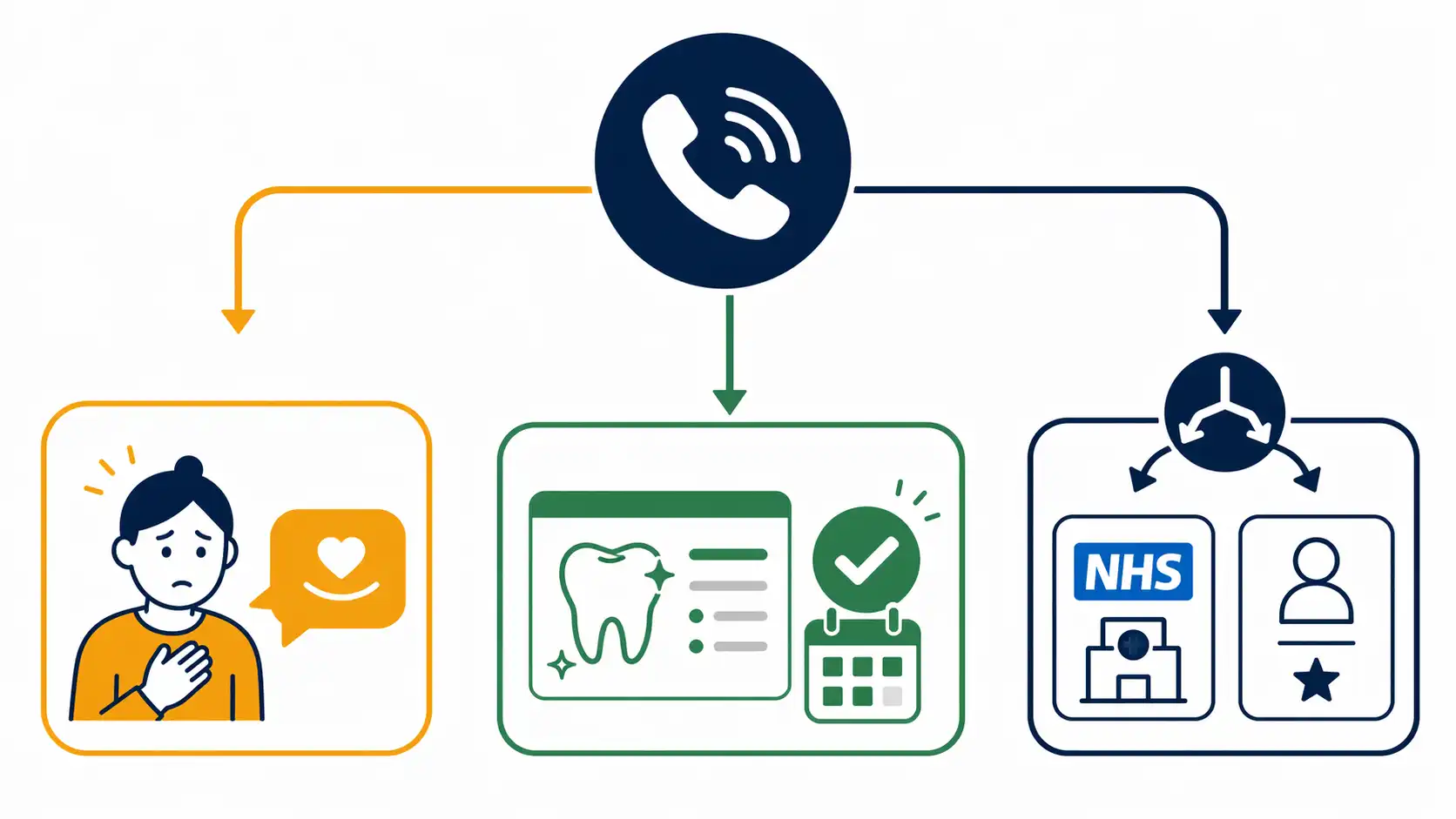
A dental practice receives enquiries that require specific handling. An anxious patient calling about their first implant consultation needs a different response to a patient calling to rebook a hygiene appointment. An NHS patient asking whether the practice has NHS availability needs routing differently to a private patient enquiring about cosmetic work.
Anxious patient handling
More than half of UK adults — 52% — report some fear of the dentist, according to a survey of 2,000 UK adults by Space Dental (Dentistry.co.uk, October 2024). The 2021 Adult Oral Health Survey from the UK government found 12% of adults have extreme dental anxiety. These patients call cautiously. They speak slowly. They may be embarrassed. They need patience, not efficiency.
An AI receptionist for a dental practice is configured to recognise anxiety cues in speech — hesitation, slow pacing, explicit statements of nervousness — and shift to a gentler, more reassuring tone. It never rushes a nervous caller. It always offers to transfer to a human team member if the patient prefers. It provides specific reassurance about what a first appointment involves without overwhelming the caller with clinical detail.
Cosmetic treatment enquiries
For implants, Invisalign, veneers, composite bonding and whitening, the AI is configured with treatment-specific information: typical treatment duration, what a consultation involves, indicative pricing, finance options where relevant, and what to expect at the first appointment. It books consultations directly into the correct diary slot — a cosmetic consultation is not the same as a routine check-up, and the AI knows that.
NHS versus private triage
For mixed practices, the AI is configured to ask the right question early: is the patient looking for NHS or private treatment? NHS patients are routed through the appropriate pathway. Private patients receive different information about availability, pricing and booking. This routing happens automatically, every time, without your receptionist having to manage it manually.
How does an AI receptionist integrate with dental practice management software?
This is the practical question most practice owners ask first — and it deserves a straight answer.
GoHighLevel CRM (native) The AI receptionist runs natively within GoHighLevel (GHL). Every call, every captured enquiry, every booking action is logged directly in the GHL CRM. Patient details, enquiry type, call summary, and follow-up tasks all land in one place automatically. This is the fully seamless setup.
Third-party dental PMS (Dentally, Exact/SOE, Carestream, R4) Integration with your existing dental practice management system is possible via webhooks and middleware (n8n or Make). This allows the AI to check availability, book appointments, and log enquiry data against patient records in your PMS. The depth of integration depends on what your specific PMS exposes via its API — we confirm exactly what is possible for your system in the discovery call.
To be clear about what this means in practice: most UK dental PMS systems have APIs that support appointment availability and booking. Dentally has a well-documented API. Exact/SOE (Software of Excellence) supports integrations via middleware. For practices on less common systems, we confirm the integration scope before committing to build.
What the AI receptionist does not do: it does not write to clinical records, access treatment history for clinical purposes, or make clinical decisions based on patient health data. It handles the front-of-practice layer — booking, enquiries, routing — not the clinical layer.
Thinking about how an AI receptionist would work in your practice? Book a free 30-minute demo and we will show you a live call handled by an AI dental receptionist — including anxious patient handling, cosmetic enquiry triage, and how it hands off to your team. Book your free demo →
Is an AI receptionist for dental practices GDC and GDPR compliant?
Compliance is the right question to ask before implementing any AI in a healthcare setting. Here is the factual position.
GDC compliance The General Dental Council does not prohibit AI use in dental practice management. In September 2024, the GDC commissioned a Rapid Evidence Assessment to understand how AI is being used in dental service provision — demonstrating active engagement with AI as part of modern dental practice (GDC, 2024).
MDDUS guidance on AI in dentistry (2025) confirms that AI use must align with GDC Standards for patient care and professional conduct. Specifically: patient consent must be obtained for AI-assisted call recordings or transcriptions, patients should be informed where AI is used in their care pathway, and AI must not be used to make clinical decisions (MDDUS, 2025).
An AI receptionist sits entirely on the administrative side of this boundary. It books appointments, answers questions, captures enquiries. It does not diagnose, advise on treatment, or influence clinical decisions. This places it clearly within acceptable use under GDC Standards.
GDPR compliance All patient data is handled under UK GDPR. We use the OpenAI API and Anthropic API directly — not consumer ChatGPT — which means patient call data is never used to train AI models. Data processing agreements are in place with all providers. Call recordings (where used for transcription) are processed and deleted per agreed retention policy. Patient communications use the correct lawful basis under UK GDPR.
CQC registration Dental practices in England are registered with the Care Quality Commission. AI used in administrative functions does not trigger CQC registration requirements for the AI tool itself, but practices should ensure their information governance policies reflect how AI is used in patient-facing communications. We provide a written data flow document to every practice we work with.
What does an AI receptionist cost for a dental practice — and what is the ROI?
The direct cost is straightforward. An AI voice agent for a dental practice starts at £197/month plus a one-off £197 setup fee. A chatbot for your website is the same. Missed call text back — which works alongside the voice agent to catch any calls the AI does not pick up in time — starts at £97/month plus £97 setup.
The ROI calculation is where it gets interesting for dental practices specifically.
For a practice handling a mix of routine and cosmetic work, the economics are compelling. A single recovered implant consultation per month more than covers the annual cost of the voice agent. A practice recovering two or three cosmetic consultations per week — enquiries that previously went unanswered — is generating tens of thousands in additional bookings from a system that costs less than £200 a month to run.
The 30-day rolling contract means there is no long-term commitment. If the system is not recovering more than it costs within the first month — which has not happened for any practice we have worked with — you can cancel. The risk of trying it is minimal. The risk of not trying it is the ongoing enquiry leak.
Want to see the ROI calculation for your specific practice? We will run the numbers with you on the demo call — based on your treatment mix, session volume, and current call handling setup. Book your free demo →
How long does it take to set up an AI receptionist for a dental practice?
Setup is faster than most practice owners expect.
Missed call text back — live in 3–5 working days
AI chatbot (website) — live in 2–3 weeks from discovery call
AI voice agent (phone) — live in 2–3 weeks from discovery call
Full setup including CRM automation — typically 4–6 weeks end to end
The timeline is driven by the configuration and testing phase, not by technical complexity. We build and test every workflow in a sandbox environment before it handles a real patient call. The go-live process is phased — out-of-hours first, so your team can see it working before it takes over full-day call handling.
For dental practices in Cheshire and the North West — Crewe, Chester, Warrington, Macclesfield, Wilmslow — we can meet in person during the setup and training phase. For practices elsewhere in the UK, the entire process runs remotely with the same level of support.
What should a dental practice look for in an AI receptionist provider?
Not all AI receptionist solutions are equal. Before you commit to any provider, these are the questions worth asking:
Does it understand dental-specific workflows? A generic AI receptionist configured for retail or hospitality will not handle anxious patient calls, cosmetic treatment enquiries, or NHS versus private triage correctly. Ask to see a live demo of a dental-specific call.
How does it handle nervous patients? With 52% of UK adults reporting dental fear, this is not an edge case. It is the majority of your new patient callers. Ask specifically how the system handles slow, hesitant callers and what the human escalation path looks like.
What is the integration story with your PMS? Ask specifically which dental PMS systems are supported, how the integration works technically, and what happens if your system is not on their list. Be wary of vague claims about "integration" that turn out to mean CSV export.
What are the data handling arrangements? Ask for a data processing agreement, ask which AI models are used and whether patient data is used for training, and ask about call recording retention policy. A provider that cannot answer these questions clearly is not ready for a healthcare setting.
What is the contract? Long contracts in a fast-moving technology space are a red flag. 30-day rolling should be the standard.

Ready to see an AI receptionist working in a dental practice?
Book a free 30-minute demo. We will show you a live AI receptionist handling a dental practice call — including an anxious patient scenario, a cosmetic treatment enquiry, and an NHS versus private triage. You will see exactly how it sounds, how it handles edge cases, and how it hands off to your team.
No obligation, no contract to sign on the call, no pressure. If it makes sense for your practice we will quote you specifically. If it does not, we will say so.
Our AI automation for dental practices page covers the full service stack with pricing. Our AI marketing for dental practices post covers the broader enquiry-to-booking-to-review picture.
Book your free demo → | Call 07366 926333 | Contact us
AI receptionist for dental practices — frequently asked questions
1. What is an AI receptionist for a dental practice? An AI receptionist for a dental practice is a voice or chat system that answers patient calls and enquiries 24/7, books appointments, handles treatment-specific questions, triages NHS versus private enquiries, and routes complex calls to human team members. It runs on the GoHighLevel platform and integrates with dental practice management systems including Dentally, Exact (Software of Excellence), Carestream and R4 via webhooks and middleware.
2. Can an AI receptionist book dental appointments directly? Yes. The AI voice agent and chatbot can book appointments directly into your diary with availability logic you control. For practices using Dentally, Exact/SOE, Carestream or R4, appointment booking integration is possible via webhooks and middleware — the exact scope is confirmed in the discovery call based on your specific PMS and its API capabilities.
3. How does an AI receptionist handle anxious dental patients? The system is configured specifically for dental anxiety — recognising hesitation, slow speech and explicit nervousness, and responding with patience and reassurance. It never rushes a nervous caller, always offers a human fallback, and provides gentle, specific information about what a first appointment involves. Given that over half of UK adults report some fear of the dentist, anxious patient handling is a configuration priority for every dental practice we work with.
4. Is an AI receptionist for dental practices GDC compliant? Yes, for administrative functions. MDDUS guidance confirms AI use in dental practice must align with GDC Standards — patient consent must be obtained for call recordings, patients should be informed where AI is used, and AI must not make clinical decisions. An AI receptionist operates entirely on the administrative side: booking, enquiries, routing. It does not diagnose, advise on treatment, or access clinical records for clinical purposes.
5. Will an AI receptionist work alongside my existing dental PMS? Integration with Dentally, Exact/SOE, Carestream, R4 and other dental PMS systems is possible via webhooks and middleware (n8n or Make). The depth of integration depends on your specific PMS and its API. For practices using GHL as their CRM the integration is fully native. We confirm exactly what is possible for your system in the discovery call before we commit to any build.
6. What happens when the AI cannot answer a patient's question? It says so honestly and offers to transfer to a human or take a message for callback. The AI is explicitly configured never to guess or fabricate an answer. If the question is outside its knowledge base, the patient is told a team member will come back to them, their details are captured in the CRM, and an alert is sent to your team. No patient is lost because of an unanswered question.
7. How does the AI handle NHS versus private enquiries? The AI is configured to identify early in the conversation whether the patient is enquiring about NHS or private treatment and route accordingly. For mixed practices, NHS patients are directed through the appropriate pathway while private and cosmetic patients receive different information about availability, pricing and booking. You define exactly how each enquiry type is handled during the design phase.
8. Can an AI receptionist handle cosmetic dental enquiries specifically? Yes — and cosmetic is one of the strongest use cases. The AI is configured with treatment-specific information for implants, Invisalign, veneers, composite bonding and whitening: typical treatment duration, consultation process, indicative pricing, and finance options. Cosmetic enquiries require fast response and detailed information — both of which the AI provides consistently at any hour.
9. How much does an AI receptionist for a dental practice cost? An AI voice agent starts at £197/month plus £197 setup. An AI chatbot for the website is the same. Missed call text back — which works alongside the voice agent — starts at £97/month plus £97 setup. All services are 30-day rolling with no long contracts. For a practice with active implant or cosmetic work, the system typically pays for itself within the first week of recovered enquiries.
10. How quickly can an AI receptionist go live for a dental practice? Missed call text back can go live in 3–5 working days. A full AI voice agent setup takes 2–3 weeks from the discovery call, including configuration, testing and training. The go-live process is phased — out-of-hours first — so your team sees it working before it handles full-day calls.

