
AI Marketing for Physiotherapists: What Actually Works for Private Clinics
Most physio clinic owners assume their marketing problem is visibility. Not enough people are finding them on Google. They need more Facebook posts. They should try Google Ads. So they spend money on those things — and still don't fill their diary.
Here's the issue we see: for most private physiotherapy clinics in the UK, the visibility isn't the problem. Enquiries are already coming in. The problem is what happens to those enquiries after they arrive.
Calls going unanswered during treatment sessions. Website visitors leaving without booking because there's nobody to chat to at 9pm. Patients who enquired last month and never got a follow-up. Happy patients who would've left a Google review if someone had simply asked (and reminded them again when they didn't - until they do!).
That's where AI marketing for physiotherapists makes its biggest difference — not in generating more traffic, but in converting the traffic you already have. This post breaks down what actually works, what it costs, and how to do it without falling foul of HCPC standards or GDPR.
If you want a deep dive on the receptionist side specifically, our post on AI receptionists for physiotherapists covers the booking and call-handling layer in detail.
What does AI marketing actually mean for a physiotherapy clinic?
AI marketing for physiotherapy clinics means using a combination of both automation and artificial intelligence to capture enquiries, follow up with prospects, book appointments, reduce no-shows, generate reviews, and reactivate lapsed patients — without adding headcount or manual admin. (sounds like a lot, it is, but AI automation is up to the job)
It is not about replacing your Google Business Profile or stopping paid ads. It is the layer that runs underneath your existing marketing: the system that catches every enquiry your current setup is dropping.
Note* If you are spending any money on ads or marketing campaigns without extensive follow up and a managed system, it's money wasted - Simple as that!
For most private physio clinics, AI marketing covers four practical areas:
Enquiry capture — answering calls, chats, and messages 24/7 so no lead goes cold
Booking conversion — turning enquiries into booked appointments without manual back-and-forth
Retention automation — reminders, follow-ups, review requests, and discharge communications
Reactivation — bringing lapsed patients back into the diary through timed outreach campaigns
You can explore the full services we provide on our AI automation for physiotherapy clinics page, which covers each of these in detail with pricing.
The reason AI marketing is particularly well-suited to physiotherapy is the structure of private practice. You are typically hands-on with patients for 45–60 minutes at a time, which means there are regular windows during the day when nobody is available to handle the phone, the inbox, or the website chat. AI fills those windows without a human needing to be present.
Why most physio marketing fails before a patient even books
The single biggest marketing failure in private physiotherapy is not generating enough awareness — it is losing warm enquiries before they convert.
Here is what that looks like in practice. A patient searches "physio for lower back pain in Nantwich" at 8pm on a Tuesday. They find your clinic on Google. Your website looks professional. They want to book but they have a question about whether you treat their specific condition. There is no chat widget and live help is out of hours. The phone number is there but it is 8pm. So they move on to the next result — a clinic with an AI chatbot on the site that answers their question and offers to book them in right now.
You never knew that visitor existed.
Physiotherapy has the highest DNA rate of any outpatient specialty in the UK at 11%, according to NHS England. Private clinics see the same pattern. On a standard private physio fee structure — £55 initial assessment, six follow-up sessions at £45 — a single patient lifetime value is around £325. One missed call a day losing one patient a week is over £16,000 a year in lost revenue. Most clinic owners have no idea those losses are happening because the patient never complained. They just booked somewhere else.
Use our missed call cost calculator to run your own numbers — the figure most clinics see surprises them.
The second failure is slow follow-up or no follow up. A patient enquires on a Monday, does not hear back until Wednesday, and has already booked elsewhere. Speed of response in healthcare is a trust signal. If the first contact from a clinic comes two days after an enquiry, the patient reasonably wonders how responsive you will be about their appointment or treatment.
How AI handles the enquiry gap that costs clinics thousands
The enquiry gap is the period between a potential patient making first contact and getting a response. Every hour that gap stays open, the chance of converting that patient drops.
AI closes that gap to seconds.
An AI chatbot on your clinic website answers questions, qualifies the enquiry, and offers to book an appointment — immediately, at any time of day or night. It does not need a lunch break. It does not get busy with another patient. It does not go home at 5pm.
Specifically for a physiotherapy clinic, a well-configured AI chatbot handles:
Questions about which conditions you treat (back pain, sports injuries, women's health, post-surgical rehab, etc.)
Whether you accept self-pay or specific PMI providers like BUPA, AXA, or Vitality
First appointment expectations (what to wear, how long, what to bring)
Pricing and availability queries
Booking directly into your clinic diary
Out-of-hours lead capture when booking is not available
Safe guarding procedures, fail safe's & red lines are built in
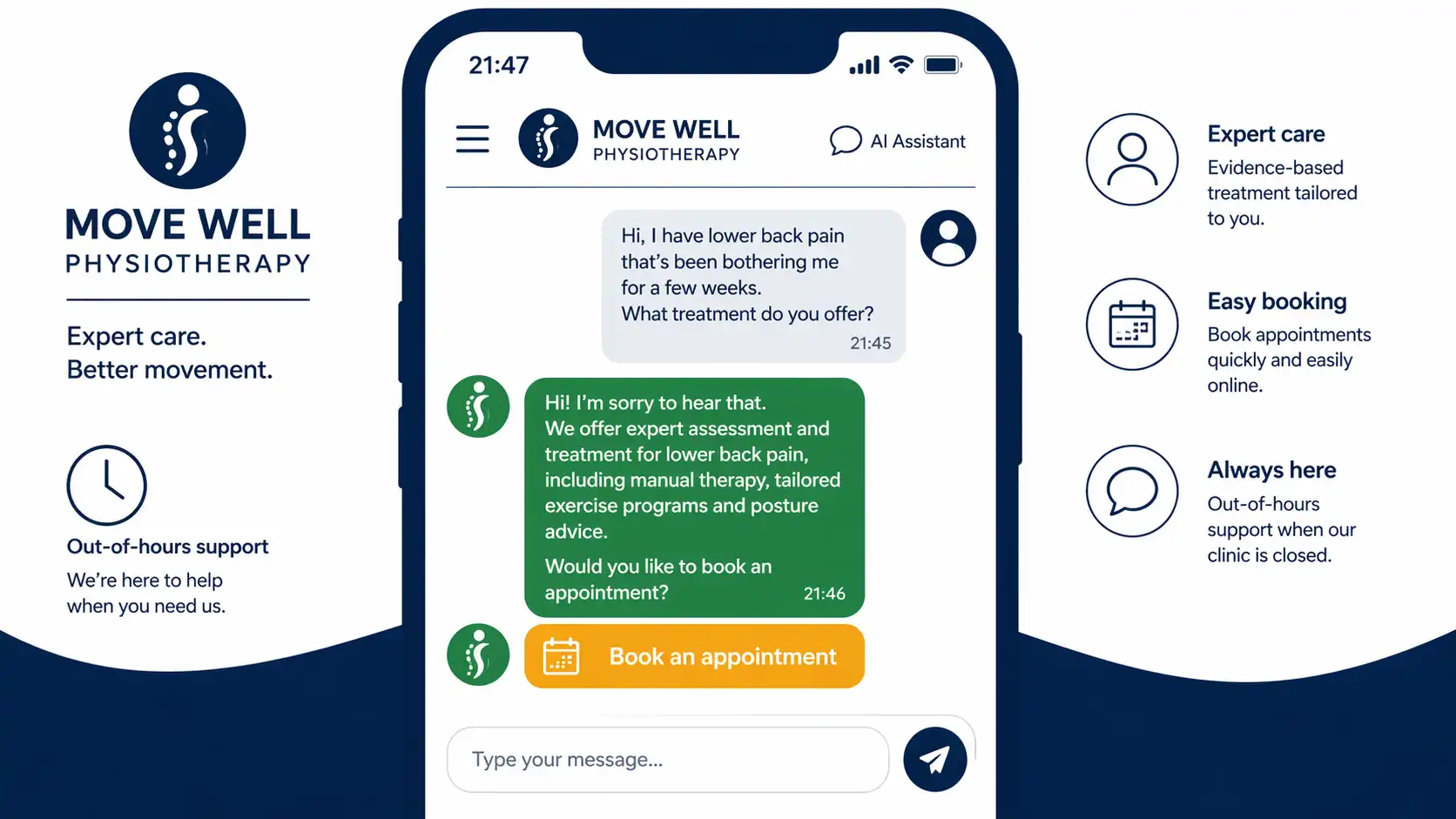
The same logic applies to missed calls. An AI missed call text back system fires a personalised SMS to anyone who rings your clinic and cannot get through — within seconds of the missed call. It offers to answer their question, book them in, or arrange a callback. It recovers the enquiry before they have had a chance to ring the next physio on Google.
For clinics in the North West — Cheshire, Greater Manchester, Warrington — where the private physio market is competitive and patients have several options within a few miles, response speed is genuinely a differentiator. The clinic that replies in 10 seconds beats the clinic that replies in 2 hours, every time.
Ready to see how AI handles enquiries for your physio clinic? Book a free 30-minute demo and we'll show you a live AI chatbot and missed call flow built specifically for a physiotherapy clinic. No obligation, no sales pressure — just a working demo of what this looks like in practice. Book your free demo →
Can AI replace a receptionist for a UK physiotherapy clinic?
Not replace — but it can cover everything a receptionist covers, for a fraction of the cost, across all hours.
A full-time receptionist costs £22,000–£30,000 a year. Part-time cover is £12,000–£18,000. For most single or two-physio clinics, that is not economic — so the physio ends up handling bookings, messages, and enquiries themselves between sessions. That is billable clinical time being spent on admin.
An AI voice agent answers your clinic phone 24/7. It handles new patient enquiries, books appointments, confirms existing bookings, answers FAQs, and triages self-pay versus PMI callers — routing BUPA and AXA patients appropriately based on your clinic's specific insurance arrangements.
Our full post on AI receptionists for physiotherapists covers how the voice agent handles the specific nuances of a physio clinic — including how it manages patients in pain, how it hands off to a human when needed, and how it integrates with practice management systems like Cliniko, TM3, PPS, and WriteUpp.
The short version: an AI voice agent for a physiotherapy clinic starts at £197/month including setup. Against a receptionist salary, the annual saving is £20,000+. The AI works every day of the year, never calls in sick, and never puts a patient on hold while it takes another call.
One point worth addressing directly: some physio clinic owners worry their patients — particularly older patients or those in significant pain — will not respond well to an AI voice. In practice, the response is usually the opposite. A well-configured AI voice agent is patient, unhurried, and consistent. It does not rush a caller who is struggling to describe their symptoms. It always offers to transfer to a human if that is what the caller wants or sets up a call back. The caller often does not know they are talking to an AI — and even when they do, the experience of being answered quickly and helpfully tends to matter more than who is doing the answering.
How does AI improve local SEO for physiotherapy clinics?
Local SEO for a physiotherapy clinic is primarily about ranking in Google's local map pack for searches like "physio near me", "physiotherapist [town]", and condition-specific searches like "sports physio Warrington" or "women's health physio Chester".
AI improves local SEO in several interconnected ways:
Review generation at scale Google reviews are the single biggest local ranking signal for healthcare searches. Clinics with more reviews and higher ratings outrank clinics with better treatment outcomes but fewer reviews. The problem is that asking patients for reviews manually is inconsistent — it relies on the physio remembering to ask, and most do not ask every time.
AI CRM automation sends a personalised review request to every patient at the right moment — typically 24–48 hours after treatment completion, when their experience is fresh and they are most likely to respond positively. This alone can double or triple a clinic's review velocity within 3 months.
Google Business Profile optimisation Your Google Business Profile is often the first thing a potential patient sees. AI-assisted content tools help keep your profile populated with fresh posts, updated service descriptions, condition-specific Q&As, and photo updates — all of which Google rewards with better local visibility.
AI search and answer engine optimisation An increasing share of local health searches now start with AI tools — Google AI Overviews, ChatGPT, Perplexity. Clinics whose websites are structured with proper schema markup, FAQ content, and direct-answer copy get cited in those AI results. Clinics without it are invisible to that traffic.
For physio clinics across Cheshire and the wider North West, local SEO is increasingly the highest-return marketing channel — because the intent behind those searches is immediate and commercial. Someone searching "back pain physio Crewe" is ready to book, not just browsing.
Want to understand where your physio clinic currently sits in local search? We offer a free local SEO snapshot as part of our demo — no strings attached. Book a free demo →
What does AI marketing cost for a private physio clinic?
AI marketing costs for a private physio clinic vary depending on which services are activated, but the entry point is lower than most clinic owners expect — and the ROI case is straightforward.
The honest framing on cost is this: most physio clinics that calculate their missed call losses, no-show revenue drain, and review gap discover they are already losing more per month than the entire cost of AI automation. The service tends to pay for itself in the first 4–8 weeks, typically through recovered missed-call bookings alone.
A few things worth knowing before you get a quote:
All AI Bridge Club services are 30-day rolling — no long contracts
Setup fees are one-off — the ongoing monthly covers hosting, maintenance, and support
Business in a Box (full stack) includes everything: voice agent, chatbot, missed call text back, CRM automation, social media, and SEO — starting at £850/month
For clinics in Cheshire and the North West, we can meet in person to walk through the setup
How do physio clinics use AI to keep patients coming back?
Patient retention is where AI marketing has its second-biggest impact for physiotherapy clinics, after enquiry conversion.
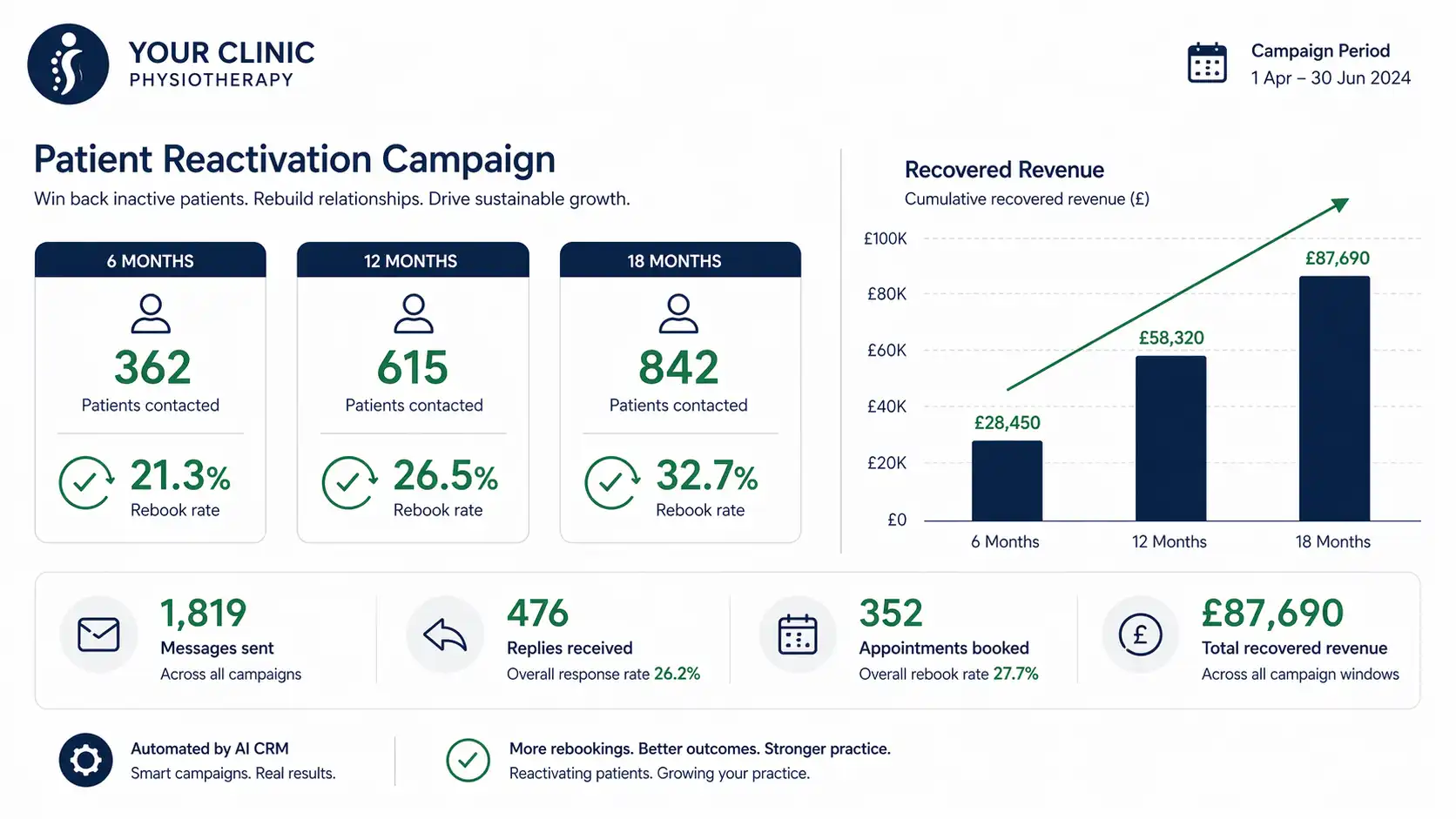
Most private physio patients complete a course of treatment and then disappear from the clinic's radar entirely — even though they would likely benefit from further treatment, maintenance sessions, or a new course when the same (or a different) problem recurs. Manual reactivation is virtually impossible at any scale: you cannot ring 200 lapsed patients individually.
AI CRM automation handles this through timed reactivation sequences:
6-month reactivation — a personalised message to patients who have not been back since their last course, checking in and making it easy to rebook
12-month reactivation — a seasonal prompt (winter is peak for musculoskeletal complaints) with a direct booking link
Post-discharge follow-up — a check-in 2–4 weeks after the final session, which also serves as a natural review request opportunity
Condition-specific prompts — for sports physios, messages timed around sports seasons or training cycles; for women's health physios, messages relevant to postpartum recovery timeframes
The maths here are straightforward. A 500-patient database with a 10% reactivation rate and a £325 average course value is £16,250 in recovered revenue from one campaign. Most clinics have never run a reactivation campaign at all.
Is AI marketing for physiotherapists GDPR and HCPC compliant?
Yes — when it is set up correctly. This is the question we hear most often from physio clinic owners, and it is the right question to ask.
The key principles to understand:
GDPR compliance All patient communications through AI Bridge Club's systems are handled under UK GDPR. We use the OpenAI API and Anthropic API directly — not consumer ChatGPT — which means patient data is not used to train any AI model. Data processing agreements (DPAs) are in place with all providers. Patient data is stored in GoHighLevel (GHL), which is GDPR-compliant with UK data residency options.
For marketing communications specifically, you need a lawful basis — typically legitimate interests for existing patients being contacted about relevant services, or consent for new marketing lists. We configure the system to use the correct basis for each communication type and include compliant opt-out mechanisms in every automated message.
HCPC and CSP standards HCPC (the statutory regulator) and CSP (the professional membership body) both publish guidance on digital tools and AI use. The key principle is that AI handles administrative and marketing functions — it does not make clinical decisions, does not document clinical findings without clinician review, and does not provide clinical advice to patients.
An AI chatbot on your website can answer questions about booking, pricing, conditions you treat, and what to expect at a first appointment. It should not attempt to diagnose or advise on treatment. We build that distinction explicitly into the system.
For AI-assisted note drafting (covered separately), the AI transcribes session audio and drafts a SOAP note saved to GHL CRM. The physio reviews, edits, and approves — then transfers the finalised note into the clinical record. For clinics on a third-party PMS, integration is subject to API access and confirmed in the discovery call.
For a clinic in Cheshire or anywhere else in the UK, we provide a written data flow document you can share with your indemnity provider if needed. We have never had a clinic tell us their indemnity provider objected once they understood how the system works.
Concerned about compliance? Let's talk it through before you commit to anything. Book a 30-minute call — we'll walk through the data flow, the consent mechanisms, and how it fits your clinic's specific setup. Book a free demo → or call 07366 926333
Ready to see AI marketing working in your physio clinic?
The clinics making the most of AI marketing are not the biggest or the most tech-savvy. They are the ones who decided to stop losing patients to missed calls, slow follow-up, and inconsistent review requests — and put a system in place to catch them.
Most of the setup takes 2–4 weeks. The ROI shows up in the first month. The contract is 30-day rolling — so if it is not working, you are not stuck.
If you run a private physiotherapy clinic in the UK — whether you are a solo practitioner in Sandbach or managing a multi-physio clinic in Manchester — the starting point is the same: a 30-minute demo where we show you the system working live, tailored to a physio clinic workflow.
Book your free demo → | Call 07366 926333 | Contact us
Physiotherapy AI marketing — frequently asked questions
1. What is AI marketing for physiotherapists? AI marketing for physiotherapists uses automation and artificial intelligence to capture patient enquiries, convert them into bookings, reduce no-shows, generate Google reviews, and reactivate lapsed patients. It covers the business side of running a private physio clinic — not clinical work. The most common starting points are AI chatbots, missed call text back, and automated appointment reminders.
2. How much does AI marketing cost for a physiotherapy clinic? Entry-level AI marketing for a physio clinic starts at £97/month for missed call text back, or £197/month for an AI chatbot or voice agent. A full AI marketing and automation stack (Business in a Box) starts at £850/month. All services are 30-day rolling with no long contracts. Setup fees are one-off. Most clinics find the system pays for itself within the first 4–8 weeks through recovered missed-call bookings alone.
3. Will AI marketing work for a small single-physio clinic? Yes — in fact, solo physiotherapy clinics typically see the strongest ROI because the admin burden falls entirely on one person. Missed calls during treatment, out-of-hours enquiries, and no-shows all hit harder when there is no support team. AI automation solves those problems without the cost of hiring a receptionist.
4. Does AI marketing for physiotherapy clinics work alongside Cliniko, TM3 or WriteUpp? Yes. AI Bridge Club integrates with all major UK physio practice management systems — Cliniko, TM3 (Blue Zinc), PPS, WriteUpp, Jane, and Nookal — via webhooks and middleware (n8n or Make). The AI receptionist and booking system can work with your existing PMS rather than replacing it.
5. Is AI marketing GDPR compliant for physiotherapy clinics? Yes, when configured correctly. We use the OpenAI API and Anthropic API directly (not consumer ChatGPT), so patient data is never used to train AI models. DPAs are in place with all data processors. Marketing communications are configured with the correct lawful basis under UK GDPR — legitimate interests for existing patient reactivation, consent for new marketing. Opt-out mechanisms are included in every automated message.
6. Will AI marketing interfere with HCPC or CSP standards? No — AI handles administrative and marketing functions only. It does not make clinical decisions, document clinical findings without physio review, or provide clinical advice to patients. For AI-assisted note drafting specifically, the physio reviews and approves every draft before it enters the clinical record. We provide written data flow documentation you can share with your indemnity provider.
7. How quickly can AI marketing be set up for a physiotherapy clinic? Missed call text back goes live in 3–5 working days. A full AI chatbot and voice agent setup typically takes 2–3 weeks from the discovery call. CRM automation — reminders, reactivation, review requests — adds a further 2–4 weeks. Most clinics are fully operational within 4–6 weeks of starting.
8. Can AI help physiotherapy clinics get more Google reviews? Yes. AI CRM automation sends a personalised review request to every patient at the right moment after treatment — typically 24–48 hours post-session. This consistent, automated approach typically doubles or triples a clinic's review velocity within 3 months, improving local search rankings for "physio near me" searches.
9. What is the difference between AI marketing and traditional digital marketing for physios? Traditional digital marketing focuses on generating visibility — SEO, Google Ads, social media content. AI marketing focuses on converting that visibility into booked patients. Most physio clinics have enough inbound interest; the gap is in what happens to that interest once it arrives. AI marketing closes the gap between enquiry and booking, between booking and attendance, and between treatment completion and return visit.
10. Do physio patients respond well to AI chatbots and automated messages? In practice, yes. Patients respond positively to fast, helpful, 24/7 availability — whether they know they are talking to an AI or not. The key is configuration: the AI must be patient, clear, and always offer a human fallback. Well-configured AI systems are particularly effective for physio enquiries because patients in pain want answers quickly and do not want to wait until Monday morning to find out if a clinic can help them.

