How to Get More Direct Restaurant Bookings Without Paying Commission
Every booking that comes through OpenTable, Resy or a delivery platform costs you money. Not just the cover price — the commission. At £1.50 to £3.00 per cover for table reservations and 25 to 30% of the order value for delivery, platform fees represent a significant and growing drain on margins that are already under pressure.
Most restaurants accept this as the cost of being found. It does not have to be. The majority of platforms bring you guests who were already searching for your restaurant by name or by location — guests who would have found you directly if your website, your Google presence and your booking process were as frictionless as the platform's.
This post covers every practical lever for increasing direct bookings — from website conversion to local SEO to automated enquiry capture — with honest assessments of what each one delivers and how quickly you can expect to see results.
What Is the Real Cost of Third-Party Booking Platforms?
Third-party booking platforms charge UK restaurants between £1.50 and £3.00 per cover for table reservations, and 25 to 30% of order value for delivery orders. On a 500-cover month this represents £750 to £1,500 in commission leaving the business every single month — before a single ingredient has been purchased.
The direct financial cost is the most visible part of the problem. The less visible cost is equally significant: platforms own the guest data from every booking made through them. When a guest books through OpenTable, OpenTable holds the email address, the booking history and the marketing relationship. You get the cover. The platform gets the customer.
This creates a compounding dependency. The longer you rely on platforms as your primary booking channel, the larger the platform's data advantage over you becomes. When they raise fees — which they do — you have no leverage. You cannot take your guests elsewhere because your guests are not yours. They are the platform's.
The goal of a direct booking strategy is not to abandon platforms. They bring genuine reach and are worth maintaining as one channel among several. The goal is to shift the balance so that direct bookings grow as a proportion of total covers month on month, reducing fee exposure and building a guest relationship you control.
For a complete view of how AI automation supports restaurants and hospitality businesses across every operational challenge — not just bookings — visit our dedicated sector page.
Why Most Restaurants Struggle to Get Direct Bookings
Restaurant owners know platforms cost money. Most want to reduce platform dependency. Most find that direct bookings stubbornly refuse to grow. The reason is almost always the same: the direct booking experience is slower, harder and less reliable than the platform alternative.
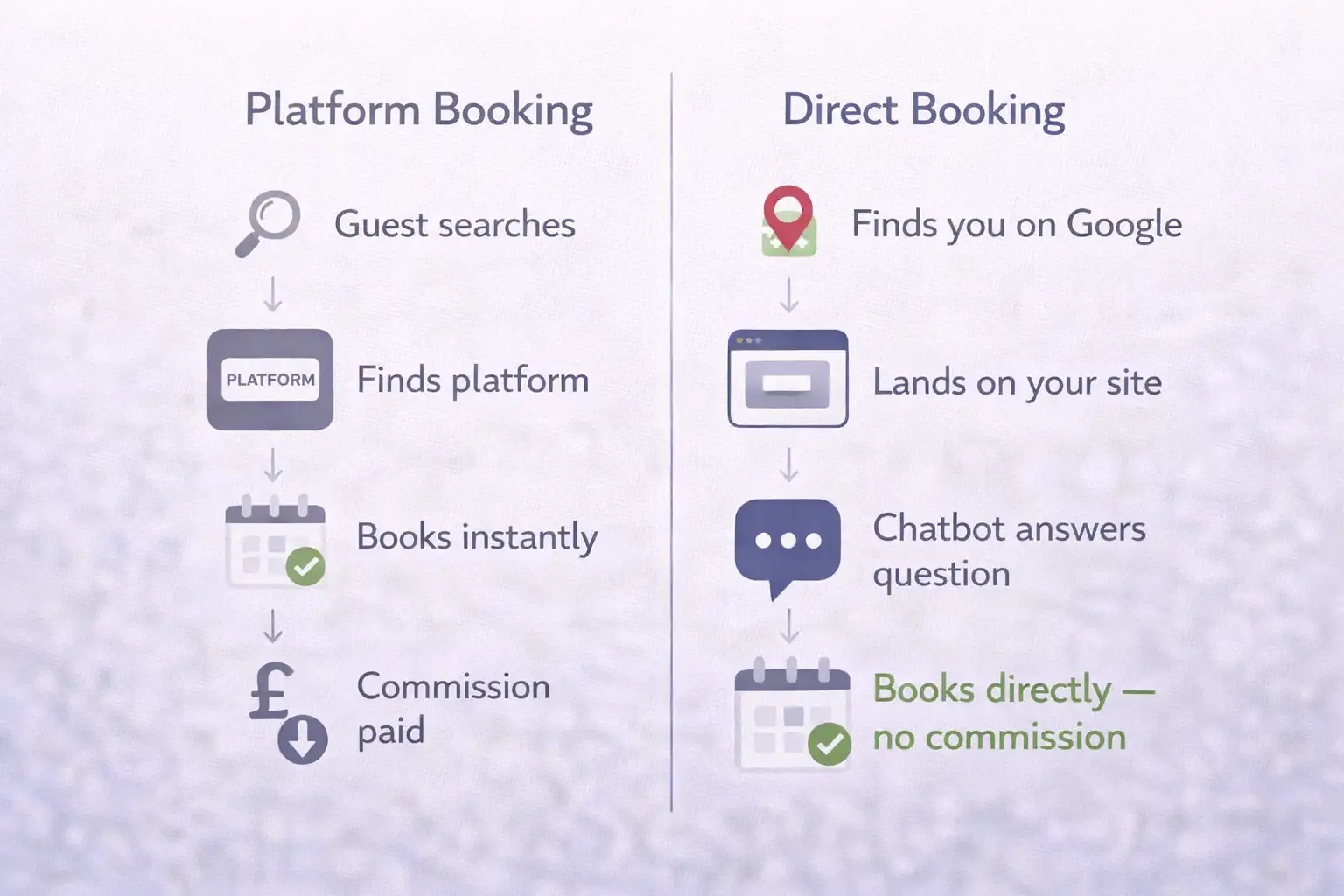
Platforms have spent hundreds of millions of pounds making the guest booking journey frictionless. Guest searches, finds, clicks, selects, books in under 60 seconds. No questions unanswered. Live availability. Instant confirmation.
The typical direct booking journey for the same restaurant looks like this: guest searches Google, finds the website, looks for a booking option, discovers it requires calling during opening hours, gives up and books through the platform instead. Or: guest sends a WhatsApp message at 8pm, nobody replies until the following morning, by which point they have already booked somewhere else.
Guests are not loyal to platforms. They are loyal to convenience. This is actually good news — because convenience is something you can compete on directly, without matching the platforms' marketing budgets. The five levers in this post each address a specific friction point in the direct booking journey.
Lever 1 — Make Your Website Convert Visitors Into Bookings
A restaurant website that converts visitors into direct bookings must load fast on mobile, display a booking option within the first scroll and respond to visitor questions instantly. Most restaurant websites fail on at least three of these four criteria and lose the direct booking to a platform as a result.
Mobile first. Over 70% of restaurant website traffic arrives on mobile devices. A booking flow that is not optimised for mobile — small buttons, slow loading, multi-step forms that are difficult on a small screen — loses the majority of its direct booking opportunity before the guest has even tried to book. If you would not comfortably book your own restaurant on your phone in under two minutes, your guests cannot either.
Visible booking above the fold. A guest who cannot see how to book within the first screen scroll will not hunt for the option. The booking button or booking widget must be immediately visible — not buried in the footer, not hidden in a navigation menu. Every additional step between landing on your website and completing a booking increases the probability that the guest books through a platform instead.
Live availability. If your direct booking system shows "call to check availability" or requires a request-and-confirm process rather than instant confirmation, you are asking guests to accept a worse experience than the platform offers. Live calendar integration showing real-time availability — and confirming instantly — closes that gap.
AI chatbot on every page. The most common reason a website visitor does not complete a direct booking is an unanswered question. What is in the set menu? Can you accommodate a nut allergy? Is there parking nearby? Without a chatbot to answer these questions instantly, the visitor bounces. With one, the question is answered in seconds and the booking completes.
A conversion-focused restaurant website with embedded booking, AI chatbot and CRM integration is the foundation that makes every other lever in this post more effective. Our post on AI chatbots for restaurants covers how the chatbot component handles visitor enquiries in detail.
AI Bridge Club builds conversion-focused restaurant websites with integrated booking, chatbot and CRM. Book a free demo to see what direct booking looks like when it works →
Lever 2 — Respond to Every Enquiry Instantly
The single most common reason a direct restaurant enquiry converts into a platform booking instead is response time. A guest who sends a WhatsApp message at 7pm and gets no reply books through a platform instead — not because they prefer the platform but because the platform responded.
This is where the majority of restaurants haemorrhage direct bookings without realising it. The enquiry arrives — on WhatsApp, Instagram DMs, Facebook Messenger, the website contact form. Nobody sees it until the following morning. By then the guest has booked elsewhere. The restaurant never knew the direct booking was available to be won.
The fix is an AI chatbot connected to all messaging channels. Every enquiry — regardless of channel, regardless of time — receives an immediate response. Availability questions, allergen queries, group booking coordination, event enquiries — all handled within seconds of the message arriving.
What this does for direct bookings specifically: the guest who messages at 9pm on a Tuesday no longer defaults to a platform because the platform responds faster. Your direct channel now responds instantly too. The advantage the platform had is removed.
Our post on how restaurant chatbots handle out-of-hours enquiries covers the full conversation flow — from guest message to confirmed booking — in step-by-step detail.
Lever 3 — Get Found Directly Through Local SEO
Local SEO ensures your restaurant appears when guests search for venues in your area on Google — in the map pack, in organic results and in AI-generated recommendations. Restaurants appearing in the top three Google Maps results receive the majority of organic booking enquiries for their location without paying per-cover fees for the privilege.
The guest who searches "restaurants Nantwich Saturday night" and books from the Google Maps result has not gone through a platform. They found you directly, clicked through to your website or called your number, and booked direct. Every cover from that search is commission-free.
Google Business Profile is the starting point. Your GBP is the single highest-impact local SEO asset for a restaurant — more influential on Maps ranking than any other factor. Categories, menu upload, photos, regular posts, Q&A responses and review management all affect where you appear. A well-managed GBP consistently outranks a neglected one, even at a similar physical location.
Review volume and recency drive Maps ranking. Google uses reviews as a local ranking signal. More recent, consistent 5-star reviews correlate directly with better Maps positioning. Automated review requests — sent to guests via SMS a few hours after their visit with a direct link to your Google review page — generate a consistent flow of fresh reviews without any manual effort from your team.
Content captures decision-stage searches. Blog posts and FAQ content targeting specific local queries — "gluten-free restaurants Crewe", "private dining Macclesfield", "best Sunday lunch Warrington" — capture guests at the point of decision who go directly from the search result to a booking. This traffic arrives with intent and converts at a significantly higher rate than social media traffic.
The compound effect. SEO investment compounds over time. Unlike platform listings which require ongoing per-cover fees, organic visibility continues delivering without cost per booking. A restaurant that invests in local SEO for 12 months has an asset that generates commission-free bookings indefinitely.
Our local SEO service for hospitality venues covers Google Business Profile management, location pages, content creation and review automation as a connected system.
AI Bridge Club manages local SEO and Google Business Profile for restaurants across Cheshire and the North West. See how we improve Maps visibility →
Lever 4 — Automated Follow-Up Turns Enquiries Into Confirmed Bookings
Most restaurant enquiries that do not convert to bookings immediately are not lost — they are simply not followed up. Automated CRM sequences follow up with every enquiry, remind guests of availability, recover abandoned bookings and re-engage guests who have not visited recently — all without manual effort from your team.
The connection to direct bookings is direct: every follow-up message uses your booking link, not a platform link. Every booking recovered through a follow-up sequence is commission-free.
Enquiry follow-up. Guest enquires via website or chatbot but does not complete a booking. Automated message sent 24 hours later with availability and a direct booking link. Many guests who were genuinely interested but got distracted complete the booking at this point.
Abandoned booking recovery. Guest starts the online booking process and does not complete it. Automated message asks if they had any questions or need help — addresses the most likely reason for abandonment and recovers the booking.
No-show recovery. Guest does not show up. Rather than simply losing the cover, an automated message sent the following week acknowledges the missed visit, offers a warm rebooking and recovers both the revenue and the goodwill. This converts a frustrating no-show into a future direct booking.
Lapsed guest re-engagement. Guest has not visited in 90 days. Automated campaign with a seasonal offer, new menu announcement or event invitation drives return visits without any manual effort. The guest re-engages directly — no platform involved.
For more on automated reminders and recovery sequences specifically for no-shows, read our post on how to reduce restaurant no-shows. The AI CRM automation service covers the full automated follow-up system in detail.
Lever 5 — Build a Guest List You Own and Can Market To
Third-party platforms own the guest data from every booking made through them. Building a direct guest list gives you a marketing asset you own — one that grows with every direct booking and enables you to drive repeat visits without any platform involvement.
When a guest books through OpenTable, that data belongs to OpenTable. You cannot email that guest a new menu announcement. You cannot invite them to your Christmas event. You cannot offer them an early booking incentive for Valentine's Day. You have the cover and the memory of their visit. OpenTable has the relationship.
Every direct booking reverses this. The guest provides contact details at the point of booking — details that are yours. Every chatbot conversation on your website or WhatsApp captures name and number. Every post-visit follow-up builds the profile. Over time a guest list of 500 to 1,000 direct contacts becomes a marketing asset worth significantly more than the same number of platform bookings.
What to do with the list:
New menu launches — direct email to every guest who has eaten with you in the last year
Seasonal offers — quiet January? Email your direct list with a February promotion. Zero platform fee.
Event invitations — private dining availability, themed evenings, wine tastings. Your list, your terms.
Re-engagement campaigns — guests who have not visited in 60 or 90 days, prompted by a personalised message
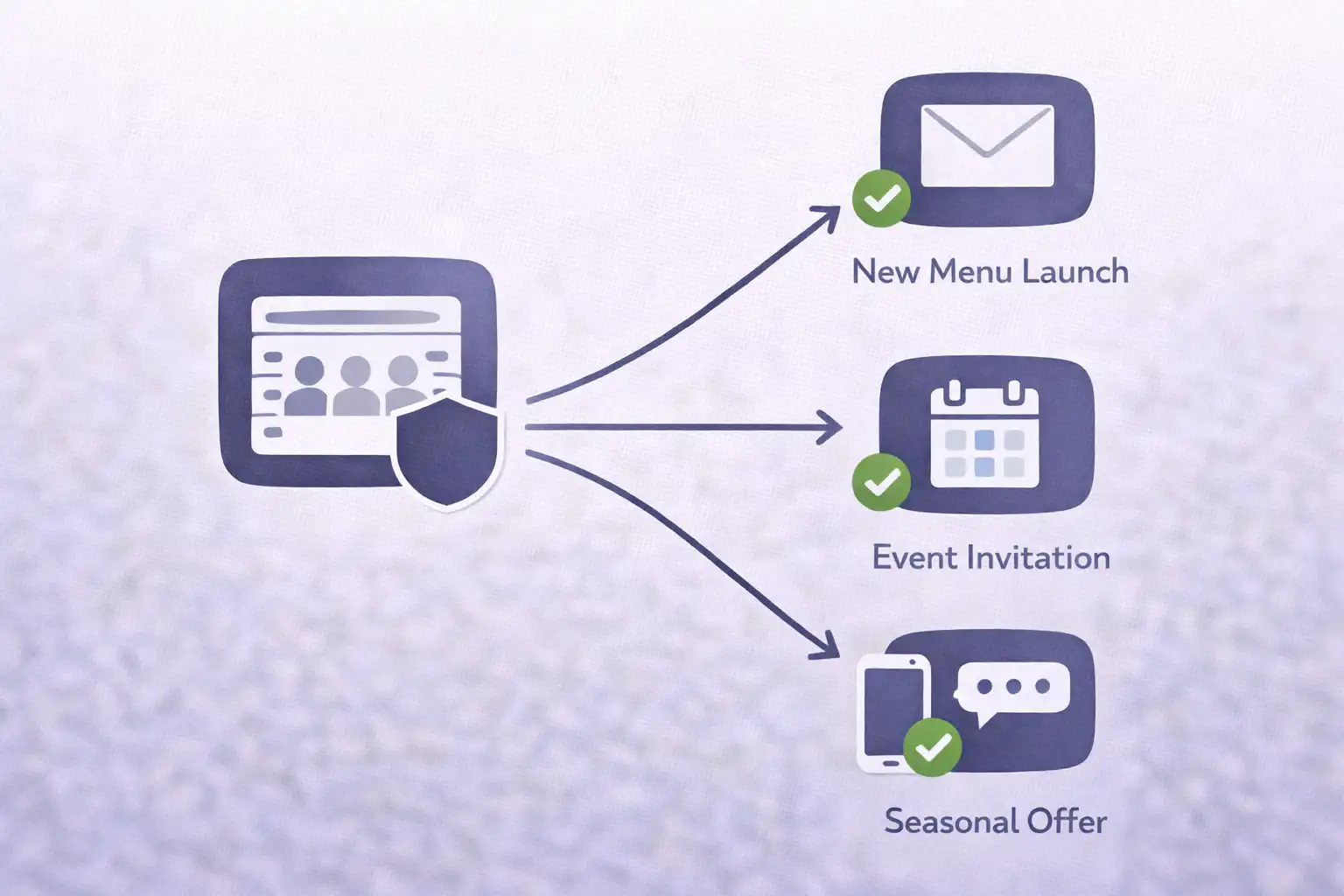
Every message in every campaign links to your direct booking system, not a platform. Every booking that results is commission-free. The guest list compounds — the larger it grows, the more direct revenue it generates per campaign.
All list building is configured to be UK GDPR compliant — consent is captured at every touchpoint and guest data is handled accordingly. AI Bridge Club builds consent capture into every chatbot and booking flow as standard.
Putting It All Together — The Direct Booking System
The most effective direct booking system for UK restaurants combines a conversion-focused website with live booking, an AI chatbot for instant enquiry response, local SEO for organic discovery, automated follow-up sequences and a guest list you can market to directly — all running as one connected system.
This is not five separate tools requiring five separate logins and five separate maintenance tasks. It is one integrated system — built on GoHighLevel — where each component feeds the others. SEO brings organic traffic. The website and chatbot convert it. CRM follows up the enquiries that do not convert immediately. The guest list grows with every direct booking and drives return visits. Repeat visits build reviews that improve SEO ranking. The cycle compounds.
Implementation is typically staged. Most restaurants start with website conversion and chatbot — these have the fastest revenue impact because they capture bookings that are already being lost right now. Local SEO and CRM automation are added over the following 60 to 90 days as the foundation is in place to make them work.
Realistic timeline: most restaurants see measurable direct booking growth within 60 to 90 days of implementing the first two levers. The full system — all five levers running together — typically shows significant shifts in the direct versus platform booking ratio within six months.
For restaurants that want everything built, configured and managed in one package, our Business in a Box service combines all five levers into one monthly fee with no long-term contract.
Ready to start moving bookings from platform to direct?
Book a free 30-minute strategy call with AI Bridge Club. We will review your current booking mix, identify where you are losing direct bookings to platforms and show you which of the five levers would make the biggest difference for your venue first.
Based in Cheshire or the North West? We are happy to meet over a coffee and walk through it in person.
No obligation. No hard sell. Just a straight conversation about what is possible.
Book your free strategy call →
Or call us directly: 07366 926333
Frequently Asked Questions
How do I get more direct bookings for my restaurant? The five most effective levers for increasing direct restaurant bookings are: a conversion-focused website with live booking and embedded chatbot, instant response to all messaging channel enquiries through AI automation, local SEO to appear in Google Maps for venue-type searches, automated CRM follow-up for enquiries that do not convert immediately, and a guest list you can market to directly. Each lever addresses a specific point where direct bookings are currently lost to platforms.
How much commission do restaurants pay to OpenTable? OpenTable charges UK restaurants approximately £1.50 to £2.50 per cover depending on the subscription tier and restaurant type. On a 500-cover month this equates to £750 to £1,250 in commission. Delivery platforms including Deliveroo, Uber Eats and Just Eat charge 25 to 32% of the total order value per delivery, making delivery commission significantly higher per transaction than table reservation commission.
Can I stop using OpenTable and still get bookings? Yes — but the transition should be gradual rather than immediate. The strategy is to grow direct bookings as a proportion of total covers over time, reducing platform dependency rather than eliminating platforms overnight. As direct bookings grow through better website conversion, SEO and chatbot response, platform reliance naturally decreases. Most restaurants find they can significantly reduce platform fees within six to twelve months of implementing a direct booking strategy.
What is the best way to increase direct restaurant reservations? The fastest single improvement is usually response time — ensuring every enquiry on WhatsApp, Instagram and the website receives an immediate response through an AI chatbot rather than waiting until the following morning. The highest long-term return typically comes from local SEO and Google Business Profile management, which generates commission-free organic bookings that compound over time.
How does a restaurant website convert more visitors into bookings? A restaurant website converts more visitors into direct bookings when: it loads quickly on mobile, it displays a booking option immediately without scrolling, it shows live availability rather than requiring a call-back, and it has an AI chatbot that answers visitor questions in real time rather than letting them bounce to a platform for a faster response.
Does local SEO help restaurants get more direct bookings? Yes. Restaurants appearing in the top three Google Maps results for "restaurant [your town]" or "best [cuisine type] [your area]" receive direct booking enquiries from guests who have not gone through any platform — the guest finds you on Google and contacts or books you directly. Local SEO investment also compounds over time, delivering commission-free bookings without per-cover fees.
How can I build a restaurant guest list I own? Capture guest contact details at every direct touchpoint — through the website booking system, the chatbot conversation, post-visit follow-up messages and event registration. Ensure consent is captured in accordance with UK GDPR at every touchpoint. Over time this builds a list you can email with new menus, seasonal offers and event invitations — entirely commission-free.
What is the difference between a direct booking and a platform booking? A direct booking is made through your own website, phone number or messaging channels — you receive the full cover value and own the guest's contact details for future marketing. A platform booking is made through a third-party service like OpenTable or Deliveroo — you pay commission on the booking and the platform retains the guest data. Direct bookings are more profitable per cover and give you a marketing relationship the platform booking does not.
How much money could I save by increasing direct restaurant bookings? The saving depends on your current platform booking volume and the commission rate. At £2.00 per cover for table reservations, shifting 200 covers per month from platform to direct saves £400 per month — £4,800 per year. For delivery-heavy restaurants at 30% commission on a £30 average order, shifting 100 orders per month from platform to direct saves £900 per month — £10,800 per year. The guest list value from owning those customer relationships adds further compounding value beyond the direct commission saving.
How long does it take to see results from a direct booking strategy? The fastest results come from chatbot and website conversion improvements — most restaurants see measurable impact within the first month as previously unanswered enquiries are captured and converted. Local SEO typically shows meaningful improvements in Google Maps positioning within three to six months. The full five-lever system typically produces a significant shift in direct versus platform booking ratio within six months of implementation.

