How to Reduce Restaurant No-Shows: What Actually Works in the UK
A table for four. Booked three weeks ago for a Saturday night. Confirmed once by email when the booking was made. Nobody shows up. No call, no message, no warning. By the time you know they are not coming it is too late to fill the slot.
This happens in restaurants across the UK every single week. Not just on quiet Tuesdays — on your most valuable Friday and Saturday evening covers, when a no-show costs the most and hurts the most. It's hard to believe there are people out there who book multiple restaurants for the same time on the same night & just decide which to go with on the day. The only way to cover this is absolute "rigorous follow up" & other AI related automation services.
For guests who find you but have questions before committing to a booking, our post on AI chatbots for restaurants covers how to capture every out-of-hours enquiry automatically.
This post covers every proven method for reducing restaurant no-shows — what the data says, what actually works in practice, and what most restaurants are not yet doing that makes the biggest difference.
What Does a Restaurant No-Show Actually Cost?
A restaurant no-show costs the venue the full revenue from that table — food, drinks and margin — with no opportunity to recover it. UK hospitality businesses lose an average of 7% of monthly revenue to no-shows and late cancellations.
To put that in real terms: 7% of monthly revenue is roughly equivalent to losing every cover from one full trading day every single month. For a 40-cover restaurant turning over £25,000 per month, that is £1,750 in lost revenue — gone before service even ends.
The direct financial cost of a no-show is the table revenue. The less visible costs compound it:
Staff have been rostered and paid for covers that never arrived
Kitchen prep has been done — ingredients used, time spent, waste created
The table could have been offered to a walk-in or a waitlisted guest if you had known earlier
Repeated no-shows affect morale and create unpredictable service patterns
A single no-show on a quiet Tuesday is an irritation. A pattern of no-shows on Saturday evenings is a structural revenue problem.
Use our free missed call cost calculator to understand what communication gaps are costing your venue — the principle applies directly to the booking confirmation gap that causes most no-shows.
Why Do Restaurant Guests No-Show?
Restaurant guests no-show primarily because they forget, because cancelling feels awkward or difficult, or because they made multiple bookings and chose a different venue without cancelling yours. Most no-shows are not deliberate — they are the result of friction in the cancellation process.
Understanding why guests no-show is important because it determines which prevention methods actually work. Four patterns account for the vast majority:
Forgotten bookings. A guest books six weeks in advance with the best intentions. Life happens. The booking never makes it into their calendar and no reminder ever arrives. The restaurant is simply not in their mind on the night.
The cancellation is too awkward. Calling a restaurant to cancel a booking feels socially uncomfortable to many people — particularly if it is a small independent venue where they fear disappointing someone. With no easy online cancellation option, many guests default to simply not showing up.
Multiple bookings. For popular dates — Valentine's Day, New Year's Eve, birthdays — many guests book two or three venues simultaneously as insurance, intending to cancel the others once they decide. Without a friction-free cancellation process, those other venues often never get the call.
Changed plans, no cancellation. Plans change. The guest assumes the restaurant will fill the table anyway. The call never gets made.
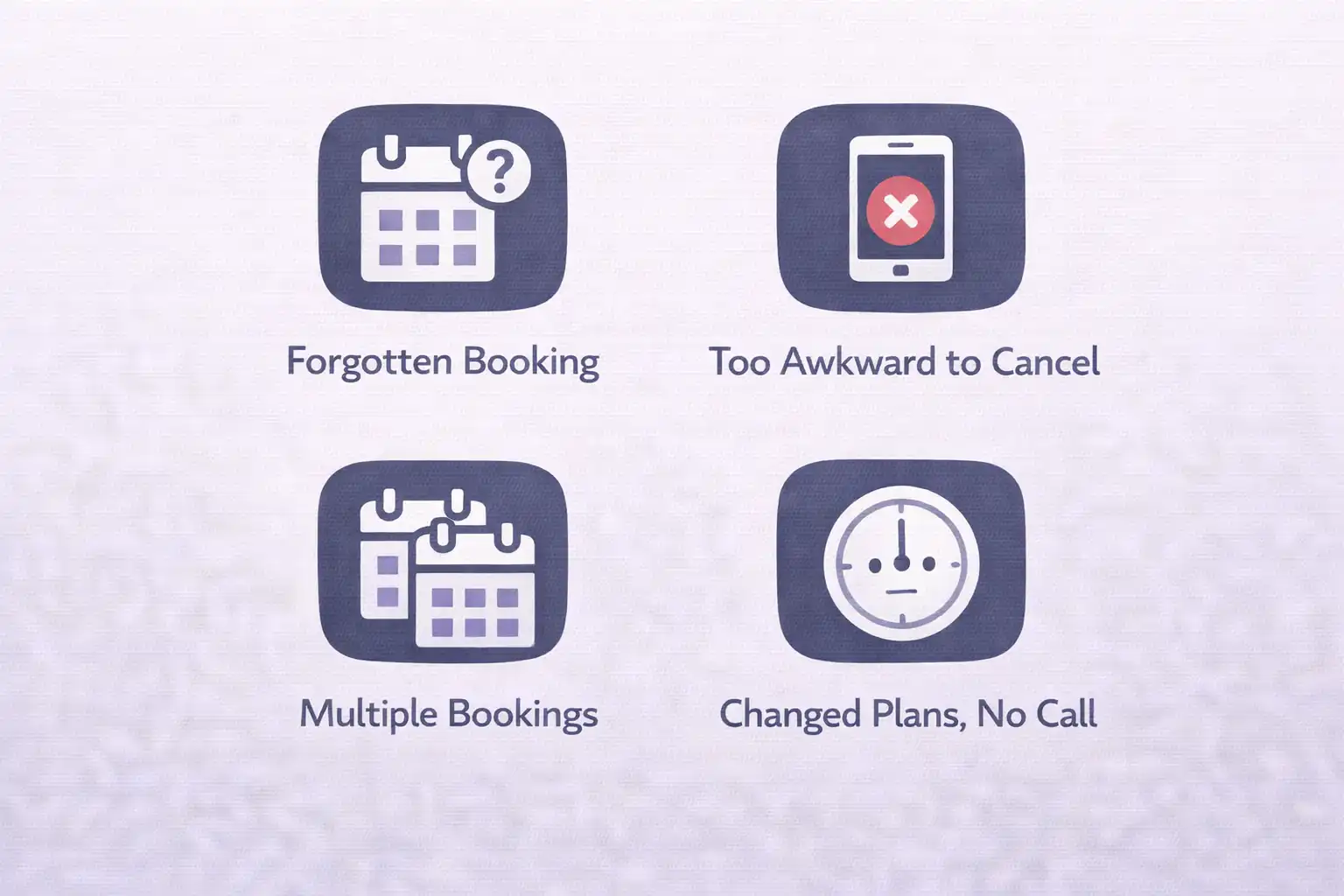
The practical implication from all four patterns is the same: most no-shows can be prevented by making it easier to confirm or cancel than to simply not show up. That is the principle everything else in this post is built around.
The Most Effective Way to Reduce No-Shows — Automated Reminders
Automated booking reminders — a confirmation immediately after booking, a reminder 48 hours before and a second reminder 24 hours before, each with a one-click confirm or cancel link — consistently reduce restaurant no-show rates by 40 to 65% across UK hospitality venues.
This is the single most impactful change most restaurants can make, and it requires no change to your booking policy, no deposit requirement and no deterrent to new bookings. It works because it solves the two most common causes of no-shows simultaneously: it prevents forgotten bookings and it removes the friction that stops guests from cancelling in advance.
The confirmation sent at the time of booking sets the expectation in writing and captures the commitment. The 48-hour reminder catches the guest while they still have time to cancel if needed — and while you still have time to fill the slot if they do. The 24-hour reminder is the final prompt, sent when the booking is immediately relevant and the decision to show up or cancel is being made.
The critical detail in every reminder is the one-click link. Not a phone number to call. Not an email to reply to. A single tap that either confirms the booking or cancels or reschedules it — with no phone call required. This removes the social friction that keeps many guests from cancelling, which means you get earlier warning of genuine no-shows and more time to fill the table.
SMS reminders consistently outperform email for hospitality — open rates are significantly higher and response times are faster. The optimal sequence uses SMS for both reminders and adds email as a secondary channel for guests who prefer it.
AI Bridge Club builds automated reminder sequences for restaurants and hospitality venues across the UK. Book a free demo to see how it works →
Should You Take Deposits or Card Details to Reduce No-Shows?
Deposits and card-hold policies reduce no-shows significantly — typically by 70 to 90% for tables that have paid a deposit — but they also reduce the total number of bookings made. The right policy depends on your venue type, average spend and local competition.
A deposit creates financial commitment. Guests who have paid £20 per head are significantly less likely to no-show than guests who have not. The psychological and practical deterrent is real and measurable.
The trade-off is equally real. A deposit requirement reduces the friction of booking — some guests will choose a competitor venue that does not require one. In a competitive local market with multiple restaurants offering similar experiences, a compulsory deposit across all bookings can suppress enquiry volume.
The approach that works best for most UK casual dining venues:
Full deposit for special events — New Year's Eve, Valentine's Day, tasting menus, private dining
Per head deposit for large groups (typically 6 or more) — where the revenue risk of a no-show is highest
Card hold rather than charge for standard weekend bookings — provides commitment without the upfront payment friction
No deposit for off-peak covers — weekday lunch, early evening — where suppressing demand would do more damage than the no-show risk
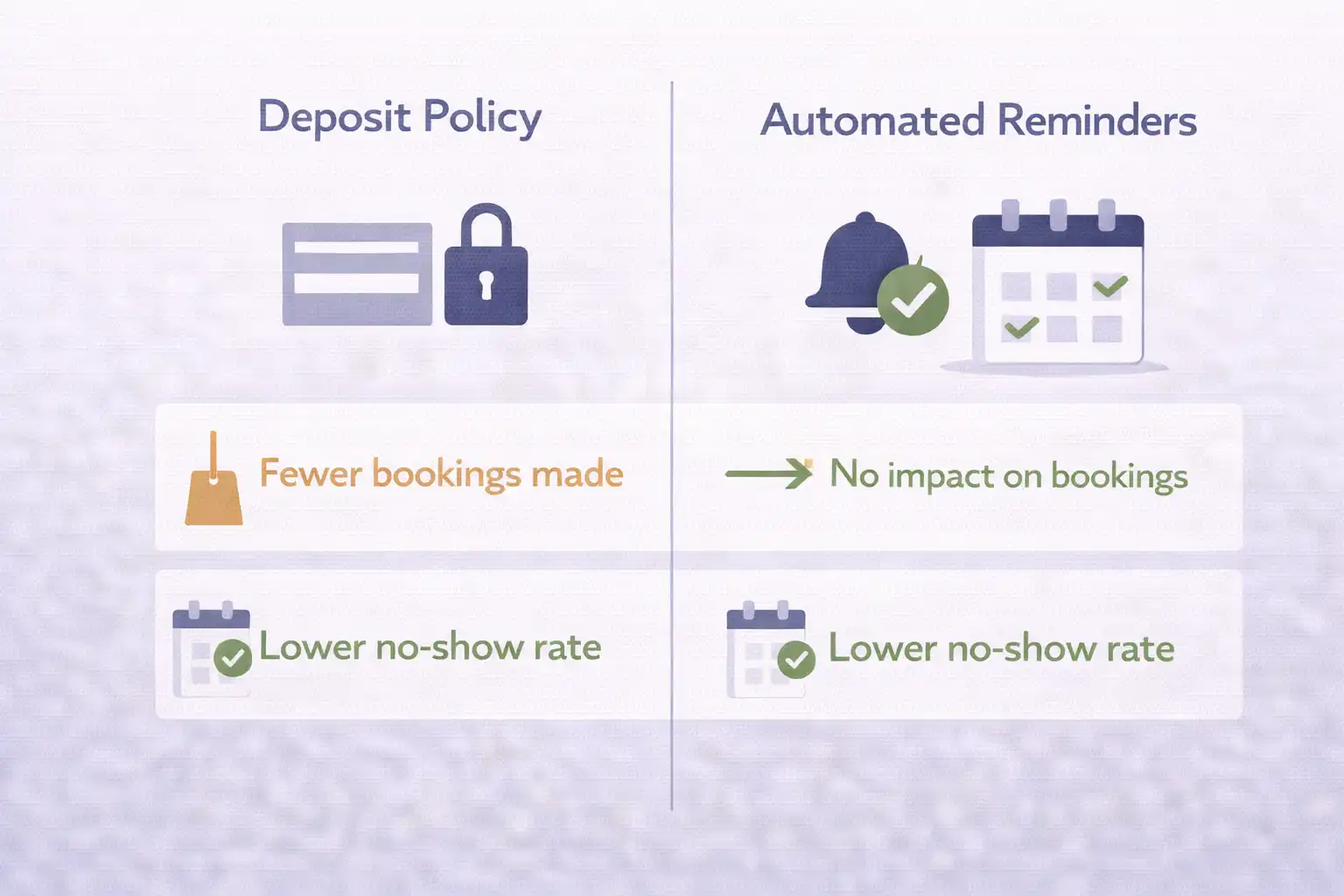
The most important point: a deposit policy works best alongside automated reminders, not instead of them. A guest who has paid a deposit but receives no reminders can still forget. A guest who receives a 48-hour reminder with a clear cancellation link — even without a deposit — will usually do the right thing.
Easy Rescheduling Reduces No-Shows More Than You Might Think
Giving guests a simple, one-click rescheduling option in every reminder message converts many potential no-shows into rebooked covers rather than lost revenue. A guest who cannot make their booking will cancel if it is easy — but rebook if rescheduling is even easier.
Most venues offer cancellation links but not rescheduling links in their reminders. This is a missed opportunity. A guest who receives a reminder, realises they cannot make the booking and clicks a rescheduling link becomes a future cover rather than a lost one. A guest who can only cancel with no obvious next step may simply not show up rather than go through the process of booking again from scratch at a later date.
The rescheduling link in your reminder should connect to your live availability — so the guest sees real, bookable slots rather than a waiting list or a request form. The interaction takes under a minute. The result is a moved cover rather than a missing one.
For guests who find you but have questions before booking, our post on AI chatbots for restaurants covers how to capture every out-of-hours enquiry automatically.
What About Walk-Ins — Can They Fill No-Show Gaps?
Walk-ins can partially offset no-show losses but are not a reliable substitute — particularly for weekend evening service when walk-in demand is highest at precisely the point when your full-price covers should already be confirmed.
Holding tables speculatively for walk-ins on your most valuable sessions carries revenue risk. If the walk-ins do not materialise, you have voluntarily left revenue on the table. If they do, you have recovered a no-show — but you would have been better served preventing the no-show in the first place.
Walk-ins serve a useful function in filling gaps created by short-notice cancellations and in supporting off-peak sessions where full pre-booking is less realistic. They should complement a no-show prevention system, not substitute for one.
The Complete No-Show Reduction System
The most effective restaurant no-show reduction combines automated reminders, easy cancellation and rescheduling, a clear cancellation policy and a deposit or card hold for high-value bookings — all running automatically without manual input from your team.
Each layer addresses a specific cause of no-shows:
Layer 1 — Booking confirmation prevents forgotten bookings by capturing the commitment in writing at the moment of booking.
Layer 2 — 48-hour SMS reminder catches guests while there is still time to fill the slot if they cannot make it. One-click confirm, cancel or reschedule.
Layer 3 — 24-hour SMS reminder is the final prompt when the booking is immediately relevant. Same one-click options.
Layer 4 — Deposit or card hold for groups, special events and premium slots adds financial commitment where the revenue risk justifies it.
Layer 5 — Clear cancellation policy communicated at every touchpoint removes ambiguity and sets the expectation that early cancellation is welcomed.
Venues implementing all five layers consistently report no-show rates dropping from the UK industry average of 7 to 12% down to 2 to 3%. That recovery represents significant monthly revenue — recovered entirely through better communication, not through deterring bookings.
For a broader view of how AI supports restaurant operations beyond no-shows, read how restaurants can use AI to improve guest experience.
For a complete view of how AI automation applies across your restaurant or hospitality business — beyond just no-show reduction — visit our AI automation for restaurants and hospitality page. For more on how restaurants are using AI across operations and guest experience, read our post on how restaurants can use AI to improve guest experience.
AI Bridge Club builds complete no-show reduction systems for UK restaurants, pubs and hospitality venues. See how it works for your venue →
Is Automation Worth It for a Small UK Restaurant?
For most UK restaurants receiving more than 20 covers per week through advance bookings, automated reminder and CRM systems pay for themselves through recovered revenue within the first month of operation.
The maths is straightforward. At average UK restaurant spend, one prevented no-show per week — a four-cover table at £35 per head — is £140 recovered. Over a month that is £560. The cost of an automated CRM system from AI Bridge Club starts from £97 per month. The payback period on a single prevented no-show is less than two weeks.
If platform commission is a separate concern, read our guide on how to get more direct restaurant bookings without paying commission.
The more important consideration for a small restaurant is time. Manual reminder sequences — sending individual texts or emails to every booking — take time that most front of house teams simply do not have. Automated systems run without input once configured. Your team does nothing differently. The reminders fire, the confirmations come back and the no-show rate falls.
AI Bridge Club configures and manages no-show automation for restaurants, pubs, cafés and hospitality venues across Cheshire, the North West and UK-wide. The setup involves a 30-minute call to understand your booking volumes and current system, a build handled entirely by us and a review session before go-live. Most venues are live within one to two weeks.
Ready to stop losing covers to no-shows?
Book a free 30-minute demo with AI Bridge Club. We will walk through the automated reminder system in action, show you the rescheduling flow from a guest's perspective, and tell you honestly whether the investment makes sense for your venue at this stage.
Based in Cheshire and the North West? We are happy to meet over a coffee and walk through it in person.
No obligation. No hard sell.
Or call us directly: 07366 926333
Frequently Asked Questions
What is the average no-show rate for UK restaurants? The average no-show rate for UK restaurants is between 7 and 12% of advance bookings. For high-demand dates such as Valentine's Day and New Year's Eve, no-show rates can be significantly higher. Venues with effective automated reminder systems typically bring their rate down to 2 to 3%.
How much do restaurant no-shows cost per month? UK hospitality businesses lose an average of 7% of monthly revenue to no-shows and late cancellations. For a restaurant turning over £25,000 per month, that represents approximately £1,750 in lost revenue every month — equivalent to losing all covers from one full trading day.
Do automated reminders actually reduce restaurant no-shows? Yes. Automated reminder sequences — confirmation at booking, 48-hour reminder and 24-hour reminder, each with a one-click confirm or cancel link — consistently reduce no-show rates by 40 to 65% in UK hospitality venues. The reduction comes from preventing forgotten bookings and removing the friction that stops guests from cancelling in advance.
Should restaurants take deposits to prevent no-shows? Deposits reduce no-shows significantly but also reduce the number of bookings made. The most effective approach for UK casual dining is to use full deposits for special events and large groups, card holds for standard weekend bookings, and no deposit requirement for off-peak covers. Deposits work best alongside automated reminders, not as a replacement for them.
What is the best time to send a booking reminder to restaurant guests? The most effective sequence is a confirmation sent immediately at the time of booking, a first reminder 48 hours before the reservation and a second reminder 24 hours before. SMS open rates and response rates are significantly higher than email for hospitality reminders. Each message should include a one-click option to confirm, cancel or reschedule.
How do I make it easy for guests to cancel without a no-show? Include a one-click cancellation link in every reminder message — not a phone number to call or an email address to contact. Removing the need for a phone call eliminates the social friction that prevents many guests from cancelling. Add a rescheduling option alongside cancellation so guests can move their booking rather than lose it entirely.
Can I reduce no-shows without taking deposits? Yes. Automated reminder sequences with easy cancellation and rescheduling links consistently reduce no-show rates by 40 to 65% without any change to booking policy. Most UK casual dining venues achieve significant no-show reduction through reminders alone, reserving deposit requirements for high-value events and large group bookings.
What is a good no-show rate for a restaurant? A no-show rate of 2 to 3% is achievable for most UK restaurants with a well-implemented automated reminder system. The UK industry average is 7 to 12%. Any rate above 5% represents a meaningful revenue recovery opportunity that automated reminders can address directly.
How much does automated booking reminder software cost for a restaurant? AI Bridge Club's CRM automation for restaurants starts from £97 per month with no long-term contract. This covers setup, the automated reminder sequence, one-click confirm and cancel links, rescheduling integration and ongoing management. One prevented no-show per week typically covers the monthly cost within the first two weeks.
Do card holds work better than deposits for reducing no-shows? Card holds are less effective than full deposits at reducing no-shows but generate significantly fewer booking abandonments. They represent a middle ground — guests feel some commitment without the friction of an upfront payment. For most UK casual dining venues, card holds on weekend bookings combined with automated reminders delivers the best balance of no-show reduction and booking volume.
we provide similar help reducing membership within the Gyms sector by using automation and follow up, similar to the Restaurant sector. Same principle, same technology, same results

