
Why Smart Dental Practices Are Turning to AI and Automation
Something is changing in UK private dentistry — and it is happening faster than most practice owners realise.
The practices filling their cosmetic books are not necessarily the ones with the best clinicians or the newest equipment. They are the ones that answer every enquiry before the patient has had a chance to ring the next practice on the list. The ones whose recall campaigns run automatically every six months without anyone picking up a phone. The ones that follow up every unconverted Invisalign consultation with a personalised sequence that feels human but requires no human effort.
They have not hired extra staff. They have not cut corners on care. They have put automation in place — and it is handling the business layer that no dentist went to university to manage.
This is not a story about AI replacing clinical expertise. The clinical relationship between a dentist and their patient stays entirely human. What AI is changing is the layer around it: how enquiries are captured, how patients are followed up, how diaries are filled, how reviews are collected, and how lapsed patients come back.
This post explains what is driving the shift, what leading practices are doing about it, and what the cost of not adapting is starting to look like.
IMAGE 1 GOES HERE Title: Dental practice owner reviewing automated systems between patients Position: After introduction, before first H2 section File name: dental-practice-ai-automation-uk-private-practice.jpg Alt tag: UK private dental practice owner reviewing AI automation systems on tablet between patient appointments
What is changing in UK private dentistry right now?
The private dental market in the UK is undergoing a structural shift that is creating significant opportunity for well-run practices — and significant pressure on those that are not adapting.
The numbers are stark. The UK dentistry market is now worth £12.16 billion (2023/24), growing 9.2% year on year, with private dentistry accounting for 69% of total market value — the highest proportion ever recorded. The private pay sector alone is worth £8.4 billion, having grown by £965 million in a single year, according to LaingBuisson's market analysis (LaingBuisson, 2024).
The driver is NHS access. In 2024, 36% of new private dental patients said they turned to private care because they could not get NHS treatment at all, and 31% because they could not get it quickly enough (CMA/GOV.UK, 2024). That represents a sustained structural inflow of patients into private dentistry that is unlikely to reverse.
But the inflow of potential patients does not automatically translate into booked chairs. More patients searching for a private dentist also means more competition for every enquiry. A patient searching for Invisalign in a medium-sized UK town now has 5–10 practice choices within a reasonable distance. The practice that answers first, follows up consistently, and generates the most reassuring reviews wins that patient. The others do not.
For dental practices in Cheshire and the wider North West — Chester, Warrington, Macclesfield, Wilmslow, Crewe — this competitive dynamic is already clearly visible. Practices that have added AI-powered enquiry capture and follow-up are outperforming those that have not, regardless of clinical quality.
What is the real cost of running a dental practice without automation?
Most dental practice owners know roughly where the money is leaking out. Very few have quantified it precisely.
Missed enquiries For a practice handling a mix of routine and cosmetic work, one missed implant enquiry per week at an average treatment value of £3,000–£5,000 represents £150,000–£260,000 in unbooked work per year. One missed Invisalign enquiry per week at £3,500–£6,000 is more again. These are not booked patients who cancelled — they are enquiries that went to a competitor because nobody answered.
Unconverted treatment plans Every practice has a percentage of treatment plan consultations that do not convert. The patient said they would think about it. Nobody followed up. The treatment — worth £3,000–£6,000 — was never booked. For a practice doing 10 cosmetic consultations a month with a 30% non-conversion rate, that is three treatments per month sitting as unrealised revenue. Automated follow-up sequences typically recover 10–20% of those consultations.
Recall leakage A dental practice with 700 active patients on a 6-month recall cycle has up to 350 patients potentially overdue at any given time. If the recall system relies on letters or manual calls and achieves a 40% response rate, 210 of those patients are booked back in. A well-run automated recall campaign achieving 60% response books 420. The difference — 210 additional appointments at £55 each — is £11,550 per cycle purely from recall optimisation.
No-shows An empty dental chair costs £150–£500 per hour. Automated reminder sequences with one-click confirmation substantially reduce the no-show rate — typically by 30–50% based on patterns across practices we work with.
Use our missed call cost calculator to run the numbers for your own practice. The figure is usually higher than practice owners expect.
Want to see what automation would recover for your specific practice? We will run the numbers with you on a free 30-minute demo call. Book your free demo →
What are smart dental practices actually automating first?
The practices making the fastest progress are not trying to automate everything at once. They start with the highest-ROI problem and build from there.
Starting point: missed call text back The entry point for most practices is missed call text back — an automated SMS that fires within seconds of a missed call, with a personalised message and a booking link. At £97/month it is the lowest-cost, fastest-setup, clearest-ROI service available. For a practice with active cosmetic enquiries, one recovered implant call per month covers the annual cost many times over.
Second layer: AI voice agent and chatbot An AI voice agent answers the practice phone 24/7 — handling enquiries, booking appointments, triaging NHS versus private callers, and managing cosmetic treatment enquiries with treatment-specific information. An AI chatbot on the website does the same for online visitors. Together they cover the full enquiry surface of the practice at any hour.
One configuration priority specific to dental: over half of UK adults (52%) report some fear of visiting the dentist, according to a survey of 2,000 UK adults by Space Dental (Dentistry.co.uk, October 2024). An AI voice agent for a dental practice is configured to recognise nervous callers and respond with patience and reassurance — never rushing, always offering a human fallback.
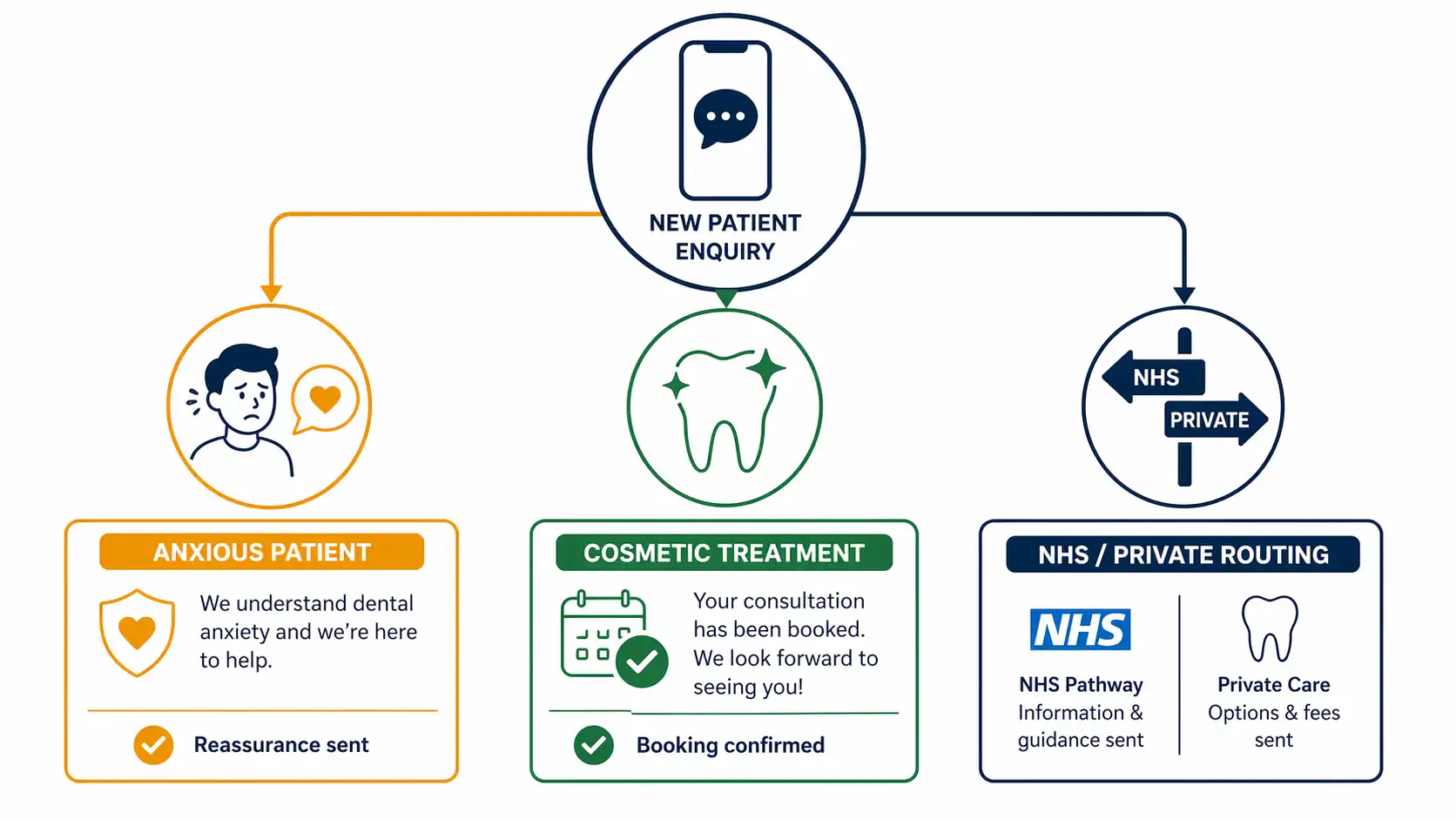
Third layer: CRM automation The CRM automation layer handles the background systems — appointment reminders, recall campaigns, treatment plan follow-up sequences, review requests, and lapsed patient reactivation. This is where the compounding effect kicks in: once running, it works continuously without any ongoing management from the practice.
The treatment plan follow-up sequence is a dental-specific feature that has no direct equivalent in other healthcare sectors. When a patient receives a treatment plan for implants, Invisalign or cosmetic work and does not confirm, an automated sequence starts — a message at 3 days, another at 7, a final at 14. The tone is helpful and informative, not pushy. For high-value treatments, recovering 10–20% of unconverted consultations represents a material revenue gain from a system that costs a fraction of a single treatment to run.
How does AI handle the compliance requirements dental practices face?
Dental practices in England operate under two regulatory frameworks that are relevant to AI use: the General Dental Council (GDC), which is the statutory regulator for dental professionals, and the Care Quality Commission (CQC), which registers and inspects dental providers.
The compliance position on AI in dental practice administration is clear.
GDC position The GDC does not prohibit AI in dental practice management. In September 2024, the GDC commissioned a Rapid Evidence Assessment specifically to understand how AI is being used in dental service provision and its implications for professionals and patients — demonstrating active regulatory engagement with AI as part of modern practice (GDC, 2024).
MDDUS guidance published in 2025 sets out the practical requirements: AI use must align with GDC Standards, patients must be informed where AI is used in their care pathway, patient consent must be obtained for AI-assisted call recordings or transcriptions, and AI must not be used to make clinical decisions (MDDUS, 2025).
Admin and marketing AI — chatbots, voice agents, recall campaigns, review requests, missed call recovery — sits entirely within acceptable use. It does not diagnose, assess, or make clinical recommendations.
CQC considerations CQC registration covers dental providers as healthcare services. AI used in administrative functions does not trigger separate CQC registration requirements for the AI tool, but practices should ensure their information governance policies reflect how AI is used in patient-facing communications. We provide a written data flow document to every practice that can be included in CQC documentation.
GDPR All patient data is handled under UK GDPR. We use the OpenAI API and Anthropic API directly — patient data is never used to train AI models. DPAs are in place with all providers.
What does the business case look like for a private dental practice?
Here is a worked example for a 2-surgery mixed practice running 80 sessions per week, with a mix of routine, hygiene, and active cosmetic work.
Current situation without automation:
Estimated missed calls per week during surgery: 8–12
Estimated enquiries lost from missed calls: 3–5 per week
Unconverted treatment plan consultations per month: 3–4 (implants/Invisalign)
Recall response rate (manual/letter): 35–45%
No-show rate: 8–12%
Monthly review additions: 2–4
With full AI automation:
Missed call text back recovers 60–70% of missed enquiries: 2–4 additional bookings per week
Treatment plan follow-up recovers 1–2 additional cosmetic treatments per month: £3,000–£12,000 in additional monthly revenue
Recall automation improves response rate to 55–65%: 20–30% more recall bookings
Automated reminders cut no-show rate to 4–6%
Review request automation adds 15–25 reviews per month
Monthly cost of full automation stack: £500–£850 Payback period: typically 2–4 weeks from first recovered cosmetic enquiry
What changes day-to-day when a dental practice automates?
The headline changes are financial — more bookings, less leakage, better reviews. But the day-to-day changes matter too.
The phone anxiety disappears. Every dentist knows the feeling of hearing the phone ring during a procedure. Can the receptionist get it? Are they with someone? Will the caller leave a voicemail? With an AI voice agent, that tension goes. The call is answered. The enquiry is handled. You see it in the CRM when you next check.
The treatment plan conversation changes. When a patient says they will think about an implant or Invisalign course, there is now a system that follows up — professionally, helpfully, and without anyone having to remember to do it. The practice no longer has to choose between a pushy follow-up call and no follow-up at all.
Recall becomes a revenue engine rather than an admin task. The recall list stops being a pile of cards or a spreadsheet nobody gets round to working. It becomes an automated revenue stream that runs in the background of every month.
Google reviews compound. A practice adding 15–25 reviews per month is accumulating a competitive advantage that takes competitors years to close. Within 12 months, a practice that was on 45 reviews can be on 200+, which materially changes its local search ranking and the confidence of new patient enquiries.

What should dental practices watch out for with AI tools?
Not every AI tool is appropriate for a dental setting. A few things worth verifying before committing.
Data handling. Ask specifically whether patient data is used to train AI models. Consumer ChatGPT and similar tools may have terms that allow this. API-level access, which is what AI Bridge Club uses, does not. This distinction matters for GDPR compliance and for CQC information governance documentation.
Integration honesty. Some providers claim to "integrate with Dentally" when they mean they export a CSV. Real integration — appointment availability, two-way data flow via webhooks and middleware — is meaningfully different. Ask specifically how the integration works and what happens if your PMS is not on their native list.
Anxious patient configuration. Given that 52% of UK adults report dental fear, a dental AI receptionist that sounds efficient but cold will damage patient experience. Ask to hear a live demo of an anxious patient scenario before you commit.
GDC documentation. Ask for written documentation of how the system aligns with GDC Standards. A provider that cannot produce this is not ready for a healthcare setting.
Contract terms. 30-day rolling should be the standard. Long contracts for AI tools that are still evolving rapidly are a red flag.
How does a dental practice get started with AI automation?
The starting point is the same for most practices: identify the biggest revenue leak and fix that first.
For most dental practices with active cosmetic work, that is missed enquiries — so missed call text back is the logical first step. For practices with a large inactive patient database, recall automation might deliver faster returns.
The typical progression:
Missed call text back (£97/month + £97 setup) — live in 3–5 days
AI chatbot or voice agent (£197/month + £197 setup) — live in 2–3 weeks
CRM automation — recall, treatment plan follow-up, review requests — live in 4–6 weeks
Full Business in a Box (from £850/month) — everything integrated, one system
Our AI automation for dental practices page covers every service with pricing. Our post on AI receptionists for dental practices covers the call-handling layer specifically, and AI marketing for dental practices covers the full conversion and retention picture.
All services are 30-day rolling. The risk of trying it is minimal. The cost of not trying it is the enquiries, consultations, and recalls you are leaving unworked every month.
Ready to see what AI automation would look like in your dental practice?
A 30-minute demo costs nothing. You will see a live AI receptionist handling a dental enquiry — including an anxious patient call and a cosmetic treatment triage — a treatment plan follow-up sequence, and a recall campaign flow. All built around how a dental practice actually works.
No obligation, no contract to sign on the call. If it makes sense for your practice we will quote specifically. If it does not, we will say so.
Book your free demo → | Call 07366 926333 | Contact us
Dental practice AI automation — frequently asked questions
1. Why are dental practices starting to use AI? UK private dentistry is growing rapidly — the market is worth £12.16 billion and private dentistry now accounts for 69% of total market value (LaingBuisson, 2024). More patients are searching for private dental care as NHS access contracts. But more enquiries only become more revenue for practices that answer every call, follow up every treatment plan, and work their recall database systematically. AI automation handles all of that without adding headcount.
2. Is AI automation only for large dental practices? No. Solo and small practices often see the strongest ROI because the admin burden falls on fewer people. A single dentist missing three implant enquiries per week because they are in surgery is losing more revenue proportionally than a larger group practice. AI automation solves the same structural problem at any practice size.
3. What is treatment plan follow-up automation? When a patient receives a treatment plan for implants, Invisalign or other high-value treatment and does not confirm, an automated sequence of personalised messages is triggered — at 3 days, 7 days and 14 days. The tone is helpful and informative. Recovering even one or two unconverted consultations per month from this sequence represents significant additional revenue for most practices.
4. How does recall automation differ from a traditional recall system? Traditional recall relies on letters that get ignored or manual calls that never get made consistently. Automated recall sends a personalised text or email to every patient when they reach their recall date, with a direct booking link. No manual effort, no missed patients. A practice with 700 active patients improving their recall response rate from 40% to 60% books an additional 140 appointments per cycle.
5. Is AI automation GDC and CQC compliant for dental practices? For admin and marketing functions — yes. MDDUS guidance confirms AI must align with GDC Standards: patient consent for recordings, patient information about AI use, and no clinical decision-making by AI. The GDC commissioned a Rapid Evidence Assessment on AI in dental service provision in September 2024. CQC does not separately register AI admin tools, but practices should reflect AI use in their information governance documentation — which we provide.
6. How does AI handle anxious dental patients? A dental AI voice agent is specifically configured to recognise anxiety cues — hesitation, slow speech, explicit nervousness — and respond with patience and reassurance. It never rushes a nervous caller and always offers a clear path to speaking with a human. Over half of UK adults report some fear of the dentist, so this is a standard configuration requirement for every dental practice we work with.
7. Will AI integration work with my existing dental PMS? Integration with Dentally, Exact/SOE, Carestream, R4 and other dental PMS systems is possible via webhooks and middleware (n8n or Make). For practices using GHL as their CRM the integration is native and seamless. For third-party PMS, integration scope is confirmed in the discovery call. We do not commit to integration before verifying API access.
8. What is the payback period for AI automation in a dental practice? For a practice with active cosmetic work, payback is typically 2–4 weeks from the first recovered enquiry. Missed call text back often pays for itself within the first few days. For practices where the primary gain is from recall or treatment plan follow-up, payback is typically 4–8 weeks. All services are 30-day rolling so the commitment required to test it is minimal.
9. How does AI affect the patient experience? Patients experience faster responses, more consistent communication, and a practice that feels available and organised. Well-configured AI is patient with anxious callers, provides clear information about treatments and pricing, and always offers a human fallback. The clinical relationship stays entirely human — AI handles the admin layer around it.
10. What is the first step for a dental practice interested in AI automation? Book a free 30-minute demo. We will show you a live system working for a dental practice, run the ROI numbers based on your treatment mix, and give you a written quote with no obligation to proceed. Most practices start with missed call text back because it is the lowest cost, fastest setup and clearest return — and build from there.

