
Why Physio Clinics Are Turning to AI Automation
Something is quietly changing in UK private physiotherapy.
The clinics that were already struggling to find a receptionist are now not bothering to look. The ones with full diaries are no longer losing 11% of their sessions to no-shows. The solo practitioners who used to spend their evenings writing notes are finishing at the same time as their last patient.
They have not hired more staff. They have not cut corners on treatment. They have put automation in place — and it is running the parts of the business that used to run them.
This is not a story about robots replacing physiotherapists. It is about AI handling the phone calls, the bookings, the reminders, the review requests, and the evening admin that no physio went to university to do. The clinical work stays human. Everything around it gets automated.
If you run a private physio clinic and you are wondering whether this is relevant to you, the honest answer is: it almost certainly is. This post explains what is driving the shift, what the clinics making the move are actually doing, and what the ones holding back are risking.
What is actually changing in UK private physiotherapy right now?
Private physiotherapy in the UK is growing — but so is the competition and the operational pressure on clinic owners.
The market has shifted in three directions simultaneously. First, patient expectations have risen: people who can book a restaurant table, order a prescription, or arrange a solicitor's appointment online at 11pm now expect the same from their physio clinic. Second, the supply of affordable admin support has tightened. Hiring a receptionist is expensive and increasingly difficult for single-location clinics. Third, AI tools that were enterprise-only two years ago are now accessible to a clinic with 200 patients and a tight margin.
The result is a widening gap between clinics that have adapted and clinics that have not. The adapters are answering enquiries 24/7, cutting their no-show rate, and generating Google reviews systematically. The ones holding back are losing those same enquiries to the adapters — and often do not realise it is happening because the patients never complain. They just go elsewhere.
Physiotherapy also has a specific structural problem that makes automation more urgent than in many other sectors. You are physically in a treatment room for most of the working day. You cannot answer the phone during a session without interrupting patient care. You cannot respond to a website enquiry in real time while you are working on someone's shoulder. The phone rings, the enquiry lands, and by the time you are free, the caller has already found someone else.
NHS England data confirms the scale of the problem at sector level: physiotherapy has the highest DNA rate of any outpatient specialty in the UK at 11%, ahead of cardiology, ophthalmology, and trauma and orthopaedics (NHS England, 2024). Private clinics see the same pattern. The difference is that in the NHS, a missed appointment is an efficiency loss. In private practice, it is direct revenue gone.
What are the real costs of running a physio clinic without automation?
Most physio clinic owners know they are losing money to missed calls and no-shows. Very few have sat down and done the maths.
Start with missed calls. The average private physiotherapy patient has a lifetime value of £325–£900 — a typical 6-session course at £45 per follow-up session, plus the initial £55 assessment. If your phone goes unanswered once during a treatment session and the caller books elsewhere, you have not lost a £45 phone call. You have lost £325 minimum. If you miss two calls a day, five days a week, across a year, you are looking at a revenue leak in the region of £150,000.
Most clinics are not missing two calls a day. But one? Almost certainly. Use our missed call cost calculator to run your specific numbers — the figure tends to land harder than the abstract.
Then there are no-shows. At 11%, a clinic running 40 sessions a week is losing four or five slots to DNAs every week. At £45 a session, that is £180–£225 per week, or roughly £9,000 per year in sessions that were booked but not attended — and that cannot easily be backfilled at short notice.
Then there is the admin time. A typical private physio spends 30–60 minutes a day on notes, letters, and reports after the last patient has gone home. That is 2.5–5 hours a week of unpaid work — time that could be spent on continuing professional development, on an additional late appointment, or simply at home.
Add it up for a solo physiotherapy clinic:
Missed call revenue loss: £15,000–£50,000+ per year
No-show revenue loss: £7,000–£12,000 per year
Admin time cost (at £45/hour equivalent): £5,000–£10,000 per year
That is a conservative £27,000–£72,000 worth of annual impact from problems that are now solvable with AI. Not theoretical future AI — available today, working in clinics like yours, at a fraction of that cost.
Before reading further — do you know how much missed calls are actually costing your clinic? Our free missed call cost calculator gives you a number in under two minutes. No sign-up required.
What are smart physio clinics actually automating first?
The clinics moving fastest are not trying to automate everything at once. They are starting with the highest-ROI problem and building from there.
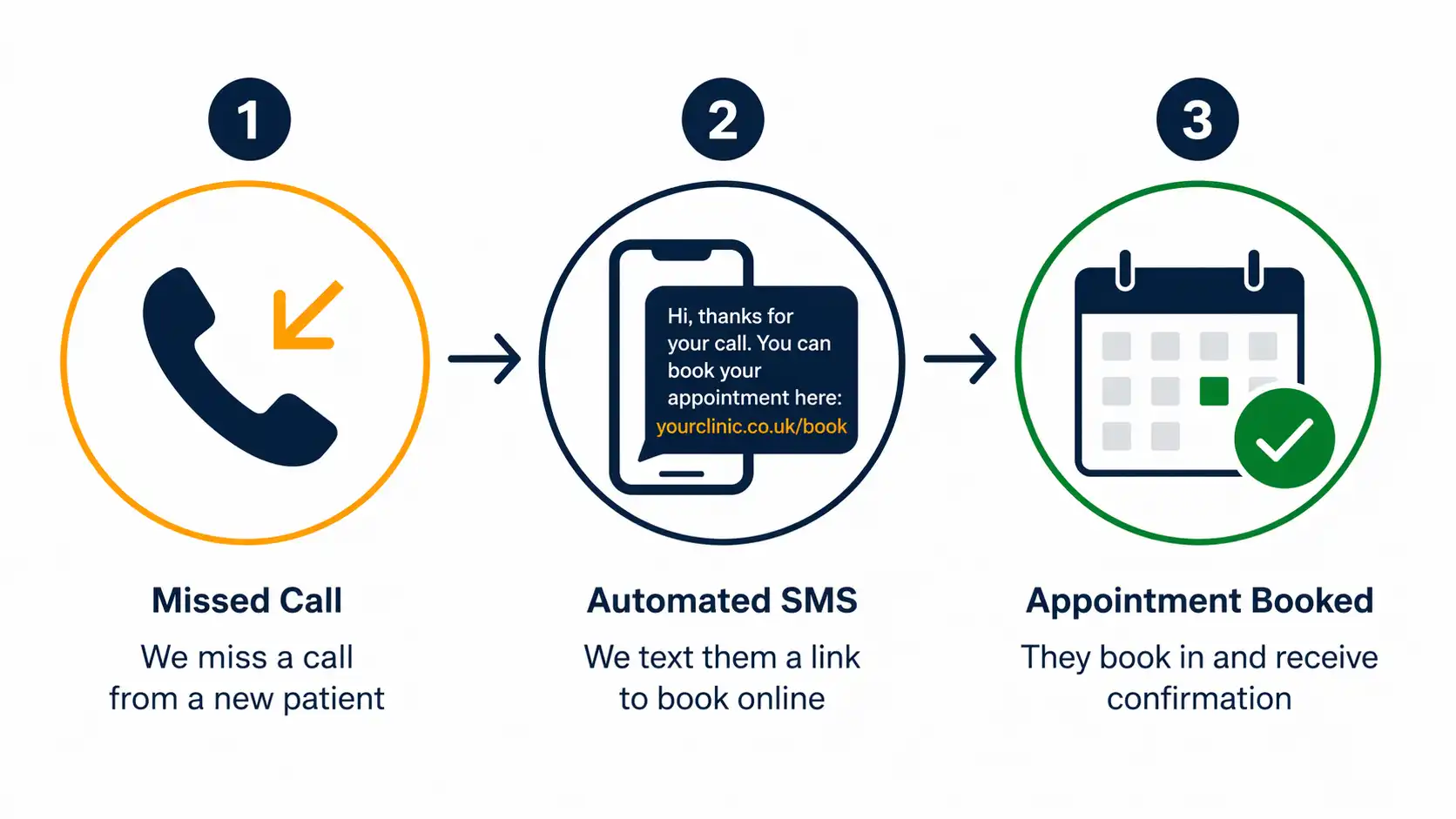
The most common starting point is missed call text back — an automated SMS that fires within seconds of a missed call, with the patient's name (where captured), a personalised message, and a booking link. It costs £97/month, takes 3–5 days to set up, and for most clinics it pays for itself within the first week by recovering enquiries that would otherwise have gone cold.
The second move is typically an AI voice agent or chatbot — a 24/7 answering system that handles new patient enquiries, answers questions about conditions treated, pricing, and appointments, triages self-pay versus PMI patients (BUPA, AXA, Vitality), and books directly into the clinic diary. For a clinic without a receptionist, this is the equivalent of hiring one — but available all hours, every day, at a fraction of the cost.
The third layer is CRM automation — the background system that runs appointment reminders, no-show follow-ups, post-treatment review requests, and lapsed patient reactivation campaigns. This is where the compounding effect kicks in: once the system is running, it works continuously without requiring any attention from the physio.
Across Cheshire and the North West, we are seeing clinics in Crewe, Warrington, Chester, and Macclesfield activate these systems and see the impact within the first month — primarily through recovered missed-call bookings and reduced DNA rates. The pattern repeats consistently: the revenue recovered in month one typically covers the cost for several months ahead.
How does AI handle the compliance concerns physiotherapists have?
This is the question that holds most physio clinic owners back, and it is the right question to ask. Healthcare is not an industry where you can hand-wave compliance concerns.
The short answer is that AI handles the administrative and marketing side of the clinic — not the clinical side. That distinction matters enormously.
An AI receptionist answers calls, books appointments, and handles FAQs. It does not diagnose, advise on treatment, or make clinical decisions. An automated reminder system sends texts and emails. It does not access or modify clinical records. A review request workflow asks happy patients to leave a Google review. It does not handle patient health data beyond what is needed for the communication.
For GDPR compliance: all systems operate under UK GDPR. Patient data is processed through GoHighLevel (GHL), which is GDPR-compliant with appropriate data processing agreements in place. Communications sent to patients use the correct lawful basis — legitimate interests for existing patients, consent for new marketing. Every automated message includes a compliant opt-out. We use the OpenAI API and Anthropic API directly, not consumer versions — patient data is never used to train AI models.
For HCPC and CSP standards: the relevant guidance from both bodies concerns the use of AI in clinical decision-making and record-keeping — not in appointment booking or patient communications. Admin automation sits comfortably within what the HCPC expects of registrants using digital tools, provided the registrant retains oversight of patient care.
For AI-assisted note drafting specifically — which is a separate and newer capability — the physio records a short audio summary, AI transcribes and drafts a SOAP-format note saved to the patient record in GHL CRM, and the physio reviews, edits, and approves before transferring it into the clinical record. For clinics using GHL as their CRM this is fully seamless. For clinics on a third-party PMS (Cliniko, TM3, WriteUpp etc.), integration is subject to API access — confirmed in the discovery call. The AI drafts. The physio owns.
We provide a written data flow document to every clinic we work with — something you can show to your indemnity provider if needed.
What does the business case look like for a private physio clinic?
The business case for AI automation in a private physiotherapy clinic is straightforward when you run the numbers honestly.
Here is a worked example for a two-physio MSK clinic running 70 sessions a week:
Current situation (without automation):
Estimated missed calls per week: 8–12
Estimated bookings lost from those missed calls per week: 3–5
DNA rate: 11% (approximately 8 sessions per week)
Estimated weekly revenue lost: £495–£585
Estimated annual revenue lost: £25,000–£30,000
Physio admin time per week: 5–8 hours combined
With AI automation:
Missed call text back recovers 60–70% of missed enquiries: 2–4 additional bookings per week
Automated reminders cut DNA rate to 5–6%: 3–4 fewer missed sessions per week
AI note drafting cuts admin time by 60–70%: 3–5 hours per week recovered
Estimated weekly revenue recovered: £225–£360
Estimated annual revenue recovered: £11,700–£18,720
Monthly cost of full automation stack: £500–£850
The payback period on a full automation stack — including voice agent, chatbot, missed call text back, and CRM automation — is typically 4–8 weeks for a clinic of this size.
For a solo physiotherapy practitioner running 25–30 sessions a week, the numbers are proportionally smaller but the ROI is often stronger — because the entire admin burden falls on one person, and the cost of a missed call or a no-show hits harder proportionally.
Interested in running the numbers for your specific clinic? Book a free 30-minute demo and we'll build out the business case together — based on your actual session volume, fee structure, and current missed call rate. Book your free demo →
What does AI actually change about a physio clinic's day-to-day?
The headline changes are quantitative — more bookings captured, fewer no-shows, more reviews. But the day-to-day changes are qualitative, and in our experience they matter just as much to clinic owners.
You stop being the last resort when things fall through. When the phone used to ring during a session, there was always a moment of tension — knowing you could not answer, wondering who it was, half-dreading the voicemail check afterwards. That disappears. The AI answers. The enquiry is handled. You find out about it in the CRM when you check between patients.
Your evenings change. For physios using AI-assisted note drafting, the shift from 45–60 minutes of post-clinic admin to 10–15 minutes of reviewing AI-drafted notes is significant — not just financially, but in terms of quality of life. Several clinic owners we work with have described it as getting their evenings back.
You stop relying on memory for follow-up. Every lapsed patient is on a reactivation sequence. Every new enquiry that did not convert gets a follow-up. Every happy patient gets a review request at the right moment. None of it requires you to remember to do it — the system does it consistently, every time.
Your Google presence improves automatically. As review volume grows through automated review requests, local search rankings improve — without any additional ad spend or manual effort. Clinics we work with in Cheshire typically see meaningful ranking improvement for "physio near me" searches within 3–6 months of activating review automation.
What do physiotherapists need to watch out for with AI tools?
Not all AI tools are equal, and there are a few genuine risks worth understanding before committing to any system.
Data handling. The most important question to ask any AI vendor is: where does patient data go, and is it used to train AI models? Consumer ChatGPT and similar tools have terms that allow data to be used for training purposes. API-level access (which is what we use) has different terms — patient data is not used for training. This distinction matters for GDPR compliance and for your indemnity.
Integration honesty. Some vendors claim their AI "integrates with Cliniko" when what they mean is it can export a CSV. Real integration — two-way data flow via webhooks and middleware — is different and more complex. Ask specifically how the integration works before you buy.
Overclaiming results. Be cautious of any provider that guarantees specific revenue numbers or specific percentage improvements without knowing your clinic's patient volume, fee structure, and current missed call rate. The numbers we use in this post are based on real patterns — but they vary by clinic. The only honest answer is "let us look at your numbers and give you a realistic projection."
Clinical boundary creep. AI tools in healthcare are evolving quickly, and some are moving into territory that is not yet settled from a regulatory standpoint. Stick to admin and marketing automation — booking, reminders, communications, note drafting with clinician approval — and you are on safe ground. Avoid any tool that claims to triage patients clinically, recommend treatments, or make decisions that a clinician should make.

How do you get started with AI automation for a physiotherapy clinic?
The starting point is always the same: work out where the biggest revenue leak is, and fix that first.
For most private physio clinics, that is missed calls — so missed call text back is the logical first step. It is the lowest cost, fastest setup, and clearest ROI. You see results within days, not weeks.
From there, the logical progression is:
Missed call text back (£97/month + £97 setup) — live in 3–5 days
AI chatbot or voice agent (£197/month + £197 setup) — live in 2–3 weeks
CRM automation (reminders, reactivation, review requests) — live in 4–6 weeks
AI note drafting — added as part of the CRM layer once the core system is running
For clinics that want everything set up and running as one integrated system — the Business in a Box option starts at £850/month and covers the full stack. For those who want to start smaller and add layers, each service is available individually on a 30-day rolling contract.
Our AI automation for physiotherapy clinics page covers each service in detail with pricing and a full FAQ. The AI receptionist for physiotherapists post goes deep on the call-handling and booking layer specifically. And the AI marketing for physiotherapists post covers the full enquiry-to-booking-to-review-to-reactivation picture.
The one thing all of those pages have in common: a free 30-minute demo where you can see the system working live before committing to anything.
Ready to see what AI automation would look like for your clinic?
The physio clinics making the most of AI right now are not the biggest or the most technically minded. They are the ones who stopped accepting that missed calls, no-shows, and evening admin were just part of running a practice — and put a system in place to deal with them.
A 30-minute demo costs nothing. You will see a live AI receptionist handling a physio booking call, a chatbot answering out-of-hours enquiries, and a CRM automation flow running reminders and review requests — all built around a physio clinic workflow.
No obligation, no contract to sign on the call, no pressure. If it makes sense for your clinic, we will quote you specifically. If it does not, we will tell you that honestly.
Book your free demo → | Call 07366 926333 | Contact us
Physiotherapy AI automation — frequently asked questions
1. Why are physiotherapy clinics starting to use AI? Private physio clinics are turning to AI because the three biggest operational problems — missed calls during treatment, no-shows, and evening admin — are now solvable with affordable automation. The shift is driven by rising patient expectations for 24/7 responsiveness, the high cost of reception staff, and the availability of AI tools that were enterprise-only two years ago. The clinics adopting AI now are gaining a competitive advantage over those that are not.
2. Is AI automation only for large physiotherapy clinics? No — solo and two-physio clinics typically see the strongest ROI because the operational burden falls entirely on the practitioner. A single physio missing two calls a day during treatment sessions can lose £30,000+ in annual revenue from unanswered enquiries alone. AI automation addresses that problem at a cost that makes sense for a small practice.
3. What is the difference between AI automation and a practice management system? A practice management system (Cliniko, TM3, PPS, WriteUpp, Jane, Nookal) manages clinical records, appointments, and invoicing within the clinic. AI automation handles the front-of-clinic layer — answering calls and enquiries, booking new patients, sending reminders, requesting reviews, and running reactivation campaigns. The two systems work together: AI captures and converts enquiries, the PMS manages the clinical relationship from there.
4. How long does AI automation take to set up for a physiotherapy clinic? Missed call text back goes live in 3–5 working days. A full AI voice agent and chatbot setup takes 2–3 weeks from the initial discovery call. CRM automation — reminders, reactivation, review requests — adds a further 2–4 weeks. A full stack (Business in a Box) is typically live within 4–6 weeks end to end.
5. Will AI make my clinic seem less personal to patients? Not in practice. Patients do not value slow responses and missed calls — they value being heard and helped quickly. A well-configured AI voice agent is patient, unhurried, and always offers to transfer to a human. The clinical relationship between physio and patient stays entirely human. What changes is the responsiveness of the administrative layer around it.
6. What happens to patient data when AI is used in a physio clinic? All patient data is handled under UK GDPR. AI Bridge Club uses the OpenAI API and Anthropic API directly — not consumer ChatGPT — which means patient data is never used to train AI models. Data processing agreements are in place with all providers. Patient data is stored in GoHighLevel, which is GDPR-compliant. Audio for note drafting is deleted after transcription unless the clinic explicitly chooses to retain it.
7. Can AI help with physiotherapy no-shows specifically? Yes. Physiotherapy has the UK's highest outpatient DNA rate at 11% (NHS England, 2024). Automated reminder sequences — text 48 hours before, voice or text 24 hours before, morning-of confirmation with a one-click rebook link — typically reduce no-show rates by 30–50% in private physio clinics. Add an automatic rebook flow for same-day cancellations and most of the lost slot revenue is recovered.
8. Does AI automation require me to change my practice management system? No. AI Bridge Club integrates with all major UK physio practice management systems — Cliniko, TM3 (Blue Zinc), PPS, WriteUpp, Jane, and Nookal — via webhooks and middleware. You keep your existing PMS. The AI layer sits in front of it, handling enquiries and communications, while the PMS continues to manage clinical records and scheduling.
9. What is AI-assisted note drafting for physiotherapists? AI-assisted note drafting is a workflow where the physio records a short audio summary after each session, AI transcribes and formats it as a SOAP note (Subjective, Objective, Assessment, Plan) saved to the patient record in GHL CRM, and the physio reviews and approves before transferring the finalised note into the clinical record. The AI drafts — the physio owns. For clinics using GHL as their CRM this is fully seamless; for clinics on a third-party PMS, integration is subject to API access. Typical time saving is 30–60 minutes a day.
10. Is now the right time for a physio clinic to invest in AI automation? The honest answer is: the clinics that move now are building an advantage that will compound. Every month of recovered missed-call bookings, reduced no-shows, and systematic review generation puts distance between them and the clinics that are waiting. The technology is available, affordable, and proven in UK healthcare settings. The 30-day rolling contract means the risk of trying it is minimal. The risk of not trying it is the ongoing revenue leak.

