
Automated Patient Reactivation for Physiotherapy Clinics
Every private physiotherapy clinic has a database of patients who came in, got treatment, and then went quiet. Some recovered fully and no longer need care. But a significant proportion are walking around with a problem that has returned, a new injury, or a nagging issue they have been putting off dealing with — and they have not re-booked simply because no one has reminded them you exist.
Patient reactivation is the process of reaching back out to those lapsed patients with a relevant, timely message. Done manually, it is time-consuming and inconsistent. Done with automation, it runs continuously in the background, costs a fraction of new patient acquisition, and generates bookings from people who already trust your clinic.
This post covers how automated patient reactivation works for private physio clinics, what a typical sequence looks like, compliance considerations, and what it realistically costs to implement.
Why Do Private Physio Clinics Lose Touch With Patients After Treatment?
The most common reason is structural, not intentional. A patient comes in for a course of treatment. They complete it, feel better, and leave. The clinic has no system that flags when that patient has not returned in six months. No one is prompted to follow up. The patient does not re-book because nothing has prompted them to think about it.
This is normal. It is not poor practice — it is just what happens when a clinic is running on clinical time and has limited admin resource. The problem is that it represents a significant and largely invisible revenue gap.
Research consistently shows that acquiring a new customer costs five to seven times more than retaining or reactivating an existing one. For a physiotherapy clinic, a reactivated patient has already demonstrated willingness to attend, has a relationship with your clinic, trusts your practitioners, and knows how to find you. The only barrier is the absence of a prompt.
For clinics in Sandbach, Crewe, Nantwich, Warrington, Macclesfield, Chester, Wilmslow, Knutsford, Congleton and across the UK, this is a consistent pattern — and it is one that automation addresses directly and cost-effectively.
How Does Automated Patient Reactivation Work for a Physio Clinic?
The mechanism is straightforward. Your patient CRM (in this case GoHighLevel, which AI Bridge Club uses as its operational platform) holds a record of every patient contact, including the date of their last appointment or interaction. The automation monitors that date and triggers a pre-written outreach sequence when a defined threshold is crossed — typically 90 days, 6 months, or 12 months since last contact, depending on your clinic's preference.
The sequence is personalised using merge fields — the patient's first name, the clinic's name — and sent via SMS, email, or both depending on what the patient has consented to receive.
A typical 90-day reactivation sequence for a private physio clinic might look like this:
Day 0 (trigger): SMS — "Hi [First Name], it has been a while since we saw you at [Clinic Name]. If you have a niggle you have been putting off sorting, we have availability this week. [Booking link]"
Day 7 (if no response): Email — a slightly longer message covering a common physio scenario (returning sports injury, desk-related back pain, post-op recovery) relevant to the patient's original presenting condition if that data is available in the CRM
Day 14 (if still no response): Final SMS — light touch, no pressure, open invitation to get in touch when ready
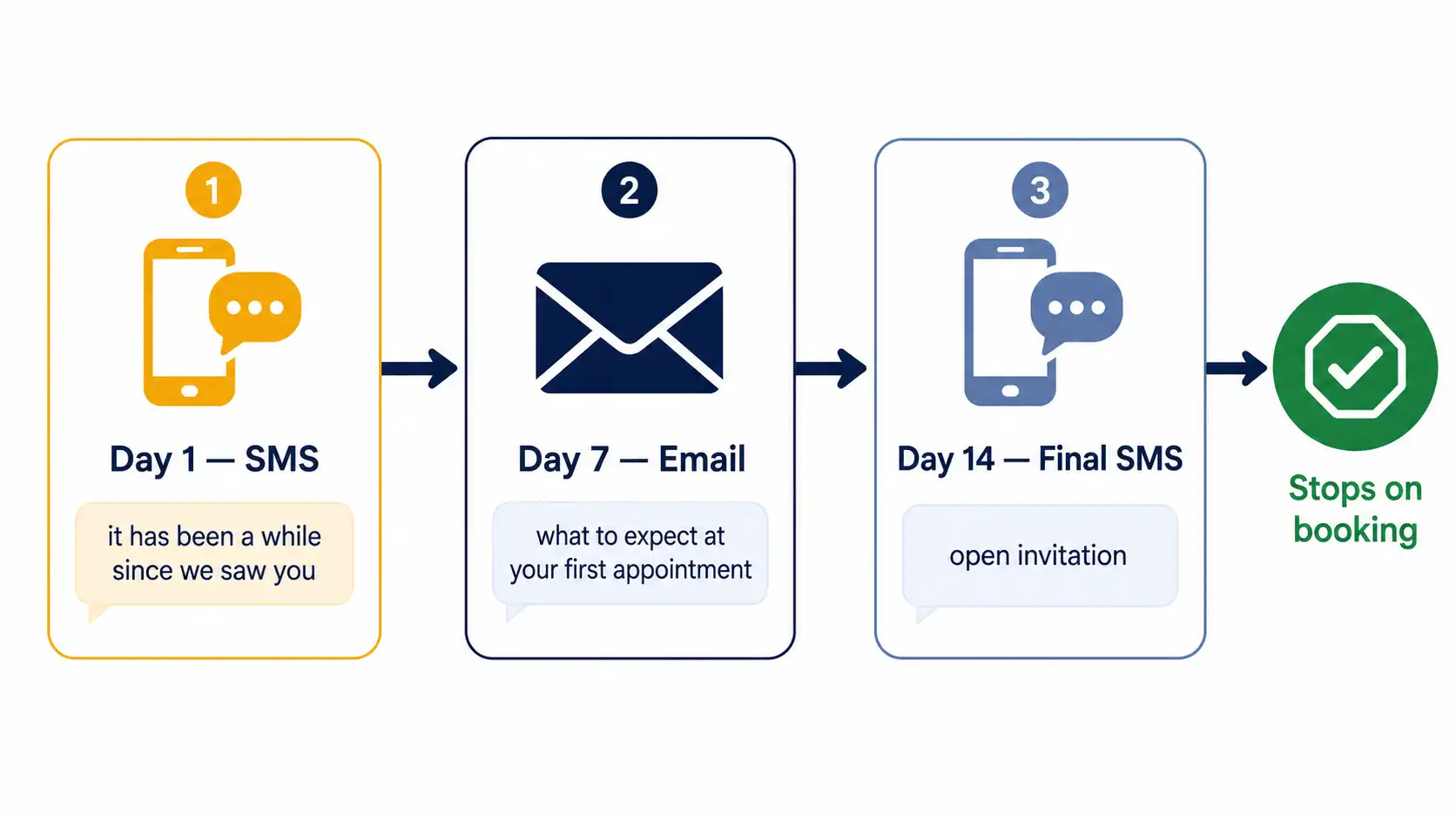
The sequence stops automatically the moment the patient responds or books an appointment. No further messages are sent. The whole thing runs without any manual input from clinic staff once it is configured.
What Is the Difference Between Patient Reactivation and Patient Recall?
These terms are sometimes used interchangeably but they describe different things in the context of a private physio clinic.
Patient recall is typically used for scheduled reviews — patients who were told at their last appointment to come back in six weeks for a follow-up, or who have a recurring condition that requires periodic review. Recall is expected by the patient and has a clinical basis.
Patient reactivation is the broader process of re-engaging patients who have fallen out of the active patient pool without a specific follow-up being planned. They may have completed a course of treatment, discharged themselves, or simply stopped attending.
Automation handles both scenarios effectively, but the messaging differs. Recall messages can reference the specific review context ("you were due back in for your follow-up"). Reactivation messages are more general and focus on relevance and opportunity ("if anything has come back or you have a new issue, we are here").
Can You Use Patient Condition Data in Automated Reactivation Messages?
This is where the compliance consideration becomes important.
In principle, personalising a reactivation message based on a patient's original presenting condition — "Hi [Name], if your lower back has been playing up again..." — would increase relevance and conversion. In practice, referencing clinical information in an automated marketing message requires careful handling under UK GDPR and the ICO's guidance on marketing to existing customers.
The safer and simpler approach, which is what AI Bridge Club implements by default, is to use non-clinical personalisation only: name, clinic name, time since last visit, and a general reference to physio as a category rather than the patient's specific condition. This approach is GDPR-compliant without requiring special category data processing consent beyond standard marketing consent.
If a clinic wants to implement condition-based personalisation, that is possible but requires a separate legal basis assessment and explicit consent capture at point of first registration. We discuss this during the onboarding process for any clinic that wants to explore it.
How Does This Fit With How Physio Clinics Already Automate Their Practice?
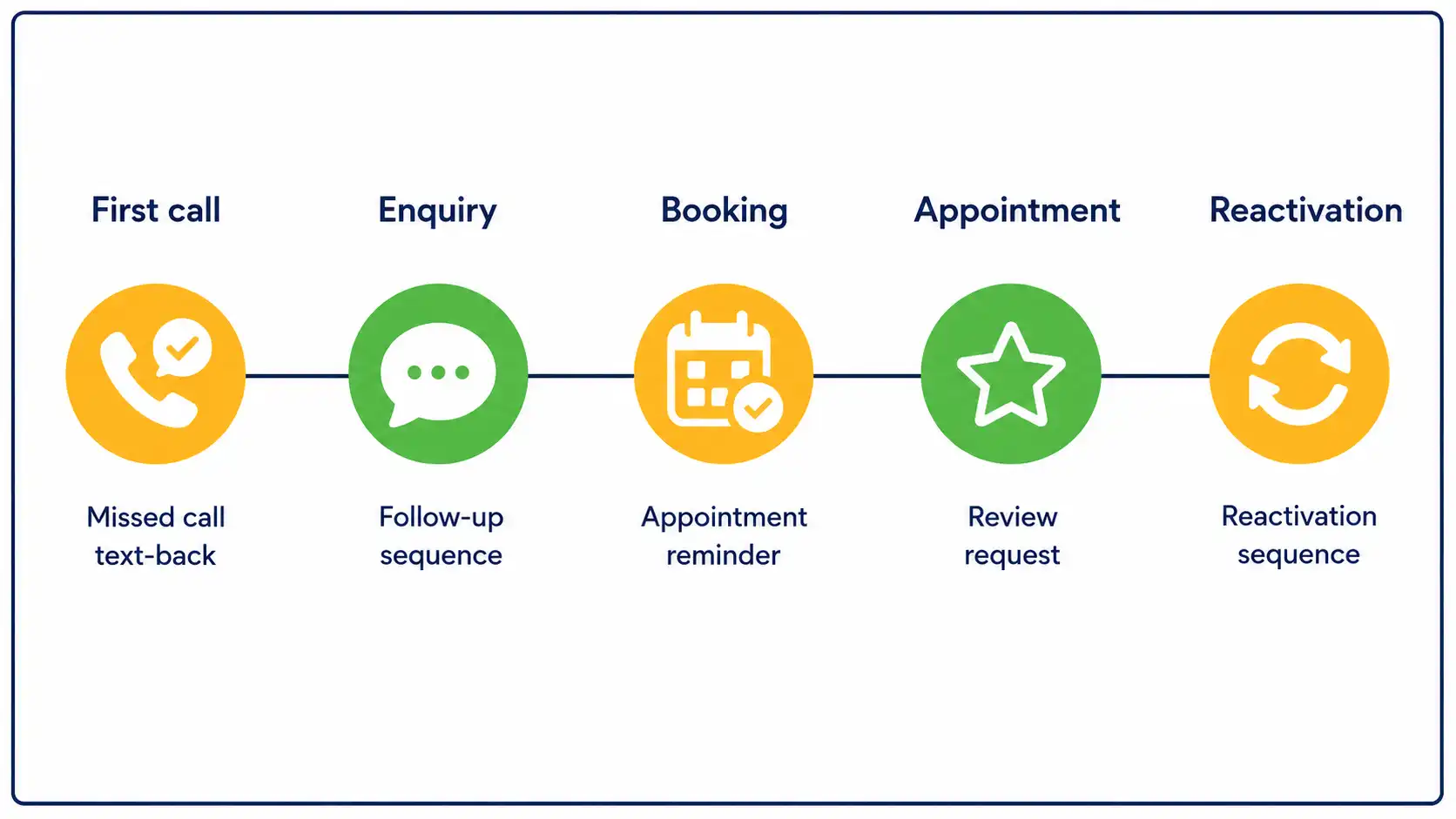
Patient reactivation sits alongside the other automation systems that private physio clinics typically implement first:
How Does This Fit With How Physio Clinics Already Automate Their Practice?
Patient reactivation sits alongside the other automation systems that private physio clinics typically implement first:
Missed call text-back — catches enquiries that would otherwise be lost when the phone is not answered
Appointment reminders — reduces DNA (Did Not Attend) rates by sending SMS reminders 24 hours and 2 hours before each appointment
Enquiry follow-up sequences — re-engages prospects who enquired but did not initially book
Review requests — automated post-appointment SMS asking satisfied patients to leave a Google reviewReview requests — automated post-appointment SMS asking satisfied patients to leave a Google review
Patient reactivation is usually the fourth or fifth system a clinic puts in place, after the immediate revenue protection systems (missed call text-back, appointment reminders) and the new patient conversion systems (enquiry follow-up). It layers on top of those and addresses a different part of the patient lifecycle — the people who are already in your database.
For a full overview of how these systems fit together, the AI automation for physiotherapy clinics page covers the complete picture.
What Results Can a Private Physio Clinic Expect From Patient Reactivation?
Reactivation results depend on three variables: the size of the lapsed patient database, the quality of the contact data held (are email addresses and mobile numbers current?), and the relevance of the messaging.
A clinic with 500 lapsed patients in its CRM, running a 90-day reactivation sequence, might expect a 5–15% response rate on the first sequence — meaning 25–75 patients either booking or making contact. At an average private physio appointment value of £50–£70, that represents £1,250–£5,250 in revenue from a one-time campaign. Ongoing automated sequences (triggering for each patient at the 90-day mark on a rolling basis) then sustain that flow continuously.
These figures are illustrative. Actual results will vary. What AI Bridge Club will do before recommending a configuration is look at the size and quality of your existing patient database and give you a realistic assessment of what is achievable.
To read about the other systems that feed into patient retention, see AI receptionist for physiotherapists, AI marketing for physiotherapists, and why smart physiotherapy clinics are turning to AI.
How Much Does Automated Patient Reactivation Cost for a Physio Clinic?
Patient reactivation is delivered as part of the AI CRM Automation service, which starts at £197/month on a 30-day rolling contract. That includes the GoHighLevel CRM platform, the automation build, the reactivation sequence, and ongoing support.
SMS message costs are charged separately at standard carrier rates (typically 3–5p per message in the UK) and passed through at cost.
There is a one-off setup fee of £197 to cover the initial configuration, sequence writing, and testing.

Frequently Asked Questions
Does patient reactivation require clinical system integration? No. The reactivation system works from contact data in the GoHighLevel CRM — name, mobile, email, and date of last contact. It does not need to connect to your clinical records software (Cliniko, Jane App, Physio Manager etc.) to function, though integration is possible if your platform supports it.
What if a patient has asked not to receive marketing messages? The system respects opt-out requests automatically. Any patient who replies STOP to an SMS is removed from all automated sequences immediately. This is a standard feature of GoHighLevel's messaging infrastructure and is UK GDPR compliant.
Can I control what the messages say? Yes. All messages are written during the setup process and approved by you before the system goes live. You can request changes at any time.
What if a patient's contact details are out of date? Messages to invalid numbers or addresses simply fail silently — they do not cause an error or disrupt the sequence for other patients. It is worth periodically reviewing your CRM for undelivered messages and updating contact details at the next patient interaction.
Is this suitable for a small clinic with one or two practitioners? Yes — in fact, smaller clinics with limited admin resource benefit most from automation because there is no capacity for manual outreach. A solo practitioner running a clinic in Nantwich, Knutsford or anywhere else in the UK can have a fully automated reactivation system running in the background with no ongoing time commitment.
How is AI Bridge Club different from using a standalone email marketing tool? A standalone email tool like Mailchimp can send reactivation emails, but it does not handle SMS, does not integrate with your phone system, does not manage missed call text-back or appointment reminders, and does not give you a single CRM view of each patient's interaction history. GoHighLevel combines all of those in one platform, which is why AI Bridge Club builds on it.
Do I need to be based in Cheshire to work with AI Bridge Club? No. We work with private physio clinics remotely across the UK. Our base is in Sandbach, Cheshire, and we can meet face-to-face with clinics in Crewe, Nantwich, Macclesfield, Chester, Warrington, Wilmslow, Knutsford and Congleton.
What is the minimum contract term? 30 days. All AI Bridge Club services are on rolling monthly contracts with no long-term commitment required.
Your lapsed patient database is one of the most valuable assets your clinic has. Are you using it?
Book a free 30-minute demo with AI Bridge Club. We will look at your CRM data, assess your reactivation opportunity, and show you exactly how the system works — with no obligation and no long-term contract.
Based in Sandbach, Cheshire. Working with private physio clinics across the UK.

